
Author: Ritish Sharma

  • What is a Certificate of Incorporation in the UAE?

    What is a Certificate of Incorporation in the UAE?

    If you’re planning to start a business in the UAE, one of the most essential documents you’ll need is a certificate of incorporation UAE. This certificate is official proof that your company has been legally registered with the authorities—either in the mainland or in a UAE free zone.

    The certificate of incorporation in UAE is like your company’s birth certificate. It shows that your business exists and allows you to do important things like open a bank account, apply for visas, sign contracts, and start your operations legally.

    Therefore, here we will explain what a certificate of incorporation is, why it’s important for businesses in the UAE, and when you need it during the company setup process.

    What is a Certificate of Incorporation in UAE?

    A Certificate of Incorporation in the UAE is an official document that confirms your company has been legally registered and is recognized by the UAE government. It marks the official beginning of your company’s legal existence and allows you to carry out business activities in the country.

    Whether you’re setting up a business in the mainland or one of the UAE’s many free zones, this certificate is a key step in the business setup process.

    The main goal of the certificate is to provide legal recognition to your business. Once you receive it, your company is officially formed and can:

    • Enter into contracts and legal agreements
    • Open corporate bank accounts
    • Apply for business licenses
    • Hire employees and sponsor their visas
    • Trade locally and internationally (depending on your license type)

    Without this certificate, you cannot legally operate your business in the UAE.

    Key Elements of Incorporation Certificate in the UAE

    The Certificate of Incorporation in UAE includes several key pieces of information:

    • Company Name: The official name of your business.
    • Registration Number: A distinct identifier assigned to your company.
    • Date of Incorporation: The date when your company was officially registered.
    • Registered Office Address: The official location of your company.
    • Jurisdiction: The issuing authority and location of registration (mainland or specific free zone).
    • Type of Company: The business structure you have chosen (e.g., LLC, Freezone company).
    • Nature of Business: What will your company do, or what industry will it operate in.
    • Share Capital: The total amount of money invested in your company by shareholders.
    • Details of Directors and Shareholders: Names and roles of the people who manage and own the company.
    • Duration of the Company: How long is your company intended to operate.
    • Governing Authority’s Stamp and Signature: Official marks from the relevant government body or authority.

    This document is often requested by banks, clients, and government bodies as proof that your business is legitimate and officially formed.

    Who Issues Certificate of Incorporation in the UAE?

    The authority that issues your Certificate of Incorporation depends on where your business is registered:

    1. Mainland Companies: The Dubai Department of Economy & Tourism (DET) in each emirate is responsible for issuing the certificate. For example, if your company is in Dubai mainland, it will be issued by Dubai DET.
    2. Free Zone Companies: Free Zone Companies are certified by their respective zone-specific authorities, such as DMCC, IFZA, JAFZA, DAFZA, Shams, and RAKEZ.

    The certificate is usually issued after you complete all the required steps of company registration, submit necessary documents, and get final approvals.

    Read Also: How to Start a Business in the UAE

    Importance of a Certificate of Incorporation in the UAE

    Obtaining a Certificate of Incorporation is a crucial step for any business aiming to operate legally in the UAE. This document serves as official proof that your company has been registered and recognized by the relevant authorities, whether on the mainland or within a free zone.

    • Legal Recognition and Compliance: The certificate confirms that your business is a legitimate legal entity, allowing you to operate within the UAE’s regulatory framework. Without it, engaging in commercial activities, signing contracts, or opening bank accounts is not permissible.
    • Access to Banking Services: Most banks in the UAE require the Certificate of Incorporation to open a corporate bank account. It assures financial institutions of your company’s legal status and compliance with local laws.
    • Building Trust and Credibility: Having this certificate enhances your company’s credibility with clients, suppliers, and investors. It signals that your business meets all legal requirements, fostering trust and facilitating partnerships.
    • Essential for Licensing and Permits: To apply for trade licenses, visas, or other government approvals, the Certificate of Incorporation is often a prerequisite. It forms the foundation for obtaining the necessary permits to operate your business smoothly.
    • Facilitates International Trade: For businesses engaged in international trade, the certificate serves as a key document when dealing with global partners. It helps establish your company’s legitimacy on an international scale, making cross-border transactions more straightforward.
    • Protection of Intellectual Property: Registering your company with a Certificate of Incorporation can aid in protecting your business’s intellectual property rights, such as trademarks and patents, under UAE law.

    How to Obtain a Certificate of Incorporation in the UAE?

    Here is a step-by-step process on how to get the certificate of incorporation in Dubai or UAE:

    Step 1: Choose the Right Jurisdiction

    Start by selecting the most suitable jurisdiction based on your business goals:

    • Mainland: Allows you to operate anywhere in the UAE.
    • Free Zone: Offers benefits like 100% foreign ownership and tax exemptions but limits operations to within the free zone or international markets.
    • Offshore: Suitable for businesses focusing on international trade without a physical presence in the UAE.

    Each jurisdiction has its own set of rules, authorities, and documentation procedures.

    Step 2: Choose the Legal Structure

    Depending on the type and scale of your business, choose a suitable legal entity such as:

    • Limited Liability Company (LLC
    • Sole Proprietorship
    • Branch of a Foreign Company
    • Free Zone Establishment (FZE) or Free Zone Company (FZC)
    • Civil Company
    • Private Shareholding Company

    This decision affects ownership, liability, and the level of regulatory compliance required.

    Step 3: Pick a Company Name

    Choose a name for your company that will reflect the nature of your business. You should check the guidelines of the Dubai department of economy & tourism (DET). Once you have selected an appropriate name, reserve it with the DET or Free Zone Authority.

    Step 4: Apply for Initial Approval

    Submit a request to the relevant authority (DET, free zone, or offshore registrar) for initial approval. This step includes:

    • Details of shareholders and directors
    • Description of business activity
    • Intended company structure

    Initial approval confirms that your business activity is legally permitted in the UAE and that the company can proceed with registration.

    Step 5: Lease Office Space

    To register your company, you must have a physical address in the UAE:

    • Mainland businesses must secure a tenancy contract (Ejari)
    • Free zone companies can opt for flexi-desks, shared offices, or full office spaces
    • Offshore businesses do not require physical office space in most cases

    Leasing office space is a critical requirement for the issuance of the trade license and Incorporation certificate in UAE.

    Step 6: Apply for a Trade License

    With initial approval, apply for a trade license from the DET or Free Zone Authority. Submit all required documents, including your business Memorandum of Association (MOA), rental agreement, and initial approvals. If you need any help with document preparation or approvals, Shuraa Business Setup experts can assist.

    Read More: How to Get a Dubai Trade License

    Step 7: Pay the Applicable Fees

    The fees vary depending on the jurisdiction, legal structure, and business activity. Costs may include:

    • Registration fees
    • Name reservation fees
    • Initial approval fees
    • Office lease charges
    • License issuance fees

    Once paid, the final set of documents will be processed.

    Step 8: Receive the UAE Certificate of Incorporation

    After successful verification of all documents and payment the DET (for mainland companies), the respective Free Zone Authority, or Offshore Registrar will issue the Certificate of Incorporation.

    This document confirms that your company is officially registered and includes important details such as:

    This certificate, along with the trade license, enables you to legally operate in the UAE.

    Step 9: Post-Incorporation Steps

    After receiving the certificate, businesses should proceed with:

    • Opening a corporate bank account
    • Registering for VAT (if applicable)
    • Applying for visas for owners and employees
    • Obtaining any special permits (for specific sectors like healthcare, education, etc.)

    Working with a reputable business setup firm like Shuraa Business Setup can simplify the entire process. From choosing the right jurisdiction to handling paperwork and obtaining your certificate of incorporation UAE-wide – experts help you avoid errors, reduce setup time, and ensure compliance.

    Documents Required to Get a Certificate of Incorporation in the UAE

    To successfully register your company and obtain the Certificate of Incorporation in the UAE, you’ll need to prepare and submit several essential documents.

    • Passport copies of shareholders and directors
    • Visa and Emirates ID (if applicable)
    • Application form
    • Initial approval certificate
    • MOA (Memorandum of Association)
    • Trade name reservation certificate
    • Tenancy contract/Ejari (if required)
    • No Objection Certificate (NOC), if required 

    Certificate of Incorporation in UAE Sample

    [LOGO OF THE ISSUING AUTHORITY]

    [NAME OF FREE ZONE / DEPARTMENT OF ECONOMIC DEVELOPMENT]

    License Number: [1234567]

    Company Registration Number: [FZ12345]

    This is to certify that
    [Company Name LLC / FZE / FZCO]

    has been duly incorporated and registered under the laws and regulations of

    [Free Zone Name / Emirate Name], United Arab Emirates.

    The company has complied with all the legal requirements for incorporation and is authorized to conduct its business activities as per the commercial license issued.

    Date of Incorporation: [DD/MM/YYYY]

    Business Activity: [E.g., General Trading, Management Consultancy, Software Development] 

    Legal Form: [LLC / FZE / FZCO]

    Issued To: [Full Name of Shareholder or Company Representative]

    Registered Address: [Office Number, Building Name, Free Zone or Emirate, UAE]

    This certificate is issued without any liability on the part of the issuing authority and is subject to compliance with all applicable laws and regulations of the UAE.

    Authorized Signatory:

    (Signature)

    Name: [Name of Authority Representative]

    Position: [E.g., Registrar, Director]

    Date of Issue: [DD/MM/YYYY]

    Stamp of the Issuing Authority
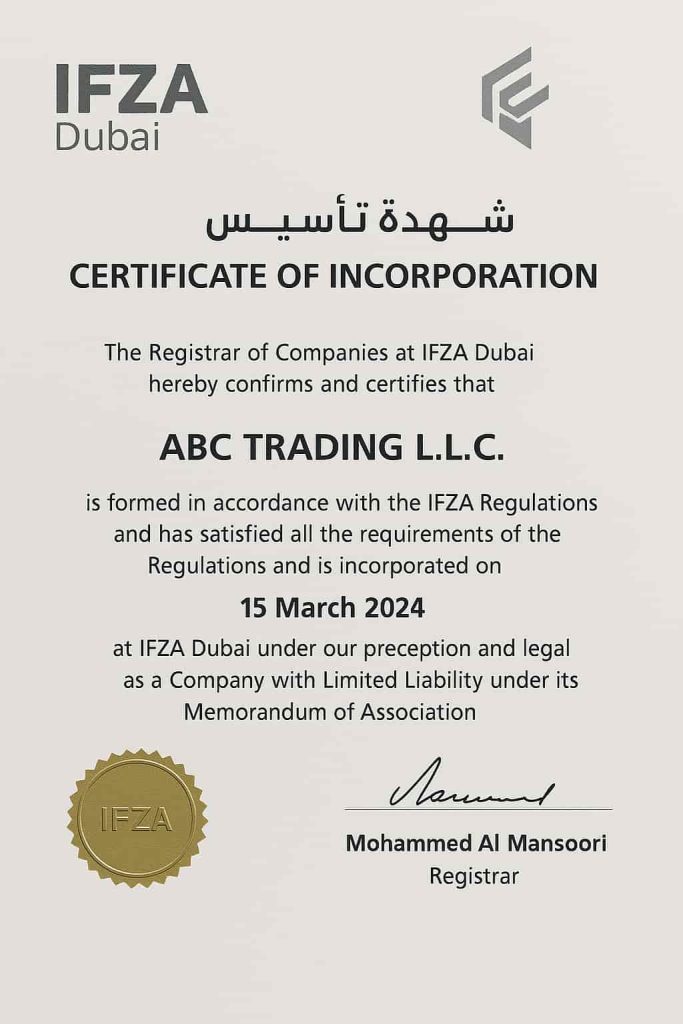
    Certificate of incorporation in UAE sample

    How to Verify a Certificate of Incorporation in the UAE?

    Verifying a company’s Certificate of Incorporation in the UAE is important to ensure its legally registered. Here are simple ways to do it:

    1. Use Official Government Portals

    • Dubai Department of Economy & Tourism (DET): Each emirate’s DET website allows you to search for company licenses. For example, Dubai’s DET portal provides options to search by business name or license number.
    • National Economic Register (NER): A centralized platform that provides information on licensed economic sectors in the UAE.

    2. Check Free Zone Authority Directories

    If the company is in a free zone, visit the relevant free zone’s website (e.g., IFZA, DMCC, DIFC, RAKEZ, JAFZA) to find their company directory and verify details.

    3. Utilize the ‘UAE Verify’ Platform

    The UAE Verify platform is a digital service that enables instant verification of digital documents issued by participating UAE authorities. Powered by blockchain technology, it ensures the authenticity and integrity of documents without the need for physical copies. You can verify documents by uploading them to the platform or scanning their QR codes using the UAE PASS app.

    4. Ask for Company Documents

    You can request:

    • Certificate of Incorporation
    • Trade License
    • MOA/AOA (Memorandum & Articles of Association)

    These confirm the company’s legal existence and activities.

    To prevent fraud and ensure authenticity, UAE Certificates of Incorporation incorporate several security features:

    • Many digital certificates include QR codes or barcodes that, when scanned, direct users to official government websites for instant verification.
    • The UAE Verify platform utilizes blockchain technology to register document hashes, ensuring that any tampering is easily detectable. This provides real-time verification of a document’s authenticity and validity.
    • Certificates often feature digital signatures and official stamps from the issuing authority.

    How to Amend Your Certificate of Incorporation in the UAE

    If your company goes through changes like a new business name, address, or shareholder structure, you’ll need to officially update your Certificate of Incorporation. Here’s how to do it:

    1. Identify the Required Amendments

    Determine the specific changes needed, such as modifications to the company name, business activities, shareholder details, or registered address.

    2. Prepare Necessary Documentation

    Gather all necessary documents that validate the proposed changes, which might include:

    • Board resolutions approving the changes
    • Amended Memorandum and Articles of Association (MOA and AoA)
    • Updated trade name reservation certificate (if changing the company name)
    • No Objection Certificates (NOCs) from relevant parties
    • Passport copies and Emirates IDs of new shareholders or directors
    • Proof of updated registered address (e.g., new tenancy contract)

    3. Submit the Amendment Application

    Submit the amendment application along with the required documents to the DET or respective Free Zone Authority.

    4. Pay Applicable Fees

    Pay the necessary fees associated with the amendment process. Fees may vary depending on the nature of the amendment and the jurisdiction.

    5. Receive the Amended Certificate

    Upon approval, the relevant authority will issue:

    • An amended Certificate of Incorporation
    • Updated trade license
    • Revised MOA and AOA

    Certificate of Incorporation vs. Trade License in the UAE

    When setting up a business in the UAE, two essential documents you’ll often hear about are the Certificate of Incorporation and the Trade License. While they’re both important, they serve different purposes.

    Here are the key differences between certificate of incorporation and trade license in UAE:

    AspectCertificate of IncorporationTrade License
    PurposeConfirms the legal formation of the companyAuthorizes the company to carry out business activities
    Issued ByDET (Mainland) or Free Zone AuthorityDET or relevant Free Zone Authority
    ContainsCompany name, registration number, date of incorporationBusiness activity, license number, expiry date
    When IssuedUpon company formation/registrationAfter business activity is approved
    ValidityPermanent (unless amended or cancelled)Needs annual renewal

    The Certificate of Incorporation in UAE is proof that your business legally exists. The Trade License is your permission slip to conduct the chosen business activities in the UAE. In short, the certificate says you exist as a company. The license says you’re allowed to operate in your chosen industry. 

    Shuraa’s Assistance with UAE Business Incorporation

    Certificate of Incorporation in UAE is an important document that shows your company is officially registered and recognized. It’s needed for things like opening a bank account, applying for a trade license, and proving your business is legal and trustworthy. At Shuraa Business Setup, we’re here to help you every step of the way.

    From choosing the right business setup to handling all the paperwork, legal steps, and PRO services, we make the process smooth and hassle-free. With our expert team by your side, you can get your certificate quickly and start running your business with confidence. Contact us for a free consultation today.

    Frequently Asked Questions (FAQs)

    1. What is a Certificate of Incorporation in the UAE?

    A Certificate of Incorporation in the UAE is a legal document issued by the Dubai Department of Economy & Tourism (DET) for mainland companies or a Free Zone Authority for free zone companies, officially confirming your business is a registered legal entity under UAE laws. It serves as proof of your company’s legal existence, authorizing it to operate, enter contracts, open bank accounts, and conduct other business activities. The certificate includes key details such as the company’s name, registration number, date of incorporation, and legal structure.

    2. What does the ‘Date of Incorporation’ mean in the UAE?

    The ‘Date of Incorporation’ refers to the official date when your company was registered and recognized as a legal entity in the UAE. This date is significant for legal and administrative purposes.

    3. How can I Get a Certificate of Incorporation in the UAE?

    To obtain a Certificate of Incorporation in the UAE, you must first choose your business structure and jurisdiction (mainland or free zone), reserve a unique trade name, and prepare documents like Memorandum of Association (MOA) and Articles of Association (AOA). Next, secure a business premise with a lease agreement and obtain initial approval from the relevant authority (DET or Free Zone authority). After submitting your application and paying the required fees, the authority will issue the Certificate of Incorporation, which confirms your company’s legal registration.

    4. Does the Certificate of Incorporation expire in the UAE?

    Typically, the Certificate of Incorporation does not have an expiry date and remains valid as long as the company is active and compliant with UAE laws.

    5. Can I operate my business in the UAE with only a Certificate of Incorporation?

    No, while the Certificate of Incorporation establishes your company’s legal existence, you also need a valid Trade License to legally conduct business activities in the UAE.

    6. What are the consequences of not having a Certificate of Incorporation in the UAE?

    Operating without a valid certificate is illegal and can result in fines, legal actions, and possible business closure.

    7. How to download Certificate of Incorporation in UAE online?

    To download your UAE Certificate of Incorporation online, use the official portal of the relevant authority—the Dubai Department of Economy & Tourism (DET) for mainland companies or the specific Free Zone Authority for free zone companies. Log in to the portal, usually with your UAE Pass, and navigate to the e-services section to find the options to search for your company’s license and download the certificate.

    8. What is the difference between certificate of incorporation and trade license in UAE?

    In the UAE, the Certificate of Incorporation (COI) proves your company’s legal existence as a registered entity, while the Trade License is the official permit allowing you to conduct specific business activities within the UAE’s jurisdiction. The COI is a permanent document confirming your company’s legal status, whereas the Trade License must be renewed annually to remain valid for operations.

    Disclaimer: The information in this post is for general guidance only and may change due to updates in government policies or regulations.


  • Everything You Need to Know About Salary Certificate UAE

    Everything You Need to Know About Salary Certificate UAE

    A salary certificate in the UAE is an official document issued by an employer to verify an employee’s income and employment details. It’s a crucial piece of paper that holds significant weight in the UAE. From securing a visa to obtaining a loan, this document is often a mandatory requirement.

    If you’re working in the United Arab Emirates, understanding the ins and outs of a salary certificate is essential. A salary certificate is needed for various purposes, including opening a bank account, applying for a loan, or even renting an apartment. It provides assurance to banks, landlords, and government authorities about an individual’s financial standing.

    So, let’s understand the specifics of a salary certificate, its importance, and how to obtain one.

    What is a Salary Certificate?

    A salary certificate is a formal document issued by an employer to verify an employee’s income, employment status, and job position. It serves as official proof of an individual’s financial standing and employment details. Essentially, it’s a detailed breakdown of an employee’s salary, including base salary, allowances, deductions, and net salary.

    The certificate is typically printed on the company’s letterhead, signed by an authorized representative, and stamped with the company seal. It is generally valid for a specific period, usually three months.

    The salary certificate typically includes:

    • Employee’s name and job title
    • Date of employment
    • Basic salary
    • Allowances (housing, transportation, etc.)
    • Deductions (taxes, social security, etc.)
    • Net salary
    • The issuing authority (usually the HR department) and their contact information

    Keep in mind, a salary slip is a monthly record of your earnings, while a salary certificate is a broader overview of your income and employment status.

    Who Needs a Salary Certificate in the UAE?

    A salary certificate is a crucial document required by various entities in the UAE. It’s commonly needed for the following purposes:

    • Visa Application: Both residents and visitors often require salary certificates to support visa applications, renewals, or changes in visa status.
    • Bank Loans and Mortgages: Financial institutions use salary certificates to assess an individual’s loan eligibility. It helps determine the loan amount and repayment capacity.
    • Rental Agreements: Many landlords in the UAE ask for a salary certificate to ensure tenants can afford the rent. It’s a common requirement, especially for high-end properties.
    • Government Services: Some government services, such as obtaining a driver’s license or applying for certain benefits, may require a salary certificate as proof of income.
    • Other Financial Transactions: Salary certificates might be needed for purchasing properties, applying for credit cards, or other financial commitments.

    Salary Certificate Format in UAE

    Here’s a sample format you can refer to:

    [Company Logo]

    Salary Certificate

    This is to certify that Mr./Ms. [Employee Name], [Passport Number], is employed with [Company Name], located at [Company Address], UAE, as a [Job Title] since [Date of Joining].

    Employee Details:

    • Name: [Employee Name]
    • Passport Number: [Passport Number]
    • Job Title: [Job Title]
    • Department: [Department]
    • Date of Joining: [Date of Joining]

    Salary Details:

    • Basic Salary: AED [Amount]
    • Housing Allowance: AED [Amount]
    • Transportation Allowance: AED [Amount]
    • Other Allowances (if any): AED [Amount]
    • Total Allowances: AED [Total]
    • Gross Salary: AED [Basic Salary + Total Allowances]

    Deductions:

    • UAE Federal Tax: AED [Amount]
    • Social Security: AED [Amount]
    • Other Deductions (if any): AED [Amount]
    • Total Deductions: AED [Total]
    • Net Salary: AED [Gross Salary – Total Deductions]

    The above-mentioned salary is paid monthly.

    This certificate is issued at the request of the employee for [Purpose of Certificate, e.g., Visa Application, Bank Loan].

    • Issued on: [Date]
    • [Authorized Signatory Name]
    • [Designation]
    • [Company Stamp]

    Please Note: The specific allowances and deductions may vary depending on the company’s policies and the employee’s employment contract.

    How to Get Salary Certificate in the UAE?

    To get a salary certificate in the UAE, you’ll need to contact your company’s HR department, specify the purpose of the certificate, and provide necessary details like your employee ID and the recipient’s information if needed. It’s important to review the certificate for accuracy before submitting it.

    Here’s a more detailed breakdown:

    • Contact HR: Reach out to your company’s HR department or the team responsible for salary-related matters.
    • State Your Purpose: Clearly explain why you need the salary certificate. This helps the HR department tailor the certificate to the specific requirements.
    • Provide Necessary Details: This includes your name, employee ID, job title, and the name of the organization requesting the certificate (if applicable).
    • Format and Attestation: If the certificate is needed for a specific purpose (like a bank loan or visa), inform your HR department. They may need to follow a specific format or get it attested by the Ministry of Foreign Affairs and International Cooperation (MOFAIC).
    • Review and Receive: Once the certificate is prepared, review it carefully to ensure all details are correct. Then, you can receive the document. The time it takes to process a salary certificate varies from company to company. It usually takes a few working days.
    • Certificate Issuance: Once processed, the HR department will issue the salary certificate on the company’s letterhead. Ensure the certificate includes all necessary details (employee name, job title, salary components, deductions, etc.). Check for any required signatures and company stamps.

    Important Considerations:

    • Purpose: Knowing the purpose of the certificate is crucial as it may affect the format and the need for attestation.
    • Attestation: If the certificate is for use outside the UAE, it may require attestation by MOFAIC and possibly the embassy of the destination country.
    • Timeframe: Employers typically need 1-3 business days to issue a salary certificate.
    • Salary Slip vs. Certificate: A salary certificate is a separate document from a payslip/salary slip. A salary slip shows a breakdown of your salary and deductions, while a certificate proves your employment and income.

    For some purposes (like visa applications or foreign transactions), the certificate might need to be attested by the Ministry of Foreign Affairs (MOFA) and the consulate of your home country.

    How to Get Your Salary Certificate Attested in the UAE

    A salary certificate is a verification process confirming the document’s authenticity. It’s typically required when you need to submit your salary certificate to foreign authorities, such as embassies or immigration offices. The attestation process ensures that the document is genuine and can be trusted.

    • Company Attestation: The first step is to get the salary certificate attested by your company. This usually involves getting a stamp and signature from the HR department.
    • Chamber of Commerce Attestation: Next, the certificate needs to be attested by the Chamber of Commerce in the emirate where your company is located. Fees vary depending on the emirate. Expect to pay around AED 100 to AED 200.
    • Ministry of Foreign Affairs (MOFA) Attestation: The final step is to get the certificate attested by the UAE Ministry of Foreign Affairs. This is the highest level of attestation in the UAE.

    Documents Required for Attestation:

    • Original salary certificate (not laminated)
    • Passport copy with valid UAE visa
    • Emirates ID
    • In some cases, the original labour contract might be required

    Getting Salary Certificate Attested Online via MOFAIC

    While the traditional process involves physical visits to different government offices, it’s becoming increasingly common to get certificates attested online through the Ministry of Foreign Affairs and International Cooperation (MOFAIC) website or app.

    • Ensure your document is eligible for online attestation.
    • Register on the MOFAIC portal.
    • Submit the required documents in digital format.
    • Complete the online payment for the attestation service. The standard attestation fee is $41 (AED 150).
    • Monitor the progress of your application online.
    • Once approved, you might be able to download the attested certificate or collect it from a designated location.

    Legal Requirements and Regulations

    While the UAE Labor Law doesn’t explicitly mandate the issuance of salary certificates, they are widely recognized and accepted as official documents. Here are some key legal considerations:

    • The salary certificate must accurately reflect the employee’s salary, job title, and employment duration. Providing false information can lead to legal consequences for both the employee and the employer.
    • Employees have the right to request a salary certificate from their employer. Denying this request could be considered a violation of employee rights.
    • Employers must adhere to data protection laws when issuing salary certificates to ensure that sensitive employee information is handled confidentially.
    • If the certificate is required for use outside the UAE, it might need to be attested by the Ministry of Foreign Affairs (MOFAIC) and possibly the embassy of the destination country.

    Key Takeaways

    Salary certificates are important documents for both employees and employers in the UAE. For employees, possessing a valid and accurate salary certificate can streamline various processes and provide peace of mind. Always ensure that the certificate is up-to-date and ready when needed. For employers, issuing accurate salary certificates helps build trust with employees and meets local regulations.

    If you’re planning to move your business to Dubai or already have one there, it’s vital to know the local rules about salary certificates and other employment documents. We recommend consulting our business setup experts to understand these requirements better. Our experts can guide you through the process and ensure your business follows all local laws to make your operations in Dubai smooth and compliant.

    Frequently Asked Questions (FAQs)

    1. What is a Salary Certificate in the UAE?

    A salary certificate in the UAE is an official document issued by an employer, verifying an employee’s income and employment details. It’s a crucial document used for various purposes, including applying for loans, credit cards, visa processing, and renting apartments. The certificate confirms the employee’s job title, salary breakdown, and employment period.

    2. How Do You Get a Salary Certificate in the UAE?

    Here’s how you can get one:

    • Contact Your HR Department
    • Specify the Purpose
    • Provide Necessary Information
    • Request Attestation (if needed)
    • Allow Time for Processing
    • Review the Certificate

    3. What is salary proof in UAE?

    A salary certificate UAE is documented proof of your employment and salary entitlement provided by your employer. It is issued by the employer on the employee’s request. This document usually holds details about your employment with the company.

    4. What is a salary transfer certificate in UAE?

    A Salary Transfer Letter, commonly known as STL, is a document the employer of a company issues to the bank. This is especially required when the employee has to repay a loan. This allows the employee’s salary to be credited to his account until he fully pays the debt.

    5. What is the format of salary certificate letter in UAE?

    In the UAE, the salary certificate format typically includes the employee’s name, job title, base salary, allowances, deductions, net salary, employment tenure, and employer details. To obtain a salary certificate, employees usually need to submit a formal request to their HR department.

  • How to Get a General Trading License in Sharjah

    How to Get a General Trading License in Sharjah

    If you’re looking to start a business in Sharjah, one of the first things you’ll need is a general trading license. This license allows you to engage in a wide range of trading activities within the emirate, making it an asset for any aspiring entrepreneur. With a general trading license, you can import, export, and trade a variety of goods and services, opening countless opportunities for growth and success.

    Acquiring a general trading license in Sharjah is a relatively straightforward process, but it does require some careful planning and preparation such as choosing a business name & legal structure, gathering essential documents, acquiring trade license from Sharjah Economic Development Department (SEDD), and other legal considerations.

    In fact, SEDD reported that the total number of business licenses issued in 2023 increased by 2%, while license renewals saw an even more impressive jump of 4.4%. These figures highlight the growing confidence investors have in Sharjah’s business environment.

    Hence, with trading license in hand, you can start conducting business activities legally in Sharjah and take advantage of the numerous opportunities available in the emirate.

    Here we will explain everything you need to know from defining your business activities to obtaining your official license in Sharjah.

    General Trading License in Sharjah

    A General Trading License in Sharjah allows a business to import, export, and trade a wide range of goods within the emirate. It’s a popular choice for businesses with diverse trading activities.

    Activities permitted under a General Trading License:

    • Importing goods
    • Exporting goods
    • Wholesaling goods
    • Retailing goods (depending on the good and location)

    This license typically covers a vast range of goods, but there might be exclusions for specific products requiring special permits.

    Types of Trading License in Sharjah

    Sharjah offers several types of trading licenses for different business activities. This typically includes:

    1. General Trading License: A general trading license allows you to import, export, and trade a wide range of goods within Sharjah. It’s a popular option for businesses with diverse trading activities.
    2. Commercial License: While similar to a General Trading License, a Commercial License might have a more specific scope depending on the exact commercial activity. It’s advisable to consult with the Sharjah DED to understand the specific activities covered under this license.
    3. Industrial License: An industrial license is required for businesses involved in manufacturing or industrial operations like the production and packaging of goods.
    4. Professional License: A professional license is for businesses offering professional services such as consultancy, legal services, accounting, or other specialized services.

    How to Get a General Trading License in Sharjah

    Obtaining a general trading license in Sharjah involves several steps and specific requirements, including:

    1. Define Your Business Activities: Identify the specific goods you plan to import, export, and trade. The Sharjah DED offers a list of tradable goods under a General Trading License, but it’s always best to confirm for your specific case with our business setup experts at Shuraa.
    2. Choose Your Business Structure: Decide on the legal structure of your company, such as a Sole Proprietorship, Limited Liability Company (LLC), or Branch of a Foreign Company. This will impact on requirements and costs.
    3. Select a Trade Name: Ensure the name adheres to Sharjah’s naming conventions and is not already in use. Reserve the trade name through the Department of Economic Development (DED).
    4. Secure an Office Space: Lease or purchase a commercial space that meets DED regulations. Obtain a tenancy contract for the chosen location.
    5. Prepare and Submit the License Application: Gather required documents like passports, visas, Memorandum of Association (MOA), tenancy contract, and any approvals from other authorities (if applicable). Submit the application and all documents to the DED.
    6. Settle License Fees: Fees vary depending on your chosen business structure, office location, and chosen activities.
    7. Open a Corporate Bank Account: Open a corporate bank account in Sharjah to facilitate your business transactions.
    8. Obtain Your Trade License: Once your application is approved and fees are settled, you’ll receive your official General Trading License.

    Depending on the nature of your business activities, you may need additional approvals from other government departments.

    General Trading License in Sharjah Free Zone

    A General Trading License obtained within a Sharjah Free Zone (SFZ) differs slightly from the standard Sharjah license. A Sharjah Free Zone General Trading License is ideal for businesses seeking the benefits of a free zone while engaging in import, export, and general trade.

    Free Zones offer various benefits, including:

    • Tax exemptions on corporate and personal income taxes
    • 100% foreign ownership
    • Simplified customs procedures
    • Repatriation of capital and profits

    How to Obtain a General Trading License in a Sharjah Free Zone

    To obtain a general trading license in Sharjah Free Zone follow these simple steps:

    1. Choose a Free Zone: Sharjah has multiple Free Zones, each catering to different industries or offering unique benefits. Research and select the Free Zone that best suits your business needs.
    2. Understand License Requirements: The specific requirements for a General Trading License might vary between Free Zones. The Free Zone authority will provide details on necessary documents, fees, and procedures.
    3. Complete the Application Process: This typically involves submitting documents, completing formalities, and paying fees as per the Free Zone’s regulations.
    4. Obtain Your License: Once your application is approved and all fees are settled, you’ll receive your official General Trading License for the specific Free Zone.

    Free Zone licenses often come with annual renewal fees. Some Free Zones might have restrictions on the types of goods allowed for trade. Be sure to confirm these details with the chosen Free Zone authority.

    General Trading License Cost in Sharjah

    The cost of a General Trading License in Sharjah can range anywhere from AED 5,000 to AED 30,000 or even more, while a specialized license or a Free Zone license might have different fee structures.

    The cost of obtaining a trading license in Sharjah can vary depending on several factors:

    • Type of business license
    • Type of business activity
    • Business location (Mainland or Free zone)
    • Company structure
    • Additional regulatory approvals

    Free Zone authorities often have set up packages with inclusive fees covering license issuance, visas (if applicable), and office space within the Free Zone.

    Contact our business setup specialist in Sharjah. They can provide a personalized quote based on your specific business needs and chosen license type.

    Discover more posts

    Start Your Sharjah Business Journey Today

    Getting a general trading license in Sharjah is a great step for anyone looking to start a business in this growing city. Sharjah is quickly becoming a major business hub, offering many opportunities for entrepreneurs.

    With a general trading license, you can trade a wide variety of goods, giving you access to many different markets. The process involves several steps, from choosing your business structure to getting all the necessary approvals and paperwork done. While it might seem complicated, it’s manageable with the right guidance.

    To make the process smoother, consider getting help from business setup experts like Shuraa Business Setup. Our team can assist you with everything you need, including licensing, paperwork, finding office space, visas, and PRO services.

    Get in touch with one of our experts today at +971 4 4081900, via WhatsApp at +971 50 7775554, or by sending an email to info@shuraa.com.

  • Absconding in the UAE: Rules, Consequences, and Amnesty Guide 2026

    Absconding in the UAE: Rules, Consequences, and Amnesty Guide 2026

    The UAE offers many opportunities, but navigating its legal requirements can be challenging. The concept of “absconding” often causes confusion for both employers and employees.

    Absconding in the UAE is a serious issue with significant consequences for both employers and employees. It occurs when an employee leaves their job without notifying the employer or obtaining the required permissions. This can result in legal action, fines, and possible deportation for the employee.

    For employers, absconding can disrupt operations, cause financial losses, and make it challenging to find a suitable replacement.

    Both employers and employees should understand the implications of absconding and follow proper procedures to avoid negative outcomes.

    What is Absconding in the UAE?

    In the UAE, absconding occurs when an employee leaves their job without notice for more than 7 consecutive days, or when a visitor overstays their visa. Employers or sponsors are required to report such cases to the Ministry of Human Resources and Emiratisation (MOHRE) or GDRFA. Consequences can include fines, deportation, a travel ban of one to ten years, and cancellation of work permits.

    This is in accordance with Article 28(1) of Cabinet Resolution No. 1 of 2022. The following are common situations that may be classified as absconding in the UAE:

    • Leaving a Job Without Notice: Employees who resign without the required contractual notice may be considered to have absconded.
    • Overstaying a Visa: Staying in the UAE after a visa expires, without renewal or departure, may be treated as absconding.
    • Working for Another Employer: Sponsored employees must not work for another company without first cancelling their current work permit and labour contract. Otherwise, this may be considered absconding.
    • Fleeing Sponsorship: If a sponsored employee leaves without notifying their sponsor, this may result in an absconding case.

    Absconding in the UAE for Visitors (Visit Visa)

    Absconding occurs when you overstay your visa and do not leave the UAE within the permitted period, including any grace period. Even brief overstays can result in fines and other issues.

    Both residence and visit visa holders may be reported as absconding if they violate visa conditions, such as failing to renew their visa or to leave the country as required.

    Key Aspects of Absconding in the UAE:

    • Overstaying a Visit Visa: If your visit visa expires and you remain in the UAE beyond the grace period, you may be classified as an absconder.
    • Not Leaving After Visa Cancellation: If your residence visa is cancelled and you do not leave within the required timeframe, this may be considered absconding. Unlike employment absconding, there is no minimum absence period. Any unauthorised overstay may be treated as absconding. Resolve any issues before departure to avoid long-term complications.

    Legal Framework Governing Absconding in the UAE

    The legal framework governing absconding in the UAE is established by two main sources:

    Federal Law No. 8 of 1980 (UAE Labour Law)

    This law governs employer-employee relations in the UAE. While it does not specifically mention “absconding,” it outlines employee obligations and the consequences of contract breaches.

    Ministerial Resolution No. (721) of 2006

    This resolution provides guidance on employment absconding. It defines absconding and outlines the procedures employers must follow to report an absconding employee to the Ministry of Human Resources and Emiratisation (MOHRE).

    Separate regulations govern visa overstays for visitors and residents. These matters are typically managed by the General Directorate of Residency and Foreigners Affairs (GDRFA).

    Types of Legal Consequences of Absconding in the UAE

    Absconding in the UAE results in significant consequences for employees, employers, and visa holders.

    1. Employees Absconding

    • Deportation: Employees identified as absconders are deported from the UAE at their own expense.
    • Travel Ban: Authorities may impose a travel ban, restricting re-entry to the UAE or other GCC countries for a specified period or permanently.
    • Blacklisting: Absconding records may be flagged in immigration systems, making it difficult to obtain future visas for the UAE or other countries.
    • Financial Penalties: Employees may be required to pay fines or compensate employers for losses caused by their absence.
    • Difficulty Finding Employment: An absconding record can severely limit future job opportunities in the UAE due to strict labour laws.

    2. Employers Absconding

    • Administrative Burden: Employers must follow formal procedures to report absconding, which can cause delays or complications.
    • Potential Legal Issues: Employers found responsible for an employee’s absconding, for example, due to unfair labour practices, may face legal consequences.
    • Reputational Damage: Frequent absconding cases can damage an employer’s reputation and hinder recruitment.

    3. Visitors Absconding

    • Fines: Authorities may impose daily fines for visa overstays.
    • Deportation: Visitors who abscond are deported at their own expense.
    • Travel Ban: Authorities may impose a travel ban, restricting future travel to the UAE and other GCC countries.
    • Difficulty Renewing Residence Visa: An absconding record can complicate the process of renewing a UAE residence visa.
    • Blacklisting: Absconding records may be flagged in immigration systems, making it difficult to obtain future visas for the UAE or other countries.

    Common Reasons for Absconding

    Employees or visitors in the UAE may abscond for various reasons, but such absences carry significant consequences.

    • Employees may abscond due to unfair treatment, low wages, unsafe conditions, or excessive workloads.
    • Unresolved disputes over salaries, benefits, or contractual obligations can also prompt employees to abscond.
    • Visitors may abscond after unintentionally overstaying, often because they missed visa renewal deadlines.
    • Visitors who lose their jobs before their visas expire may abscond out of fear of deportation or because they cannot renew their visas.
    • Visitors who lack funds before their visa expires may abscond to avoid overstay fines.

    How to Resolve an Absconding Case

    Resolution of an absconding case in the UAE depends on whether the report was filed by an employer for an employment visa or by a travel agent or sponsor for a visit visa.

    1. Verify Your Status

    Before taking any action, confirm the details of the absconding report.

    • For employment visas, check your status on the MOHRE website or app using your passport number or Labour Card ID.
    • For visit visas, use the GDRFA Smart Portal for Dubai or ICP Smart Services for other Emirates to check for active travel bans or circulars.

    2. Resolution for Employment Visa Holders

    If you have an absconding report under a work permit, you have three options:

    Option A: Amicable Settlement (Withdrawal by Employer)

    The fastest resolution is for your employer to withdraw the report voluntarily.

    • Process: The employer must log in to the MOHRE portal or visit a Tasheel centre to submit a withdrawal request.
    • Requirements: A formal withdrawal letter and payment of a fee, typically between AED 2,000 and 5,000, plus administrative costs.
    • Result: Once the report is withdrawn, the work ban is lifted, and you may proceed with visa cancellation or transfer.

    Option B: Proving a “False” or “Malicious” Report

    If the report was filed while you were working, on approved leave, or involved in a labour dispute, you may challenge it.

    • Step 1: File a grievance or labour complaint through MOHRE’s Twa-fouq centres.
    • Step 2: Provide evidence, such as attendance records, medical reports, or communications like emails or WhatsApp messages, showing you were in contact with your employer.
    • Consequence for Employer: If the report is found to be false, the employer faces a fine of AED 5,000 and may be blacklisted by the ministry.

    Option C: Voluntary Reporting for Deportation

    If you cannot settle or succeed in a grievance, you may report to immigration authorities, such as Aweer Immigration in Dubai, to request a safe exit. This will likely result in deportation and a permanent or temporary travel ban, but you will avoid further detention.

    3. Resolution for Visit Visa Holders

    Absconding on a visit visa usually results from overstaying or violating visa terms.

    1. Contact the Sponsor: If a travel agency sponsored your visa, they may have filed the report to avoid fines. Negotiate with the sponsor to pay any outstanding overstay fees so they can withdraw the report through GDRFA or Amer centres.
    2. Amnesty Programs: The UAE occasionally announces amnesty periods, such as in late 2024, allowing violators to leave without fines or bans. Check current ICP updates for active programs.

    4. Final Legal Clearance

    After the report is withdrawn or settled:

    • Settle Fines: Pay all accumulated overstay fines, which are approximately AED 50 per day.
    • Obtain Clearance: Request an official Clearance Certificate or Withdrawal Approval to ensure your name is removed from the blacklist.

    This guide explains how to resolve absconding cases in the UAE by withdrawing reports, proving false accusations, or seeking voluntary deportation.

    Amnesty Programs

    Amnesty programs allow individuals who have overstayed their visas to leave the country without incurring fines or penalties. Some programs also offer options to regularise visa status and remain legally in the UAE, which may require additional fees.

    In some cases, amnesty programs help individuals who have violated visa rules, such as working without a permit, resolve their status and potentially avoid deportation or travel bans.

    Please note that the UAE does not offer regular amnesty programs for absconding cases. However, temporary amnesty programs are sometimes introduced to assist individuals in situations that may otherwise lead to absconding.

    How to Avoid Being Marked as Absconding in the UAE

    To avoid being marked as “absconding” (Huroob) in the UAE, maintain clear communication and comply with Ministry of Human Resources and Emiratisation (MOHRE) regulations.

    1. Maintain Professional Communication (The 7-Day Rule)

    Under the UAE Labour Law, an employer can file an absconding report if you are absent for 7 consecutive days without a valid reason.

    • Always notify your HR or manager in writing, such as by email or WhatsApp, if you are sick or have an emergency. Written notice is essential, as oral communication is difficult to prove in court.
    • Obtain formal leave approval in writing or through the company’s HR portal before leaving the country or stopping work.
    • If you are unwell, obtain a medical certificate from a UAE-registered clinic and submit it to your employer within 48 hours of your absence.

    2. Manage Resignations Properly

    Absconding reports often result from poorly managed resignations.

    • Serve the notice period specified in your MOHRE employment contract, typically 30 to 90 days. Leaving before this period may be considered absconding.
    • Ensure your employer acknowledges receipt of your resignation letter. If they do not, send it by registered post or through a Notary Public.
    • Sign the formal “End of Service” document and return all company property, such as laptops and keys, to avoid potential claims or reports of missing items.

    3. Stay Informed During Disputes

    If you have a dispute with your employer, such as unpaid wages, continue attending work and follow proper procedures.

    • If your employer withholds pay or treats you unfairly, file a formal dispute at a Twa-fouq Centre while you are still employed. This helps protect you from a retaliatory absconding report.
    • If the dispute makes working impossible, request a “NOC” or temporary permission to be absent from the workplace from the MOHRE mediator during legal proceedings.

    4. Monitor Your Visa Status

    Absconding reports can sometimes be filed without the employee’s knowledge.

    • Ensure your mobile number is linked to your Emirates ID to receive SMS notifications from GDRFA or ICP.
    • Periodically review your status on the MOHRE Inquiry Portal if you suspect your employer may take legal action.

    5. For Visit Visa Holders

    • Leave the country or renew your visa at least 24 to 48 hours before your visa expires.
    • If you cannot afford to exit, inform your travel agency. They are legally required to report absconding cases to avoid significant fines on their license.

    Are you currently in a dispute with your employer, or are you planning to resign soon?

    Seek Expert Help When Needed

    It is important for employers and visitors to understand the legal consequences of absconding in the UAE, as it can result in immigration bans, fines, or arrest. Both employers and employees should know their rights and responsibilities. Employers must follow the correct procedures to report and prevent absconding.

    If you are unsure about your rights or facing a complex situation, consult immigration experts such as Shuraa. Our team specialises in UAE labour and immigration laws and can guide you through the process.

    If you are relocating to Dubai or moving your business to the UAE, Shuraa can manage your legal requirements, visas, and paperwork. This allows you to focus on your goals while we help you stay compliant and avoid absconding issues.

    Frequently Asked Questions (FAQs)

    1. What is the penalty for absconding in the UAE?

    Absconding, defined as an absence of more than seven consecutive days without a valid reason or contact, results in the following consequences:

    • Automatic cancellation of the work permit and residency visa.
    • Imposition of a one-year labour ban.
    • Overstay fines of AED 50 per day, standardised nationwide since February 2026.
    • Potential deportation, entry bans of one year or more, or fines up to AED 20,000 for repeat offences.

    2. What is the new rule for absconding in the UAE?

    There have been no significant changes to the core definition of absconding as a seven-day absence in 2025–2026. Key updates include a unified overstay fine of AED 50 per day across all emirates from February 2026, increased penalties of AED 5,000 or more for false employer reports, and fully online MOHRE and ICP processes for faster verification and withdrawal.

    3. How can I remove abscond in the UAE?

    The employer, or both parties, must submit a “Cancellation of Absence from Work Complaint” through the MOHRE portal or app using UAE Pass login, or through GDRFA for Dubai cases.

    The process involves contacting the employer to request withdrawal, submitting the application online with supporting documents, obtaining MOHRE verification (including calls to both parties), paying any overstay fines, and subsequent lifting of the ban.

    If the employer refuses to cooperate, you may file a labour complaint or appeal through MOHRE. Legal assistance may be required.

    4. How can I check my abscond status in the UAE?

    • To check your absconding status, log in to the MOHRE website or app using UAE Pass, navigate to Inquiries, and review your labour complaint or status using your passport or Emirates ID.
    • Alternatively, use ICP Smart Services at smartservices.icp.gov.ae to check your visa or residency status.
    • For Dubai cases, use the GDRFA Dubai app or website.
    • You may also contact MOHRE at 600 590 000.

    5. How much does it cost to remove an absconder in the UAE?

    There is no fixed removal fee; costs may include the following:

    • MOHRE or GDRFA service fees range from AED 115 to 315, though online applications are often free aside from government charges.
    • Overstay fines are AED 50 per day, which can accumulate to significant amounts if the overstay period is extended.
    • Optional services, such as typing centres or legal assistance, may cost AED 500-2,000 or more. Fines can be paid at ICP, GDRFA, the airport, or Amer centres.

    6. What will the company do if I abscond?

    If an employee is absent for more than 7 days without explanation, the employer will attempt to contact them. If unsuccessful, the employer files an absconding report with MOHRE to avoid penalties. This action triggers automatic visa cancellation through ICP or GDRFA, protects the company’s quota and record, and may allow the employer to pursue unpaid dues. Further action is typically not taken unless fraud is suspected.

    7. How many types of absconding are there in the UAE?

    There is one main type of absconding under Federal Labour Law: unexplained absence for more than seven consecutive days.

    Slight procedural differences:

    • Private sector employees (general MOHRE).
    • Domestic workers (dedicated MOHRE services). Overstay on visit/tourist visas is similar but immigration-focused (not always labelled “absconding”).

    For your specific case, please consult the official MOHRE or ICP portals directly, as rules may vary slightly by emirate or contract.

    8. How long does absconding last in the UAE?

    An absconding record can remain on your immigration file for several years, depending on your specific situation.

    9. Can I come back to the UAE after absconding?

    Returning to the UAE after absconding is often difficult. You may face a travel ban and may need to pay fines or resolve outstanding issues before re-entry is allowed.

    10. Can you exit the UAE with an absconding case?

    No, you generally cannot leave the UAE with an active absconding case. An alert on your passport will usually prevent departure until the issue is resolved.

    11. Is there amnesty for absconding in the UAE?

    The UAE occasionally offers amnesty programs for visa violations, but these are not guaranteed and may not cover all absconding cases.

    12. What happens if I overstay my visa in the UAE?

    For visitors, overstaying a visa is considered absconding. You will incur daily fines, may be deported, and could be banned from returning to the UAE or other GCC countries.

    Disclaimer: The information in this post is for general guidance only and may change due to updates in government policies or regulations.

  • How to Start an Uber Business in Dubai

    How to Start an Uber Business in Dubai

    Uber has revolutionized the way we think about transportation, offering a convenient and reliable ride-sharing service that has become incredibly popular all over the world. In Dubai, Uber has quickly gained a strong foothold in the market and is providing residents and tourists alike with a convenient way to get around the city.

    If you’re considering starting an Uber business in Dubai, you’re tapping into a market that is ripe with opportunity. The demand for convenient transportation options in a bustling city like Dubai is high which makes it an ideal location to launch your own Uber business.

    Owning an Uber business in Dubai isn’t just about having a car on the road. It’s about building a fleet, managing drivers, and capitalizing on the ever-growing demand for convenient and reliable transportation. So, let’s understand the ins and outs of starting an Uber business in Dubai.

    Ride-sharing Market in Dubai

    Dubai’s ride-sharing market is a significant player within the UAE’s shared mobility sector. The market size & growth are expected to reach $3.55 billion in revenue in 2023, with a projected annual growth rate of 1.72% reaching $3.8 billion by 2027. Shared vehicles are the main driver, accounting for a projected volume of $2.44 billion in 2023.

    The biggest user segment is daily commuters, who find ride-sharing cost-effective and a time-saver considering Dubai’s heavy traffic congestion.

    Key Considerations

    As an Uber driver, you’re an individual using the Uber app to connect with riders. The requirements are simpler, focusing on valid licenses, a suitable vehicle, and passing Uber’s background checks.

    Owning an Uber business as a fleet owner in Dubai requires a different approach. You’ll be operating a fleet of vehicles under your company and employing drivers in partnership with Uber. This path involves RTA regulations and licensing procedures.

    How to Start an Uber Business in Dubai

    Dubai’s ride-sharing market offers potential, but remember, it’s a well-regulated space. Individual drivers working with Uber in Dubai require a Professional License issued by the Roads and Transport Authority (RTA). You may also need to be affiliated with a company that has the proper permits to operate under RTA regulations.

    For entrepreneurs looking to start a ride-share business in the UAE, becoming a fleet owner with Uber can be a great option. Becoming a fleet owner with Uber in Dubai offers a chance to participate in the ride-sharing market without the heavy lifting of starting your own company. Here’s how you can do it:

    Become a Fleet Owner with Uber

    With two or more cars meeting Uber’s requirements, you can register as a fleet owner on the Uber app. You’ll manage your drivers and earn a commission on their rides.

    1. Sign Up with Uber

    • Download the Uber app and create a business profile.
    • Go through the registration process, which may involve providing company details and relevant documents.

    2. Add Your Vehicles

    • Once registered, you can add your vehicles (minimum of two) to your Uber fleet dashboard within the app.
    • Each vehicle will need to meet Uber’s specific requirements regarding age, model, insurance, and safety features.

    3. Connect Drivers

    • Uber can help you find drivers, but you also have the option to recruit them yourself.
    • Whichever method you choose, ensure drivers have the necessary RTA licenses and meet Uber’s driver qualifications.

    4. Start Earning

    Once your vehicles and drivers are connected, you’ll start earning a commission on every trip completed by your drivers.

    Keep in mind, you’re responsible for ensuring your drivers comply with Uber’s policies and RTA regulations. Maintaining your vehicles in top condition is essential for rider safety and continued operation on the Uber platform.

    Limousine License for Ride-Sharing Business

    To operate a luxury ridesharing business in Dubai, you’ll need a Limousine License issued by the Roads and Transport Authority (RTA).  Here’s a breakdown of the requirements:

    • Register a company with the Department of Economic Development (DED).
    • Seek approval from the RTA, demonstrating your company’s financial strength (including the AED 5 million minimum).
    • Secure physical office space that meets the RTA’s minimum size requirements.
    • Own and register a minimum of 20 vehicles that meet RTA’s limousine specifications.
    • Ensure all your drivers possess the necessary permits issued by the RTA (different from a standard driver’s license).

    Compliance with RTA Guidelines

    • You don’t need a separate RTA license to operate as a fleet owner under Uber.
    • Drivers need a Professional License issued by the RTA. However, as the fleet owner, you can’t directly apply for this on their behalf.
    • Vehicles must meet RTA standards for commercial passenger transport. This typically involves specifications on age, model, and safety features.
    • You’ll need to comply with UAE labour laws regarding driver employment, salaries, and benefits.

    A business consultant like Shuraa specializing in the UAE transportation industry can offer valuable guidance on RTA regulations and legalities for your business.

    Essential Considerations for Setting Up Your Uber Fleet

    Here are some key considerations for setting up your Uber fleet in Dubai:

    • Purchasing vs. Leasing Vehicles: Purchasing offers long-term ownership and potential resale value but requires a larger upfront investment and carries the risk of depreciation. Leasing lowers upfront cost and potentially aligns well with depreciation cycles but comes with fixed monthly payments and limited ownership flexibility. Consider factors like planned fleet size, budget, and preferred vehicle ownership model.
    • Commercial Insurance: Standard car insurance won’t suffice. You’ll need commercial insurance specifically designed for ridesharing with coverage for passengers, drivers, and the vehicle itself.  Consider offering additional driver’s insurance to protect them in case of accidents while on the job.
    • Technology Integration: Utilize the Uber Fleet app (available for Android) to manage your drivers, assign vehicles, track performance, and access valuable data on earnings and trip metrics.
    • Driver Management: Look for qualified drivers with valid UAE licenses, good driving records, and excellent customer service skills. Conduct thorough background checks on potential drivers to ensure passenger safety and trust. Provide training on Uber policies, RTA regulations, customer service protocols, and safe driving practices.
    • Driver Compensation: Offer competitive pay and benefits to attract and retain qualified drivers. Consider a commission-based structure or a combination of salary and incentives.
    • Vehicle Maintenance: Regular maintenance is crucial for safety, reliability, and driver satisfaction. Develop a maintenance plan and consider partnering with a reliable auto repair service.

    Your Dubai Uber Fleet Awaits!

    The Dubai ride-sharing market is booming, and with careful planning, you can be a part of its success. If you want to own a fleet or become an Uber driver, stay informed about the market, maintain high service standards, and always look for ways to grow your business. With determination and smart planning, you can take advantage of the opportunities in Dubai’s ride-hailing sector.

    Starting a business involves a lot of paperwork and understanding of the rules. To make this process easier, consider getting professional help from Shuraa. We help entrepreneurs set up their companies, handle all the paperwork, get the necessary licenses, and even provide office space. Our expert team will support you every step of the way in setting up a business in Dubai, ensuring you get off to a great start.

    Take the first step towards your Uber business today, get in touch with us at +971 4 4081900, via WhatsApp at +971 50 7775554, or by sending an email to info@shuraa.com.

    Frequently Asked Questions (FAQs)

    1. How do I become an Uber partner in Dubai?

    To become an Uber partner in Dubai, you can sign up through the Uber app if you meet their requirements (valid UAE license, vehicle standards, Emirates ID, background check). If you have two or more cars, you can become a fleet owner by registering them with Uber. You’ll then be responsible for managing your drivers, who must also meet Uber’s requirements.

    2. How to Become an Uber Driver in Dubai?

    To become an Uber driver in Dubai, you need to submit the required documents (background check clearance, medical examination, valid UAE residence visa) and obtain a professional license issued by Dubai’s Roads and Transport Authority (RTA). The license is mandatory for all commercial passenger vehicle drivers, including Uber. You can also partner with Licensed Fleet Owners. These companies will manage the legalities and obtain the necessary permits.

    3. How Much Does an Uber Car Owner Make in Dubai?

    The earnings of an Uber fleet owner in Dubai depend on various factors like the number of vehicles, driver performance, and total trip completions. There’s no fixed income, but you’ll earn a share of the revenue generated by each trip completed by your drivers.

    4. What are the requirements to be an Uber driver in Dubai?

    Drivers must possess a valid UAE driver’s license, a special Professional License issued by the RTA (obtained through companies with the proper permits), and pass background checks.

    5. What type of car is suitable for Uber in Dubai?

    Choose fuel-efficient, reliable sedans or SUVs that meet Uber’s minimum vehicle standards (age, model, safety features). Consider factors like passenger comfort and fuel efficiency when selecting vehicles.

    6. Can I drive for Uber in Dubai without an RTA card?

    No, you cannot drive for Uber in Dubai without a valid RTA (Roads and Transport Authority) Professional License. This special license is different from a standard UAE driver’s license.

    Disclaimer: The information in this post is for general guidance only and may change due to updates in government policies or regulations.

  • ICP Smart Services: Your 2026 Guide to UAE Visas and IDs

    ICP Smart Services: Your 2026 Guide to UAE Visas and IDs

    Dealing with UAE government procedures can be tough, but the ICP Smart Services portal has made things much easier. Getting expert advice helps you pick the right service, avoid mistakes, and move through the process smoothly. In this 2026 guide, Shuraa Business Setup, the UAE’s top business consultancy, explains how the ICP platform works and shares our proven steps for successful applications, whether you need a visa, want to renew your ID, or are interested in the Golden Visa program.

    We have more than 26 years of experience helping people with UAE residency and business setup. We’ve put our knowledge together in this easy-to-follow guide.

    What Are ICP Smart Services? The Digital Gateway to the UAE

    ICP Smart Services is the official online portal from the Federal Authority for Identity and Citizenship (ICA). It makes it easier for people and businesses to access federal services, so many tasks that once needed in-person visits can now be done online.

    Residents, visitors, and business owners use this platform for services such as:

    • Applying for or renewing visas, including tourist, residence, and work visas
    • Managing Emirates ID services, such as new applications, renewals, and replacements
    • Accessing passport services for UAE nationals
    • Applying for the UAE Golden Visa
    • Managing residency and entry permits

    Shuraa Insight: “While the portal is public-facing, its integration with over a dozen other government systems (like health and immigration databases) is where complexities arise. A simple error in one field can trigger delays across multiple silent checks. Our role is to ensure your application is perfectly aligned before submission.”

    Why Choose ICP Smart Services? Beyond Convenience

    BenefitWhat It Means for YouShuraa’s Added Value
    24/7 AccessApply from anywhere, no queues.We manage submissions during peak UAE working hours for faster internal processing.
    Faster ProcessingAutomated workflows reduce manual handling.Our pre-check avoids the 3-5 day “suspension loop” caused by document errors.
    Real-Time TrackingSee your application status live.We monitor your application and proactively intervene if status stalls.
    Reduced PaperworkDigital document submission.We provide certified, correctly formatted digital copies meeting exact specs.
    Enhanced SecurityGovernment-level data encryption.We add a layer of confidential data handling and secure document storage.

    According to official ICA reports, more than 90% of routine Emirates ID renewals are completed within 48 hours using ICP Smart Services, provided the applications contain no errors.

    Who Must Register and Use ICP Smart Services?

    • All UAE residents, both expatriates and nationals, need to register to get their Emirates ID, passport (for nationals), and other residency services.
    • Visitors and business travellers should register to apply for e-visas, check their visa status, and manage entry permits.
    • Businesses that handle employee visas must register. Since most mainland sectors now allow 100% foreign ownership, many companies do not need a local sponsor. However, some professional licenses still require a Local Service Agent (LSA), who does not own any part of the business.
    • Golden Visa applicants must use ICP Smart Services as the primary federal channel to apply for the 10-year residency program.

    A Simple Guide to Registering for ICP Smart Services

    1. Go to the official ICP Smart Services website.
    2. On the homepage, click on “Register.”
    3. Fill in your full name, date of birth, nationality, and provide your Emirates ID number if you are a resident, or your passport number if you are a visitor.
    4. Choose a secure username and password to set up your login details.
    5. Enter the OTP sent to your phone and upload clear scans of your ID or passport to verify your identity.
    6. Check your details, submit your registration, and then log in to start using ICP Smart Services.

    It’s best to use an email address and phone number you plan to keep for a long time, since changing them later can take a while.

    Critical Guide: ICP, GDRFA or TAMM – How to Choose the Right Portal

    Many people get confused about which portal to use. If you submit your application to the wrong one, it will be rejected right away.

    PortalJurisdictionPrimary Use Case
    ICP Smart ServicesFederal (ICA)Emirates IDs, Federal Visas, Golden Visas, Services for UAE Nationals.
    GDRFA DubaiEmirate of DubaiDubai-issued residence visas, entry permits for Dubai visa holders.
    TAMM / ADMEmirate of Abu DhabiAbu Dhabi government services, including certain residency services.
    DET / Dubai NowEmirate of DubaiNote: The former Dubai DED is now DET (Dept. of Economy & Tourism). Dubai business licenses and related services.

    Here’s a simple rule: If your visa or ID was issued by the Federal ICA, use the ICP portal. If it was issued by Dubai Immigration (GDRFA), use their portal. If you are not sure, check the issuing authority on your visa page or Emirates ID.

    How to Apply for a Visa Using ICP Smart Services

    1. Start by logging in to the ICP portal.
    2. On the dashboard, click on “Visa Services.”
    3. Choose the type of visa you need, like Tourist, Residence, or Work.
    4. Fill out the online form with your correct passport and personal details.
    5. If needed, enter your sponsor’s details. For example, provide your company’s information if you are applying for a work visa.
    6. Upload the required documents. These usually include a copy of your passport, a photo, and any additional documents, such as proof of relationship for dependents.
    7. Pay the necessary fees securely with your card or e-wallet.
    8. Submit your application, then track its status in real time.

    How to Apply for the UAE Golden Visa via ICP

    The Golden Visa gives investors, entrepreneurs, and specialists many valuable benefits. Here’s how you can apply:

    1. Start by visiting the ICA website to check if you qualify as an investor, entrepreneur, specialist, or outstanding student.
    2. Log in to ICP Smart Services and go to the residency or citizenship eChannels section.
    3. Use the eligibility checker tool in ICP and enter all required details.
    4. Start your application by selecting the Golden Visa category and completing the form.
    5. Upload the required documents. Investors need to provide proof of investment. Specialists should submit certified educational certificates, employment contracts, and professional licenses.
    6. Pay the required fees and submit your application. Golden Visa fees are higher, but they provide a 10-year visa.
    7. You can track your application status through ICP. Once approved, your visa will be sent to you electronically.

    At Shuraa, our Golden Visa Success Framework goes beyond paperwork. We help build strong cases for approval by preparing executive summaries for high-net-worth investors, validating foreign educational certificates through UAE attestation, and ensuring entrepreneurs’ business plans align with key sector priorities.

    How to Check Your Visa or Application Status

    1. Sign in to your ICP Smart Services account.
    2. Click on “My Services” or choose “Application Status.”
    3. Enter your reference number to find your application.
    4. Check your current status. It will show as Submitted, Under Review, Approved, Rejected, or Pending Additional Documents.

    Your ICP Application Health Check (Shuraa’s 5-Point Pre-Submission Framework)

    Go through this checklist before you submit your application to avoid the most common reasons for rejection.

    1. Check that all your scanned documents are in colour, saved as PDF or JPEG files, under 2MB, and easy to read. Make sure your passport copy is valid for at least six more months.
    2. Make sure your sponsor’s trade license is still active and not about to expire. The system will also check this for you.
    3. Choose the right service type. Remember, “Visa Renewal” and “New Visa” are separate services with different fees.
    4. If this is your first residency application, you’ll need to do biometrics at an approved typing centre. Your application won’t move forward until you finish this step.
    5. Double-check that every detail, like your name, date of birth, and passport number, matches your uploaded documents exactly. Even a one-digit mistake in your passport number can cause your application to fail.

    Realistic Processing Timelines for 2026

    Please note that the “Shuraa Managed” timelines include our pre-submission audit and ongoing follow-up.

    ServiceStandard ICP Processing TimePotential Delay FactorsShuraa Managed Timeline*
    Tourist Visa Renewal24-48 hoursPrevious overstay fines, unclear passport copy.24 hours
    New Employment Visa5-7 working daysMedical test results delay, company license renewal pending.3-5 days
    Emirates ID Renewal48-72 hoursOld photo not meeting new spec, address discrepancy.24-48 hours
    Golden Visa (Investor)15-30 working daysProperty valuation delays, proof of funds documentation.10-20 working days
    Visa Status Change5-10 working daysMissing NOC from previous sponsor, exit permit not closed.4-7 working days

    The 5 Most Common ICP Application Rejections & How to Avoid Them

    1. Sponsor’s License is Expired or Under Renewal: The system checks license status instantly. Make sure your company sponsor’s license is valid before you submit your application.
    2. Medical Test Result Not Found: This usually happens if you apply before the testing centre uploads your medical test result to the federal system. Wait until you receive the “result available” SMS before applying.
    3. Inconsistent Personal Information: Ensure all your personal details, including the spelling of your name, match exactly across your application form and supporting documents.
    4. Incorrect Visa Type Selected: Double-check that you have chosen the right visa type for your situation, such as “New Visa,” “Renewal,” or “Change of Status.”
    5. Bank Statement Format Unclear: If you are a Golden Visa investor, submit a 3-month bank statement stamped by the bank. If it is not in Arabic or English, include a translation. Avoid sending screenshots, as they are often rejected.

    Shuraa Insight: “Our clients save an average of 40% time by using our pre-submission document audit. We catch these errors before they cause 2-3 week delays and reapplication fees.”

    ICP for Business Owners: Managing Employee Visa Portfolios

    If you own a business in the UAE, ICP is a helpful HR tool that lets you:

    • Apply for new visas for your employees and their dependents.
    • Renew several existing visas before they expire.
    • Track the status of all your company’s visa applications in one place.
    • Update employee passport details and cancel visas when someone leaves your company.

    Note from Shuraa PRO Service: If your company has more than 10 employees, we can manage your entire visa portfolio. We handle every step, keep track of renewals, and make sure you stay compliant to avoid any fines.

    Begin Your UAE Residency Journey with ICP and Shuraa

    ICP Smart Services is a key platform for managing UAE residency, but its changing rules can be tricky to navigate. When you work with Shuraa Business Setup, we make the process simple. We handle everything, from preparing documents to working with the authorities, so you can focus on your goals in the UAE.

    Let Shuraa be your trusted partner. We support you with everything from setting up your company under the new 100% ownership laws to obtaining a Golden Visa and managing corporate visas, ensuring your setup goes smoothly.

    Further Reading & Essential Guides

    ICP Smart Services FAQ

    1. What is the difference between ICA and ICP Smart Services?

    The ICA, or Federal Authority for Identity and Citizenship, handles identity and citizenship matters in the UAE. ICP Smart Services is the official website where you can access ICA services online.

    2. How can I check my UAE visa status using ICP Smart Services?

    To check your visa status, log in to the ICP Smart Services portal. Go to ‘My Services’ or ‘Application Status,’ select your visa application, and you will see its current status, such as ‘Under Review’ or ‘Approved’.

    3. Is the ICP Smart Services portal secure for payments?

    Yes, the ICP portal uses strong government-level encryption to keep your personal information and payments safe.

    4. Can I apply for a UAE Golden Visa through ICP Smart Services?

    Yes, you can begin your Golden Visa application on ICP Smart Services after checking your eligibility on the official ICA website.

    5. What should I do if my ICP Smart Services application is rejected?

    If your application is rejected, the portal will usually tell you why, such as missing documents or errors. Fix the problem and try again, or ask a specialist like Shuraa Business Setup for help.

    6. Do I need a local sponsor to use ICP Smart Services for a visa?

    No, you do not need a sponsor just to use the portal. However, some visas, like employment visas, do require a sponsor, and you can submit those applications through the portal.

    Are you looking for an easy way to start your journey in the UAE?

    Get in touch with Shuraa Business Setup, your trusted partner since 2001.

    Call us at +971 4 4081900, send a WhatsApp message to +971 50 7775554, or email us at info@shuraa.com.

    We can help you build your future in the UAE.

    Disclaimer: This guide is for informational purposes based on 2026 regulations. Government policies and procedures are subject to change. Always verify the latest requirements on the official ICP website or consult with a licensed business setup consultant like Shuraa.

  • How to Get a Business Loan in Dubai

    How to Get a Business Loan in Dubai

    Starting a business in Dubai can be exciting, but it often requires a significant amount of capital. This is where business loans come in. Business loans play a crucial role in helping startups and established businesses in Dubai achieve their goals and expand their operations. Whether it’s for purchasing inventory, hiring new employees, or investing in new equipment, a business loan can provide the necessary funds to take a business to the next level.

    In Dubai, the lending landscape is highly competitive, with a wide range of financial institutions and lenders offering various loan products to businesses of all sizes. From traditional banks to alternative lenders, businesses in Dubai have plenty of options when it comes to securing financing.

    If you’re concerned about how to get a business loan in Dubai, which type of business loan is suitable, or the essential requirements, we’ve got you covered. Here we will explain everything you need to know about the business loan in Dubai.

    Business Loan in Dubai: Why & When Businesses Need it

    Businesses in Dubai, like anywhere else, can benefit from a business loan for a variety of reasons. Here are some common scenarios where a business loan might be helpful:

    1. Starting a Business: Financing the initial setup costs, equipment, inventory, or marketing expenses can be a major hurdle for new businesses. A business loan for a new company in Dubai can bridge the gap between your own capital and what you need to get your business up and running.
    2. Inventory Purchase: Perhaps you have an opportunity to take advantage of bulk discounts or seasonal demands. A business loan can help you stock up on inventory without straining your cash flow.
    3. Expansion: Maybe your business is growing, and you need to invest in additional equipment, marketing, or staff to keep up with demand. A business loan can provide the capital you need to scale up your operations.
    4. Unexpected Expenses: Even the most well-run businesses can face unexpected expenses, such as repairs, property damage, or lawsuits. A business loan can help you cover these costs without derailing your business.

    Eligibility Criteria for Business Loans in Dubai

    Here are the general requirements you must meet before applying for a business loan in Dubai:

    • Most banks require your business to be operational for a minimum period, typically 1-2 years. This allows them to assess your financial stability through past performance.
    • The minimum annual turnover requirement varies per bank, but it’s common to see a threshold of around AED 1 million (USD 272,200).
    • A healthy business bank account with a positive transaction history is a plus.
    • You’ll need a valid trade license to operate legally in Dubai.
    • Banks may also require documents like the Memorandum of Association (MOA) and Articles of Association (AOA), which define your company’s structure and purpose.
    • The minimum age for loan applicants can vary, but it’s generally 21 years or older.
    • A strong credit score (if applicable) can improve your chances of securing a loan with favourable terms.

    Types of Business Loan in Dubai

    Dubai’s financial sector offers a diverse range of business loan options for various needs and stages of growth. Here are the common types:

    1. Conventional Business Loans

    • The most common type, offering a lump sum of capital to be repaid with interest over a set period.
    • Suitable for various purposes like equipment purchase, expansion projects, or working capital needs.
    • Interest rates can be fixed or variable, depending on the agreement with the bank.

    2. Islamic Financing

    • Shariah-compliant alternative to conventional loans, adhering to Islamic principles of profit and loss sharing.
    • Instead of interest, the bank participates in your business profits or bears losses alongside you.
    • Ideal for businesses seeking financing that aligns with their religious beliefs.

    3. SME (Small and Medium Enterprise) Loans

    • Designed specifically for startups and smaller businesses, often with lower minimum turnover requirements and simplified application processes.
    • May come with government support or subsidies, offering favorable terms for entrepreneurs.

    4. Working Capital Loans

    • Designed to bridge temporary cash flow gaps, these loans provide short-term financing to cover ongoing operational expenses like payroll or inventory purchases.
    • They typically have shorter repayment terms and may be secured or unsecure.

    5. Equipment Financing

    • Provides financing specifically for the purchase of essential equipment for your business.
    • The equipment itself can serve as collateral, simplifying the application process.
    • Repayment terms are often aligned with the equipment’s depreciation schedule.

    6. Trade Finance

    • Facilitates international trade transactions by providing financing for imports or exports.
    • Tools like letters of credit or documentary collections ensure secure transactions for both parties.
    • Ideal for businesses involved in global trade activities.

    Additional specialized loan options might be available depending on your industry and specific needs.

    Documents Required for Business Loan Application in UAE

    Here is the list of the essential documents you’ll likely need to submit for a business loan application:

    • Completed bank application form
    • A valid trade license
    • Company registration documents
    • Financial statements (for the past 6 to 12 months)
    • Passport copies
    • A copy of the Emirates ID
    • Audit reports (if applicable)
    • VAT certificate
    • Proof of ownership of assets
    • List of employees
    • Collateral documents (may require for a larger loan)

    How to Get a Business Loan in Dubai?

    Having explored the eligibility criteria, loan types, and required documents, you’re now equipped to tackle the business loan application process in Dubai. Here’s the application process:

    1. Assess Your Needs and Eligibility: Before diving in, clearly define your business needs and the loan amount required. Research the eligibility criteria set by different banks.
    2. Research and Compare Loan Options: Don’t settle for the first offer! Explore various banks and compare their business loan products. Pay close attention to factors like interest rates, repayment terms, fees, and eligibility criteria. If you’re interested in Islamic financing, explore banks offering Sharia-compliant business loan products.
    3. Gather Required Documents: Before applying for a business loan, ensure you have all the necessary documents. Organize your documents clearly and professionally for a smooth application process.
    4. Submit Your Application: Once you’ve chosen a bank and gathered your documents, submit your formal application. This can be done online, in person at a branch, or through a dedicated relationship manager (if applicable).
    5. Follow-up and Negotiation: After submitting your application, follow up with the bank to check the status and address any inquiries they might have. Depending on the bank and your negotiation skills, there might be some room for negotiation on interest rates or repayment terms.
    6. Loan Approval and Disbursement: Upon successful application review, the bank will notify you of the loan approval and disbursement process. This may involve signing loan agreements and fulfilling any final conditions. Once approved, the loan amount will be deposited into your business bank account.

    Things to Know Before You Apply for a Loan in UAE

    When considering applying for a loan in the UAE, there are several important factors to be aware of. Here are some key points:

    1. Islamic Finance & Traditional Finance

    The UAE offers both conventional and Islamic finance options.

    • Conventional Finance: Traditional loans involve interest rates. You borrow money and pay back the principal amount plus interest charged by the bank.
    • Islamic Finance: Sharia-compliant finance adheres to Islamic principles. Loans are structured as partnerships or asset-based financing, with profit-sharing or predetermined profit rates instead of interest.

    If adhering to Islamic principles is important to you, Islamic finance might be the preferred option. Research both conventional and Islamic loan options to find the most competitive rates and terms that suit your needs.

    2. Credit Score and Debt

    UAE banks heavily consider your credit score when assessing loan applications. A good credit score increases your chances of approval and qualifies you for better interest rates.

    • Debt-to-Burden Ratio (DBR): This ratio compares your monthly debt obligations (including existing loans) to your monthly income. Banks typically have a maximum DBR limit (around 50%) to ensure you can manage repayments comfortably.

    3. Repayment Period

    Longer repayment periods result in lower monthly instalments but ultimately lead to higher total interest payments. Select a repayment period that fits your budget comfortably. Don’t overextend yourself to avoid financial strain later.

    4. Calculate Affordability

    Before applying, factor in your monthly income, existing debts, and essential expenses. Use a loan calculator to estimate your monthly installments and ensure they fit comfortably within your budget.

    5. Hidden Costs

    Be aware of potential hidden costs like processing fees, late payment penalties, and early repayment charges. Factor these into your overall loan comparison.

    Expanding Your Business in the UAE?

    Getting a business loan in Dubai can be a game-changer for your entrepreneurial journey. Remember to clearly define your needs, gather all necessary documents, and compare different lenders to find the best deal for your business.

    If you’re aiming to establish or expand your business in the UAE, look no further than Shuraa Business Setup for expert guidance. Our team of business specialists can handle everything from company registration and complex paperwork to licensing, PRO services, and visa assistance.

    We go the extra mile to offer budgeting assistance and financial advice to help you explore the best loan options for your specific needs. 

    So, let us help you bring your business vision to life. Reach out to Shuraa Business Setup today at +971 44081900 or WhatsApp at +971 507775554 or drop an email at info@shuraa.com and take the next step towards securing the funding you need to grow your business in the UAE.

  • How to Renew Trade License in Abu Dhabi

    How to Renew Trade License in Abu Dhabi

    A trade license is a legal document that allows individuals or businesses to engage in commercial activities in Abu Dhabi. It is a crucial requirement for conducting business in the emirate and ensures that all operations are carried out in compliance with local laws and regulations. Without a valid trade license, individuals or businesses risk facing penalties, fines, or even closure of their operations.

    Trade license renewal in Abu Dhabi is essential to ensure the smooth continuation of your business activities. Failure to renew your license on time can result in legal consequences, such as fines or the suspension of your business operations. It is essential to understand the renewal process and adhere to the deadlines set by the relevant authorities to avoid any disruptions to your business.

    If you’re not sure how to renew your trade license, we’ve got you covered. Here we will guide you through the necessary steps, documents required, and any fees associated with the renewal process.

    What is a Trade License in Abu Dhabi?

    A trade license in Abu Dhabi is basically a permit that allows you to legally operate a business within the emirate. It’s issued by the Department of Economic Development (DED). There are different types of licenses depending on your business activity, like general trading, industrial, service, or even e-commerce.

    How to Obtain a Trade License in Abu Dhabi?

    To get a trade license in Abu Dhabi, there’s a process to follow:

    1. Choose your business activities and legal structure. This will determine the type of license you need.
    2. Pick a trade name and get it approved by the DED.
    3. Apply for initial approval.
    4. Depending on your situation or business activity, you might need a local sponsor and sign a Memorandum of Association (MOA).
    5. Find a location for your business and secure a tenancy contract.
    6. Prepare and submit all the required documents to the DED. This typically includes copies of passports and visas for shareholders, your residency permit, a bank letter, and the tenancy contract with Ejari attestation (which is a verification process). There might be additional documents depending on your specific case.
    7. Once approved, you’ll receive your trade license.

    Read more: How To Get A Trade License In Abu Dhabi

    Why Renew Your Trade License?

    Trade license renewal in Abu Dhabi is crucial for any business operating in the Emirates. Here’s why it’s so important to renew on time:

    • Stay Legal and Avoid Penalties: A trade license is mandatory to operate a business legally. Failing to renew it can result in hefty fines and even business closure.
    • Maintain Business Continuity: A valid license ensures your business operations can run smoothly without interruption. You can avoid any potential delays or restrictions due to an expired license.
    • Benefit from Long-Term Renewals: The Abu Dhabi DED now offers trade license renewals for up to 3 years instead of just 1 year. This saves you time, reduces renewal hassle, and potentially lowers overall procedural costs.
    • Uphold Business Reputation: A renewed license signifies your commitment to compliance and professionalism, which can strengthen your reputation with clients, partners, and investors.

    In short, renewing your trade license on time is essential to avoid legal issues, maintain business continuity, and project a positive image.

    Requirements for Abu Dhabi Trade License Renewal (Mainland & Freezone)

    The requirements for renewing your trade license in Abu Dhabi depend on whether your business operates in the mainland or a free zone: 

    1. Abu Dhabi Mainland

    • Ejari Registration Certificate and a photocopy of the Tenancy Contract
    • Photocopy of the Existing Trade License
    • Passport Photocopies of All Business Partners & Relevant Individuals
    • Copies of Valid Emirates IDs
    • Family Member IDs (if applicable)
    • No Objection Letter (if applicable)
    • Typed BR/1 Form (Standard renewal application form)

    2. Abu Dhabi Freezone

    • Original and Copy of Business Trade License
    • PO Box Renewal Confirmation
    • Shareholder’s Passport Copy
    • Audit Report (for specific free zones)
    • Additional Documents (depending on the free zone)

    Remember, these are general requirements. It’s always best to consult with the business setup expert in Abu Dhabi at Shuraa for the latest and most accurate information on trade license renewal requirements.

    How to Renew Trade License in Abu Dhabi? Step-by-Step Process

    Here’s a step-by-step process for trade license renewal in Abu Dhabi, combining the best aspects of both mainland and free zone procedures:

    1. Check License Validity

    First things first, verify your trade license expiry date. Don’t wait until the last minute to initiate the renewal process.

    2. Review Tenancy Contract

    Ensure your tenancy agreement for your business premises is valid for at least one more month from the intended application date. Renew it if necessary.

    3. Prepare Required Documents

    Ensure you have all necessary documents ready, depending on your business jurisdiction i.e. Mainland or Freezone.

    4. Choose Your Renewal Method

    You can renew your trade license online through the TAMM platform or in person at a DED service center.

    A. Online Renewal:

    • Access TAMM Platform: Abu Dhabi has a convenient online portal called TAMM (TAMM – Department of Economic Development). Check if your business is eligible for online trade license renewal through TAMM.
    • Log in with UAE Pass: You’ll need to log in using your UAE Pass, which is the digital identity system for the United Arab Emirates.
    • Submit Application & Documents: Follow the on-screen instructions to submit your renewal application and upload the required documents electronically.
    • Review and Make Payment: The system will guide you through reviewing the application details and making the necessary fee payment.
    • Download Renewed License: Upon successful payment, you can download your renewed trade license directly from the TAMM platform.

    B. Offline Renewal:

    • Visit DED or Free Zone Authority: If online renewal isn’t available or preferred, head over to the Department of Economic Development (DED) for mainland businesses or your specific free zone authority.
    • Submit Application & Documents: Present the completed application form (BR/1 form for mainland) and all the required documents in person.
    • Payment and Processing: Clear any outstanding dues and pay the renewal fees as directed by the authorities.
    • Collect Renewed License: Once approved, you’ll be able to collect your renewed trade license.

    For complex business activities or if you’re unsure about any aspect of the renewal process, consider consulting with a business setup expert at Shuraa Business Setup in Abu Dhabi for guidance.

    What Happens if You Don’t Renew Your Trade License

    Failing to renew your trade license in Abu Dhabi can lead to a series of complications for your business. This may include:

    • Financial Penalties: The most immediate impact is financial. You’ll likely face fines for operating without a valid license. These can vary depending on the duration of the lapse and the type of license but can be substantial. In some cases, there might be a base fine for non-renewal and additional monthly penalties for every month you operate without a renewed license.
    • Business Disruption: An expired license can put your business operations on hold. You might not be able to legally sign contracts, open bank accounts, or secure permits necessary for your business activities.
    • Blacklisting: In severe cases, the authorities could blacklist your company. This can have serious repercussions, potentially limiting your ability to conduct business transactions, invalidating visas sponsored by your company, and even leading to deportation for business owners or managers.
    • Negative Image: An expired license can reflect poorly on your business and damage your reputation with clients and partners.

    How Much is the License Renewal Fee in Abu Dhabi?

    Abu Dhabi trade license renewal fees in Abu Dhabi generally range from AED 100 to AED 300, depending on whether your business is in the mainland or a free zone, and the duration of the renewal period you choose (One- or three-year renewal period).

    The fee structure for free zone trade license renewals can vary depending on the specific free zone authority. It’s generally recommended to check with your relevant free zone authority for their current renewal fees. However, it typically involves a base fee and might also depend on factors like your business activity and visa requirements.

    Get Expert Help for Your Abu Dhabi Trade License

    Renewing your trade license in Abu Dhabi is super important to keep your business running smoothly and legally. If you don’t renew it on time, you might face fines or other issues that could disrupt your business.

    But don’t worry—you don’t have to handle this all by yourself. Shuraa Business Setup is here to help! Our team of experts will make sure your trade license is renewed on time without any hassle.

    Beyond trade license renewal in Abu Dhabi, Shuraa Business Setup offers a comprehensive range of services including company formation, paperwork management, licensing, visa assistance, PRO services, and much more.

    So, why stress about the renewal process? Contact Shuraa Business Setup today at +971 44081900 or WhatsApp at +971 507775554 or drop an email at info@shuraa.com and let us take care of all your business needs so you can focus on growing your business.

    Frequently Asked Questions (FAQs)

    1. How can I check my trade license online in Abu Dhabi?

    While you can’t view the full details of your trade license online, you can verify its validity through the TAMM platform (https://www.tamm.abudhabi/).

    Here’s how:

    • Log in to TAMM using your UAE PASS.
    • Navigate to the “My Businesses” section.
    • Locate your business and check the expiry date listed for your trade license.

    2. What are the conditions for Abu Dhabi Trade License Renewal?

    The main conditions for renewing your trade license in Abu Dhabi are:

    • A valid tenancy contract registered with the Ejari system (for mainland businesses).
    • No outstanding fees or fines related to your trade license.
    • Possession of all required documents, which may include copies of passports, visas, and your current trade license

    3. How long does it take to renew a trade license in Abu Dhabi?

    The processing time for trade license renewal can vary depending on the complexity of your business activity and any additional approvals needed. Generally, it can take anywhere from a few days to a couple of weeks.

    4. Can I renew my Abu Dhabi Trade License after it expires?

    There might be a grace period of up to 30 days after expiry where you can still renew your license. However, late fees will likely apply. It’s best to avoid this situation and initiate the renewal process well before the expiry date.

    Disclaimer: The information in this post is for general guidance only and may change due to updates in government policies or regulations.

  • The Top Food Manufacturing Companies in UAE

    The Top Food Manufacturing Companies in UAE

    The food processing industry in the UAE has been experiencing significant growth in recent years, with a number of top food manufacturing companies in the UAE leading the way. These companies play a crucial role in meeting the food demands of both residents and tourists in the UAE.

    From dairy products to packaged snacks, these companies produce a wide range of food items that are consumed on a daily basis.

    Let’s explore the top food manufacturing companies in the UAE and learn more about their contributions to the ever-growing food market.

    Food Industry in Dubai

    The food industry in the UAE, especially in Dubai has experienced significant growth and diversification in recent years. Dubai’s strategic location, booming tourism sector, and its status as a global business hub have contributed to the expansion of its food industry.

    The food processing industry alone contributed AED 12 billion to Dubai’s economy in 2022, with a projected annual growth rate of 5%. The UAE government also actively promotes food security by encouraging local production and reducing reliance on imports.

    Variety on the Menu

    Food companies in Dubai or UAE produces a wide range of products, including:

    • Dairy: Major players like Emirates Food Industries (EFI) manufacture dairy products like milk, cheese, and yogurt.
    • Bakery: Bread, pastries, and other baked goods cater to the local and regional markets.
    • Beverages: From bottled water to juices and soft drinks, Dubai manufactures a wide variety of beverages.
    • Snacks: The industry produces a large selection of snacks, from potato chips to nuts and dried fruits.
    • Convenience Foods: Ready-made meals and frozen food cater to busy lifestyles.

    Top Food Manufacturing Companies in the UAE

    Here is the list of the top 12 food companies in Dubai and across the UAE:

    1. Emirates Food Industries (EFI)

    Emirates Food Industries, also known as EFI, is a large food and beverage company headquartered in Dubai. Established in 1999, EFI is a large conglomerate with a diverse food and beverage portfolio. They own several well-known brands in the UAE, including:

    • National Food Industries: A leading manufacturer of snack foods in the Middle East
    • Al Rawabi Dairy Company: The UAE’s largest dairy company
    • National Foods Company: A producer of a variety of food products, including flour, rice, and pasta
    • Al Ain Farms: A pioneer in the UAE’s dairy industry

    EFI is a major player in the UAE’s food and beverage sector, with a strong presence across various categories. The company’s vertically integrated operations allow it to control the entire supply chain to esnure quality and efficiency.

    • Specialization: Dairy, snack foods, flour, rice, pasta, and other food products

    2. Al Islami Foods

    Al Islami Foods is a Dubai-based company founded in 1981. It’s one of the leading processors and distributors of halal meat, poultry, and frozen food products in the Middle East and North Africa (MENA) region.

    They are one of the leading processors of meat in the UAE and a trusted household brand known for high-quality and innovative products. Their commitment to halal production and hygiene standards has earned them a loyal customer base. The company has a well-developed distribution network that reaches consumers across the UAE and beyond.

    • Specialization: Halal meat, poultry, and frozen food products

    3. Delta Food Industries

    Founded in 2012, Delta Food Industries is a Sharjah-based company that manufactures a wide range of food products.

    Delta Food Industries has grown rapidly in a short period and established itself as a major player in the UAE’s food manufacturing sector. Their dedication to quality and innovation has helped them build a strong brand reputation.

    • Specialization: Dry grocery products like pasta, rice, flour, pulses, spices, nuts, and snacks like cookies and chips. They also produce dairy products, including milk, cream, and cheese.

    4. Global Food Industries

    Global Food Industries is a leading manufacturer of frozen food products in the UAE. It was founded in 1992 and headquartered in Sharjah, the company offers a wide variety of frozen seafood, meat, poultry, and vegetable products.

    It is a major supplier of frozen food products to supermarkets, restaurants, and hotels in the UAE and the wider region. The company is known for its high-quality products and its commitment to food safety.

    • Specialization: Frozen seafood, meat, poultry, and vegetable products

    5. National Food Products Company (NFPC)

    NFPC is a well-established food manufacturing company in the UAE. Since its inception in 1971, NFPC has been a key player in the food industry, offering a wide range of products across various categories.

    NFPC places a strong emphasis on research and development to create innovative and nutritious food options for consumers. With a focus on sustainability and customer satisfaction, NFPC has earned a reputation as a leading food manufacturer in the UAE and beyond.

    • Specialization: dairy products, juices, snacks, and culinary products.

    6. Dubai Refreshment Company (DRC)

    DRC is a leading manufacturer and distributor of food, water, and beverage products in Dubai. They have a long-standing reputation for excellence and produce popular brands like:

    • Arqa: Bottled drinking water
    • Oasis: Carbonated beverages
    • Barbican: Malt beverages
    • Yoohoo: Chocolate milk

    Why is it among the top? DRC is a household name in Dubai, offering a range of essential and popular food and beverage products. They focus on quality, safety, and cater to diverse consumer tastes.

    • Specialization: Food, water, and beverage products (bottled water, carbonated beverages, malt beverages, chocolate milk, etc.)

    7. United Food Industries (UFI)

    UFI is a major player in the UAE’s food industry, headquartered in Abu Dhabi. They manufacture and distribute a broad range of food products under well-recognized brands like Aseel, Safi, Nawar, Mumtaz, Della Terra, and Super Sun.

    UFI offers a diverse product portfolio, catering to various consumer needs and taste buds. Their established brands hold a strong reputation in the market, ensuring consistent quality and customer satisfaction.

    • Specialization: Diverse range of food products (snacks, cooking oils, condiments, juices, etc.) under established brands.

    8. Agthia

    Agthia is one of the leading food and beverage companies in the UAE, specializing in the production of a wide range of products including water, flour, animal feed, and packaged food. It offers a comprehensive range of high-quality food and beverage products across various categories to consumers in the UAE, GCC region, Turkey, and the wider Middle East.

    • Specialization: Al Ain water, Yoplait yogurt, Al Foah dates, Al Faysal bakery & sweets, Atyab (frozen vegetables), and Al Ain frozen vegetables.

    9. Hunter Foods

    Hunter Foods is a leading manufacturer and distributor of high-quality sausages, cold cuts, and other processed meat products.

    Hunter Foods is known for its innovative and flavourful products, catering to a wide range of consumer preferences. They prioritize high-quality ingredients and adhere to strict food safety standards.

    • Specialization: Processed meat products (sausages, cold cuts, luncheon meats)

    10. Al Rawabi Dairy Company

    Al Rawabi Dairy Company is one of the largest dairy producers in the UAE. It is renowned for its high-quality dairy products and commitment to animal welfare and sustainability.

    Al Rawabi operates modern dairy farms and production facilities equipped with advanced technology to ensure the freshness and safety of their products. Their product range includes fresh milk, yogurt, cheese, and other dairy products, all made from locally sourced ingredients.

    • Specialization: Dairy products (milk, yogurt, cheese, etc.)

    11. Majan Food Industries LLC

    Majan Food Industries is a leading manufacturer and distributor of food products based in Ajman. They offer a broad range of items under their own brands and private label products.

    Why is it among the top? Majan Food Industries caters to a diverse consumer base with its extensive product portfolio, including cooking oils, condiments, spices, bakery products, and beverages. Their ability to adapt to market trends and offer competitive pricing contributes to their success.

    • Specialization: Diverse range of food products (cooking oils, condiments, spices, bakery products, beverages)

    12. Bayara

    Bayara is a leading manufacturer and distributor of food products with a focus on Middle Eastern and Mediterranean cuisine. They offer a wide range of products under their own brand “Bayara” and also produce private label goods.

    It is renowned for its high-quality and flavourful Middle Eastern and international cuisine products. Their product portfolio includes a variety of items like tomato paste, jams, canned vegetables, pulses, legumes, nuts, and spices.

    • Specialization: Middle Eastern and international cuisine products (tomato paste, jams, canned vegetables, pulses, legumes, nuts, spices)

    Opportunities for Entrepreneurs in the Food Industry in the UAE

    • The UAE’s population is a beautiful mix of cultures and nationalities. This creates a demand for a wide variety of cuisines, from niche international flavours to healthy and organic options.
    • People are becoming more health-conscious, and the UAE is no exception. This presents opportunities for entrepreneurs to cater to dietary needs with organic, gluten-free, or vegan options.
    • People are increasingly ordering food online. Cloud kitchens with low overhead costs and delivery apps can cater to this demand efficiently.
    • The food industry is broader than just restaurants. There’s a demand for services like catering companies for events and corporate functions, or meal preparation companies.
    • The food industry thrives on creativity. If you have a unique concept, recipe, or food product, there’s a market for it in the UAE.
    • Food trucks are a popular and affordable way to serve up delicious food. Find a unique concept and set up shop at popular locations.

    What is the Food Safety Law in the UAE?

    The main legislation governing food safety in the UAE is the Federal Law No. 10 of 2015 on Food Safety. This law outlines various regulations and standards to ensure the safety and quality of food throughout the entire supply chain.

    Here are some key aspects of this law:

    • The law emphasizes ensuring the safety and edibility of food throughout all stages, from production to consumption.
    • No food can be imported for the first time into the UAE without approval from the Ministry of Climate Change and Environment (formerly Ministry of Environment and Water).
    • All food businesses operating within the UAE, at any stage of the food chain (production, processing, distribution, etc.), require a license or registration from the relevant authorities.
    • The law emphasizes the importance of being able to trace food items throughout the supply chain.
    • The law outlines strict penalties for violations, including fines and imprisonment, depending on the severity of the offense.

    Shuraa Sets the Table for Your UAE Business

    The top food manufacturing companies in the UAE have set a high standard for quality and innovation in the industry. For entrepreneurs looking to enter the market, there are plenty of opportunities for success and growth.

    If you’re interested in producing traditional Emirati delicacies or introducing new international flavours to the market, the UAE offers a supportive environment for food manufacturing businesses.

    To ensure a smooth and successful business setup process, it is highly recommended to seek assistance from professionals like Shuraa Business Setup. Our business setup experts in Dubai can help you with the complexities of setting up a food manufacturing company in the UAE including company registration, licensing, approvals, PRO services, office space, visa assistance and beyond.

    So, contact us today for a free consultation at +971 44081900 or WhatsApp at +971 507775554 or drop an email at info@shuraa.com.

  • How to Open a Dubai Offshore Company Bank Account

    How to Open a Dubai Offshore Company Bank Account

    Opening an offshore company bank account in Dubai can be a smart financial move for entrepreneurs and investors looking to optimize their business operations. Offshore company bank accounts are accounts opened outside of the account holder’s home country, often in a jurisdiction with favorable tax laws and regulations. These accounts offer benefits such as increased privacy, asset protection, and potential tax savings.

    Dubai, with its stable economy and strategic location, has become a popular choice for opening offshore company bank accounts. The city offers a business-friendly environment, world-class banking services, and a range of investment opportunities. Entrepreneurs and investors worldwide are drawn to Dubai for its ease of doing business and access to global markets.

    Let’s explore the benefits of opening an offshore company bank account in Dubai, the process of setting up an account, and why it can be an asset for your business ventures.

    What is Offshore Banking in Dubai?

    Offshore banking in Dubai refers to opening a bank account in Dubai that is associated with a company or individual residing outside of the United Arab Emirates (UAE).

    These accounts are typically set up in one of Dubai’s Free Zones, which are special economic zones that offer various benefits to businesses, including tax exemptions and relaxed regulations.

    Why Open an Offshore Company Bank Account in Dubai?

    There are several reasons why offshore companies need bank accounts:

    1. Facilitate International Transactions

    Offshore bank accounts in Dubai allow companies to receive and send international payments conveniently, which is essential for businesses operating in multiple countries.

    2. Separate Financial Management

    Offshore accounts enable companies to separate their international business finances from their domestic accounts, simplifying bookkeeping and financial management.

    3. Tax Advantages

    Certain offshore jurisdictions, including some Free Zones in Dubai, offer tax benefits for companies incorporating and banking there. This can result in significant tax savings.

    4. Confidentiality

    Offshore banking can provide a layer of confidentiality for companies’ financial activities, which can be advantageous for businesses seeking privacy.

    5. Access to a Stable and Well-Regulated Economy

    Dubai offers a business-friendly environment with a strong financial infrastructure. This can provide peace of mind for companies looking to expand their operations into new markets.

    How to Open an Offshore Account in Dubai

    Opening an offshore company bank account in Dubai involves several steps, and it’s crucial to ensure compliance with local regulations and requirements. Here’s a step-by-step process:

    1. Choose a Bank

    Research and select a reputable bank in Dubai that offers offshore banking services. Consider factors such as reputation, fees, services offered, and requirements.

    2. Establish Your Offshore Company

    You’ll need to have a registered offshore company in Dubai before opening a bank account. This typically involves working with a formation agent who can guide you through the company registration process.

    3. Complete Your KYC (Know Your Customer)

    Dubai adheres to strict KYC regulations. You’ll need to provide the bank with documents that verify your identity and the identity of your company’s beneficial owners (people who ultimately own or control the company). This typically includes:

    • Passport copies of all shareholders, directors, and authorized signatories.
    • Proof of residence (e.g., utility bill or bank statement).
    • Notarized copies of company documents (Certificate of Incorporation, Memorandum and Articles of Association, etc.).
    • Business plan and/or purpose of the account.
    • Reference letters from banks or professionals.
    • Personal and/or corporate financial statements.
    • Any additional documents required by the bank.

    4. Submit the Application

    Once you’ve compiled the required documentation, submit your application to the chosen bank. This may involve an in-person meeting or an online application process depending on the bank’s policy.

    5. Due Diligence Process

    The bank will conduct its due diligence process, which may include background checks on the company and its directors/shareholders, verification of documents, and compliance checks.

    6. Pay the Initial Deposit

    Fund your new offshore bank account in Dubai with the minimum deposit amount required by the bank.

    7. Account Activation

    After the bank approves your application and verifies your documents, your offshore company bank account will be activated. You’ll receive account details and online banking access (if available).

    8. Compliance and Reporting

    Ensure ongoing compliance with local regulations and reporting requirements for offshore companies. Stay updated on any changes in regulations that may affect your offshore account.

    The entire process, from company incorporation to opening the bank account, can take anywhere from a few weeks to several months depending on the complexity of your case.

    Considering the complexities involved, consulting with a specialist in Dubai such as Shuraa who can guide you through the process can be helpful. We can assist with company registration, bank selection, document preparation, and regulations.

    Post-Account Opening Considerations

    Conduct regular transactions through your offshore bank account in Dubai to avoid dormancy. Dormant accounts may incur fees or even be subject to closure by the bank. The definition of “dormant” can vary by bank, so check with your bank about their specific policy.

    Consult with a tax advisor in your home country to understand your reporting obligations for offshore accounts. Offshore accounts don’t necessarily shield you from taxes in your home country. Tax laws can be complex and vary by country, so consulting with a professional is essential.

    The bank may request updated documents or information periodically to comply with Know Your Customer (KYC) and Anti-Money Laundering (AML) regulations. Be prepared to cooperate with these requests to maintain your account in good standing

    What are the Fees for Opening an Offshore Company Bank Account in Dubai?

    The fees associated with opening an offshore company bank account in Dubai are generally around $ 950. Certain banks might require a minimum deposit to open the account, which could be around AED 50,000 (around $13,610 USD).

    However, it can vary depending on several factors, including:

    Chosen Bank: Different banks have their own fee structures, so comparing rates and account features is essential.

    Account Type: The type of account you select (basic current account, account with international transactions, etc.) will likely influence the fees.

    Minimum Deposit: Some banks may have minimum deposit requirements to open an account, and this initial deposit might count towards the fees.

    There will be costs associated with incorporating your offshore company. This can include government registration fees, agent fees, and registered office address fees. These can range from a few thousand to several thousand US dollars depending on the chosen package and complexity of the structure.

    Take the Next Step! Open Your Offshore Bank Account in Dubai Today

    Opening an offshore company bank account in Dubai offers numerous benefits for businesses seeking global expansion and financial diversification. By establishing a presence in one of the world’s leading financial centers, companies can enjoy advantages such as tax efficiency, asset protection, and access to international markets.

    Remember, consulting with a professional formation agent like Shuraa Business Setup can ensure a smooth and efficient process.

    Shuraa Business Setup is your one-stop shop for all your business establishment needs in Dubai. We offer a comprehensive range of company formation services, including assistance with offshore company incorporation and bank account opening. Our team of experts can guide you through every step of the process and ensure you meet all compliance requirements.

    Reach out to us at +971 44081900 or WhatsApp at +971 507775554 or drop an email at info@shuraa.com. Together, let’s make it happen.

    Frequently Asked Questions

    1. What is an offshore bank account?

    The offshore bank account is an essential tool for managing your company’s finances. Dubai Offshore provides comprehensive help for the establishment and administration of an offshore account.

    2. Can I open my offshore bank account online?

    Yes, you can open your offshore bank account online with some banks in Dubai’s Free Zones. However, the process may include in-person requirements like a follow-up meeting or video call for verification.

    Absolutely! Opening an offshore bank account in Dubai is legal if you use it for legitimate business activities. Offshore accounts are not intended to evade taxes or launder money.

    4. What documents do I need to open an offshore bank account?

    Typically, you’ll need to provide KYC (Know Your Customer) documents, including:

    • Personal documents (passports, proof of address) for directors and shareholders
    • Company documents (incorporation certificate, MoA & AoA, shareholder certificates)
    • Business plan and financial documents (depending on the bank)

    5. How long does it take to open an offshore bank account?

    The timeframe to open an offshore bank account can vary depending on the complexity of your case. It can take anywhere from a few days to weeks, from company incorporation to account activation.

    6. Can any type of company open an offshore bank account in Dubai?

    Not all companies qualify for offshore bank account in Dubai. Typically, businesses operating within the UAE itself are restricted from using offshore accounts. Offshore bank accounts are designed for companies conducting business outside of Dubai.