Category: UAE Legalities

  • MOHRE Enquiry Services in the UAE: Everything You Need to Know

    MOHRE Enquiry Services in the UAE: Everything You Need to Know

    The Ministry of Human Resources and Emiratisation (MOHRE) is the primary governing body overseeing labour laws, employment regulations, and workforce management in the UAE. It ensures that employees are treated fairly and that businesses follow the rules, creating a smooth and transparent job market.

    MOHRE enquiry services provide a convenient way for both employees and employers to access essential employment-related information, such as labour contracts, work permits, salary complaints, and company registration status. These services help streamline processes, reduce disputes, and ensure that labour laws are upheld across various industries.

    By offering online and offline support, MOHRE helps workers stay informed about their rights and assists businesses in following legal requirements.

    But what are the different types of MOHRE enquiry services, how to use them, and why are they beneficial for everyone in the UAE workforce? Let’s understand.

    What is MOHRE?

    The Ministry of Human Resources and Emiratisation (MOHRE) is the UAE’s official government body responsible for overseeing labour laws, regulating employer-employee relationships, and ensuring a fair and transparent job market. It plays a crucial role in shaping the country’s workforce policies and protecting the rights of both workers and businesses.

    Role and Responsibilities of MOHRE

    MOHRE is responsible for:

    • The Ministry of Human Resources and Emiratisation (MOHRE) is responsible for implementing and enforcing labour laws in the UAE.
    • Regulating employment contracts, work permits, and labour rights.
    • Ensuring timely wage payments and addressing salary disputes.
    • Managing the Wages Protection System (WPS) to ensure fair payments.
    • Handling workplace complaints and labour disputes.
    • MOHRE is also responsible for promoting Emiratisation programs to increase job opportunities for UAE nationals.
    • Additionally, MOHRE supervises occupational health and safety standards in workplaces.

    Key Services Provided by MOHRE

    MOHRE offers a variety of services to support both employees and employers, including:

    • Labour Contract Services: MOHRE provides a service for checking and verifying labour contracts online.
    • Work Permit Applications: MOHRE is responsible for issuing and tracking work permits.
    • Labour Card Enquiries: MOHRE offers a service for checking the validity and status of labour cards.
    • Salary Complaint Registration: MOHRE allows employees to file and track salary disputes.
    • Company Registration Verification: Ensuring businesses are legally registered and compliant.
    • Absconding Case Enquiries: Helping employees check if they have been reported as absconding.
    • Occupational Health and Safety Regulations: MOHRE ensures that workplaces meet safety standards by enforcing occupational health and safety regulations.

    What Are MOHRE Enquiry Services?

    MOHRE enquiry services are a set of online and offline tools provided by the MOHRE to help employees and employers access important labour-related information. These services allow users to check their labour contract, work permit status, salary complaints, company registration details, and more, all in a quick and convenient way.

    Types of MOHRE Enquiry Services in UAE

    a) Labour Contract Enquiry

    Employees can verify their labour contracts online to ensure that all details, including salary, job title, and benefits, match what they agreed upon.

    Steps to verify contract details:

    • Visit the MOHRE website (www.mohre.gov.ae) or download the MOHRE app.
    • Navigate to the Labour Contract Services section.
    • Enter your passport number, Emirates ID, or labour card number.
    • View and download your contract details.

    b) Work Permit Enquiry

    The MOHRE enquiry service allows employees and employers to check the status of a work permit application and understand any delays or rejections.

    How to check work permit status:

    1. Go to the MOHRE website or app.
    2. Click on Work Permit Status.
    3. Enter your application number.
    4. View the current status of your work permit.

    Common reasons for rejection or delay:

    • Incomplete or incorrect documentation.
    • Employer’s failure to meet legal requirements.
    • Blacklisted company or employer violations.

    c) Labour Card Enquiry

    A labour card is an official identification document for employees working in the UAE. Checking its status ensures that you are legally employed.

    Steps to check your labour card status:

    1. Visit the MOHRE website or app.
    2. Select Labour Card Information.
    3. Enter your labour card number or passport details.
    4. View the validity and status of your labour card.

    Why is a valid labour card important?

    • It proves legal employment in the UAE.
    • A valid labour card is required for salary payments through the Wages Protection System (WPS).
    • A valid labour card is necessary for renewing a work permit and visa.

    d) Salary Complaint Enquiry

    Employees facing salary delays or disputes can file a complaint through MOHRE and track its progress.

    How to lodge a salary complaint:

    1. Call the MOHRE helpline (80060) or visit the website/app.
    2. Select Salary Complaint Services.
    3. Provide your Emirates ID, labour card number, and employer details.
    4. Submit the complaint and receive a reference number.

    How to check complaint status:

    1. Use the MOHRE website/app under the Complaint Status enquiry section.
    2. Enter your case number to track updates.

    e) Company Information Enquiry

    The MOHRE enquiry service allows employees and businesses to verify the legal status of a company before hiring or employment.

    How to check a company’s registration and compliance status:

    1. Visit the MOHRE website and go to Company Services.
    2. Enter the company’s trade license number or name.
    3. View company details, including its legal status and compliance history.

    Why is this important?

    • Employees can avoid working for fraudulent companies.
    • Employers can verify business partners or subcontractors before engaging in deals.

    f) Absconding Case Enquiry

    An absconding case is when an employer reports an employee as missing from work without notice. Employees can check their status and resolve any issues.

    How Can you check absconding status:

    1. Visit the MOHRE website or app.
    2. Go to Absconding Case enquiry.
    3. Enter your passport number or labour card details.
    4. View your case status.

    Legal consequences of absconding:

    • Travel ban or permanent work ban in the UAE.
    • Fines and deportation in severe cases.
    • Absconding can result in difficulties securing new employment.

    How Can you resolve an absconding case:

    • Contact MOHRE or a legal advisor for guidance.
    • Discuss with the employer to withdraw the case if there was a misunderstanding.
    • Provide necessary documents to prove legitimate reasons for absence.

    How to Access MOHRE Enquiry Services?

    You can easily access the Ministry of Human Resources and Emiratisation (MOHRE) enquiry services in the UAE through several convenient channels.

    1. MOHRE Official Website

    The MOHRE website offers a comprehensive range of enquiry services. Users can access services such as application status checks, company information, and more.

    How to Use:

    1. Visit the MOHRE Enquiry Services page.
    2. Select the specific service you wish to enquire about.
    3. Enter the required details, such as your application number or personal information.
    4. Submit the information to view the status or details of your enquiry.

    2. MOHRE Mobile Application

    For on-the-go access, MOHRE provides a mobile application compatible with both iOS and Android devices. The app allows users to check application statuses, view labour contracts, and access other services.

    How to Use:

    1. Download the MOHRE app from the Google Play Store or the Apple App Store.
    2. Install and open the application on your device.
    3. Navigate to the ‘Services’ section and select ‘Inquiry Services.’
    4. Choose the specific enquiry service you need and enter the necessary information.
    5. Submit your enquiry to receive the relevant information.

    3. MOHRE Toll-Free Helpline

    For direct assistance, MOHRE offers a toll-free helpline where representatives can provide information and support regarding various services.

    How to Use:

    1. Dial 600590000 to connect with an MOHRE customer service representative.
    2. Provide the necessary details related to your enquiry.
    3. The representative will assist you with your questions or direct you to the appropriate service.

    4. MOHRE Service Centres

    For in-person assistance, MOHRE operates service centres across the UAE where individuals can receive support and access various services.

    How to Use:

    1. Locate the nearest MOHRE service centre through the MOHRE website.
    2. Visit the centre during working hours.
    3. Speak with a service representative to receive assistance with your enquiries.

    Benefits of Using MOHRE Enquiry Services

    UAE MOHRE enquiry services provide convenient and reliable access to important labour-related information for both employees and employers in the UAE. Here are the key benefits:

    • Quick and Easy Access to Information: Employees can check work permits, labour contracts, and salary complaints instantly. They can verify company compliance and employee records without hassle. MOHRE services are available online, via mobile app, customer service hotline, and service centres.
    • Increased Transparency in the Labour Market: Employees can verify that their contract details match what they agreed upon. They can also check that their business complies with MOHRE regulations.
    • Faster Resolution of Employment Issues: Employees can efficiently file and track salary complaints. They can also check and resolve absconding cases and work permit issues without delays. The system helps both parties avoid unnecessary legal trouble.
    • Improved Legal Compliance: MOHRE services ensure that businesses follow UAE labour laws regarding employee rights, contracts, and wages. Employers can check company status and avoid penalties for non-compliance. Employees can verify the legitimacy of potential employers before accepting a job.
    • Accessible 24/7 for Added Convenience: The MOHRE website and mobile app allow access anytime, anywhere. The helpline support ensures assistance even outside regular office hours.

    Protect Your Rights and Stay Compliant with MOHRE

    Staying informed about UAE MOHRE enquiry services is essential for both employees and employers in the UAE. These services help you stay informed, resolve work-related issues quickly, and ensure compliance with UAE labour laws.

    Using these services can save you time, prevent misunderstandings, and protect your rights as an employee or business owner. However, if you ever face complex legal or labour-related issues, getting expert guidance can make things easier. At Shuraa Business Setup, we are here to assist you with employment laws, company compliance, and legal support to ensure a smooth and hassle-free experience in the UAE. Reach out to us today, and let’s simplify the process together.

    Frequently Asked Questions (FAQs)

    1. How can I make an enquiry or lodge a complaint via MOHRE?

    You can submit enquiries or complaints through the MOHRE websitemobile app, or by calling the customer service helpline at 600 590000.

    2. How do I track my enquiry or complaint status with MOHRE?

    You can track your enquiry or complaint status online via the MOHRE website or app using your reference number.

    3. How do I contact MOHRE for assistance?

    You can contact MOHRE via their toll-free number (600 590000), email (info@mohre.gov.ae), or visit a MOHRE service centre.

    4. How can I check my labour card status?

    You can check your labour card status through the MOHRE website or app by entering your passport number, Emirates ID, or labour card number.

    5. What are the working laws in the UAE?

    The UAE Labour Law (Federal Decree-Law No. 33 of 2021) regulates employment, covering:

    • Working Hours: 8 hours/day, 48 hours/week (reduced to 6 hours/day in Ramadan).
    • Overtime: Employers must compensate for extra hours worked.
    • Contracts: Employers can only offer fixed-term contracts, which can last up to 3 years.
    • Wages: Employers must pay wages through the Wage Protection System (WPS).
    • Leaves: 30 days of annual leave, sick leave, maternity/paternity leave, and public holidays.
    • Termination: Employees must give 30-90 days’ notice for termination, depending on the terms of the contract.
    • End-of-Service Benefits: Expats receive gratuity pay based on service years.
    • Employee Rights: Protection against unfair dismissal, discrimination, and workplace harassment.

    6. How do I check if I have an absconding case against me?

    You can check your absconding status through the MOHRE website or by contacting their customer service.

    7. Can MOHRE help verify a company’s legal status?

    Yes, employees and job seekers can check company registration and compliance details using MOHRE enquiry services online.

    Disclaimer: The information in this post is for general guidance only and may change due to updates in government policies or regulations.
  • How to Check Your UAE Visa Status Using ICA Smart Services

    How to Check Your UAE Visa Status Using ICA Smart Services

    Keeping track of your visa status in the UAE has never been easier, thanks to the ICA Smart Services UAE Visa Status Check. Managed by the Federal Authority for Identity, Citizenship, Customs & Port Security (ICA), this user-friendly platform lets you check your visa details quickly and conveniently from anywhere in the world.

    Did you know that the UAE processes over 20 million visas annually? With such high volumes, it’s crucial to ensure your visa information is accurate to avoid fines or legal complications. Whether you’re a resident, visitor, or business traveller, staying updated on your visa status ensures a seamless and worry-free experience in the UAE.

    What sets ICA Smart Services apart is its simplicity and reliability. Accessible 24/7, this online tool provides real-time updates on visa validity, renewal requirements, and application progress. No more paperwork or long queues—just a streamlined, efficient way to manage your visa status.

    In this guide, we’ll take you through everything you need to know about performing an ICA Smart Services UAE Visa Status Check. Let’s dive in and make your visa management hassle-free!

    What is ICA Smart Services in the UAE?

    ICA Smart Services in Dubai or UAE is an advanced digital platform introduced by the UAE’s Federal Authority for Identity, Citizenship, Customs & Port Security (ICA). This platform is designed to simplify and streamline a variety of immigration and residency-related services for residents, visitors, and businesses in the UAE.

    About the Federal Authority for Identity, Citizenship, Customs & Port Security (ICA)

    The ICA is a key government entity responsible for managing the UAE’s identity, residency, and border security. It ensures the efficient handling of visa processes, residency permits, Emirates ID services, and other immigration-related operations. The ICA plays a pivotal role in maintaining the security and smooth functioning of the country’s borders while offering user-friendly services for both individuals and organisations.

    What are the essential services provided by ICA Smart Services in Dubai?

    The ICA Smart Services platform provides a wide range of online services to cater to the diverse needs of people living in or visiting the UAE. Some of its most popular offerings include:

    1. Visa Validity Checks

    Verify the status and validity of your UAE visa instantly.

    2. Emirates ID Tracking

    Track the status of your Emirates ID application or renewal.

    3. Visa Applications and Renewals

    Submit and manage applications for entry permits, visit visas, and residency renewals.

    4. Residency Status Updates

    Check and update details related to your UAE residency. 

    5. Fines and Penalties Inquiry

    Look up and pay fines related to visa overstays or other immigration violations.

    6. Family Sponsorship Services

    Apply for family sponsorship visas with ease.

    7. Entry Permits and Extensions

    Apply for, track, or extend entry permits for personal or business purposes.

    New ICA Smart Services UAE Visa Status Check

    The ICA Smart Services UAE visa status check is a feature on the ICA Smart Services platform that allows users to verify their visa details, validity, and status quickly and efficiently. This digital tool eliminates the need for in-person visits or lengthy procedures, offering a seamless online experience for individuals and businesses alike.

    Using ICA Smart Services, you can check your visa validity.

    • Confirm the validity of your UAE visa.
    • Check the expiration date to plan renewals or extensions.
    • Ensure your visa details are correctly recorded.
    • Verify the personal information associated with your visa.
    • View any fines incurred for overstaying or other violations.
    • Check the name and details of your sponsor (for employment or family visas).
    • Entry permit information.

    Accessible through the ICA Smart Services website or mobile app, this feature is part of the UAE’s commitment to leveraging technology for better public service delivery.

    How to Use ICA Smart Services for UAE Visa Status Check

    Checking your visa status through UAE ICA Smart Services is quick and straightforward. Follow these simple steps to verify your visa validity and details online:

    Step 1: Visit the ICA Smart Services website or app.

    Access the ICA Smart Services Platform. Visit the official ICA website, where you can conveniently find the visa status check option directly on the main page.

    Step 2: Select the “Visa Status Inquiry” Option

    On the homepage, locate the section for visa-related services. Click on “Visa Status Inquiry” or “Check Visa Status and Validity.”

    Step 3: Enter Your Details

    Provide the required information, which may include:

    • Passport Number
    • Emirates ID (if applicable)
    • Nationality
    • Date of Birth

    Ensure that the information entered matches the details on your passport or Emirates ID.

    Step 4: Submit the Information

    After entering the details, click the “Submit” or “Search” button. The system will process your request and display your visa status and validity on the screen.

    Step 5: Review Your Visa Details

    Check the displayed information carefully, including:

    • Visa expiry date.
    • Current visa status (valid, expired, or under renewal).
    • Any fines or pending actions, if applicable.

    Step 6: Save or Print the Details (Optional)

    For your records, you can take a screenshot or print the visa status details.

    What are the documents required for the ICA Smart Services UAE Visa Status Check?

    To check a visa status through ICA Smart Services in Dubai, you will need to provide specific documents and details, such as:

    • Passport
    • Passport Number
    • Emirates ID (if applicable)
    • Visa Copy (Optional)
    • Nationality
    • Date of Birth
    • Entry Permit or Visa Number (Optional)

    What Are the Benefits of Using the ICA Smart Services for UAE Visa Status Check?

    Checking your visa status online through ICA Smart Services offers several benefits:

    1. Convenience at Your Fingertips

    With online access available 24/7, you can verify your UAE visa status anytime, from anywhere, without the need to visit an immigration office.

    2. Avoid Fines and Legal Issues

    UAE laws impose penalties for overstaying or failing to renew a visa on time. Regularly checking your visa status ensures you stay compliant and avoid unnecessary fines or legal trouble.

    3. Time-Saving and Hassle-Free

    Online status checks save you the time and effort of queuing at service centres. The process is quick and requires minimal documentation.

    4. Real-Time Updates

    The platform provides real-time information, helping you stay updated on the exact status of your visa, including expiry dates and any necessary actions.

    5. Transparency and Accuracy

    By checking your visa status online, you get accurate information directly from official UAE government databases, reducing the risk of errors or misinformation.

    6. Plan Your Stay or Renewal

    Whether you’re a resident, visitor, or business traveller, knowing your visa status helps you plan ahead for renewals, extensions, or new applications.

    Streamline Your Visa and Business Setup with Shuraa

    Checking your visa status regularly is essential to avoid fines and stay compliant with UAE rules. The ICA Smart Services UAE Visa Status Check makes it easy to know your visa details and validity online, without any hassle. It’s a quick and simple way to stay on top of your visa status and avoid any surprises.

    If you’re thinking about moving your business to Dubai, managing your visa and permits can be a lot to handle. That’s where Shuraa Business Setup can help! We offer complete business setup services, including handling all your visa applications, renewals, and permits, so you don’t have to worry about the paperwork.

    Use the ICA Smart Services UAE to check your visa status today, and if you’re planning to set up your business in Dubai, get in touch with Shuraa Business Setup for a smooth, stress-free process. Contact us at +971 4 4081900, WhatsApp at +971 50 7775554, or info@shuraa.com, and let us take care of the details.

    Frequently Asked Questions

    1. What is the ICA Smart Services UAE Visa Status Check?

    The ICA Smart Services UAE visa status check is an online service offered by the Federal Authority for Identity, Citizenship, Customs & Port Security (ICA). This user-friendly platform lets you track your visa application status effortlessly, eliminating the need for long queues or time-consuming phone calls.

    2. How Reliable is the ICA Smart Services UAE Visa Status Check?

    The ICA Smart Services platform offers an exceptionally reliable way to check your UAE visa status, delivering real-time updates straight from official UAE government databases. With pinpoint accuracy, it displays crucial details like your visa type, expiry date, and renewal information. Designed to be both secure and user-friendly, this service provides instant, trustworthy updates, empowering you to stay informed and manage your visa effortlessly. Whether you’re planning your next steps or ensuring compliance, ICA Smart Services makes visa management simple and stress-free.

    3. Can I check my visa status without an Emirates ID?

    Yes, you can check your visa status without an Emirates ID. The ICA Smart Services platform allows you to use your passport number and other personal details to check your visa status.

    4. Are ICA Smart Services UAE Visa Status Check Services free?

    Yes, most basic services offered through the ICA Smart Services platform are free of cost. However, some specific services or features may have associated fees.

    5. What Visa Statuses Can I Check Using the ICA Smart Services in the UAE?

    When checking your visa status through the ICA platform, you may encounter the following visa statuses:

    Active: Your visa is valid and currently in use.
    Expired: Your visa has passed the expiration date and needs renewal.
    Cancelled: The authorities have cancelled your visa, and it is no longer valid.
    Under Process: The authorities are processing your visa renewal or application.
    Rejected: The authorities have rejected your visa application, and you need to take further action.

    6. Is the ICA UAE app available in English?

    Yes, the ICA UAE app is available in English. It also supports other languages, such as Arabic.

    7. Can I Use ICA Smart Services to Check the UAE Visa Status for a Family Member?

    Yes, you can check the visa status of a family member if you have their relevant details, such as their passport number and date of birth. This makes it easier for family members or sponsors to stay updated on the status of their loved ones’ visas.

    8. Is It Safe to Enter My Personal Information on ICA Smart Services UAE Visa Status Check?

    Yes, it is completely safe to enter your personal information on the ICA Smart Services platform. The UAE government ensures that the platform is secure and uses the latest encryption technology to protect your data.

    9. Is ICA Smart Services UAE Visa Status Check Applicable to All Visa Types?

    Yes, you can use the ICA Smart Services visa status for most types of visa applications, including residency visas, visit visas, employment visas, and even entry permits. The platform provides a centralised system for tourists to check the status of various visa types issued by the UAE authorities, making it a convenient tool for all visa holders.

    *Note: The information in this post is for general guidance only and may change due to updates in government policies or regulations.
  • What Is an Establishment Card in the UAE?

    What Is an Establishment Card in the UAE?

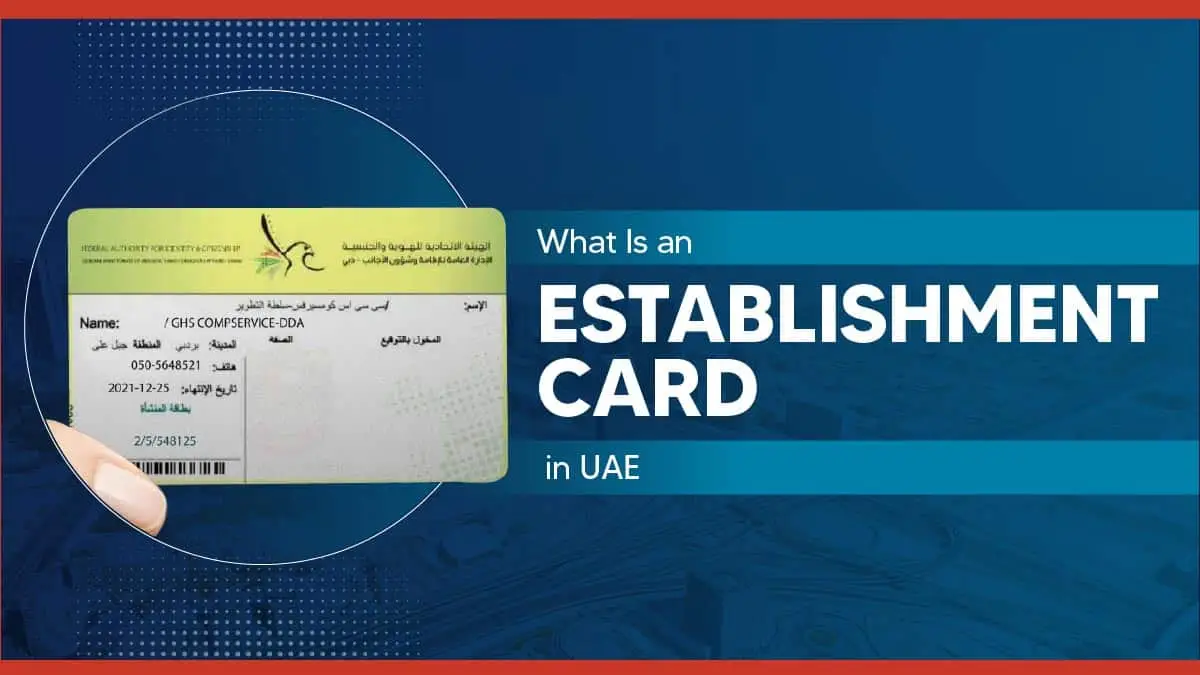
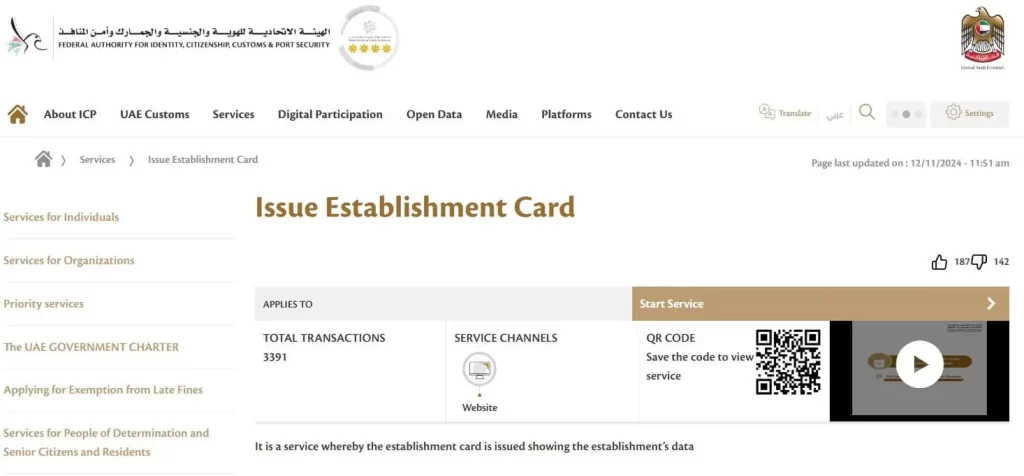
    An Establishment Card is an essential document for companies operating in the UAE, particularly regarding hiring employees and managing labour relations. This establishment card in UAE is issued by the Ministry of Human Resources and Emiratisation (MOHRE) and is required for companies to legally employ workers in the country.

    In this blog, we will explore everything you need to know about the establishment card in the UAE, including how to check, renew, and apply for it in Dubai.

    What Is an Establishment Card?

    An establishment card is a document linking a company to the UAE Ministry of Human Resources and Emiratisation (MOHRE). It is required for companies recruiting foreign workers and all businesses intending to hire employees in the UAE.

    It allows the government to monitor and regulate employment practices, ensuring companies comply with the UAE’s labour laws.

    What is an Establishment Card Number in UAE?

    The establishment card number is a unique identifier assigned to every company registered in the UAE. This number is essential for tracking and processing employee visa applications and labour-related activities.

    Dubai Establishment Card: Key Points

    In Dubai, the establishment card is essential for companies to access the labour market. The card is issued to legal entities and enables them to employ staff. Whether setting up a business or already running one, obtaining a Dubai establishment card is necessary to manage labour contracts and employee visas.

    Benefits of Having an Establishment Card

    1. Legal Employment: Enables companies to hire employees legally in the UAE, ensuring compliance with labour laws.
    2. Facilitates Visa Processing: Streamlines the process of applying for and renewing employee visas.
    3. Access to MOHRE Services: Provides access to essential services offered by the Ministry of Human Resources and Emiratisation.
    4. Improved Labour Relations: Helps maintain organised and transparent labour practices, fostering trust and compliance.
    5. Business Credibility: Enhances a company’s reputation as a legitimate and compliant business entity.
    6. Ease of Renewals and Updates: Simplifies the process of updating or renewing business-related permits and documentation.

    Grace Period for Establishment Card Renewal

    Companies are typically given a grace period of 30 days after the card’s expiry date to renew it. Failure to renew within this period may result in fines or legal consequences.

    How to Check Establishment Card Online?

    How to Check Establishment Card Online

    To check the status of your establishment card UAE, you can easily access the information online. Follow these simple steps:

    1. Visit the official MOHRE website for services and resources.
    2. Log in to your company’s account.
    3. Navigate to the “Establishment Services” section.
    4. Select “Check Establishment Card Status.”
    5. Enter the required details, such as your establishment number or UID.

    How to Download Establishment Card Online?

    The process to download an establishment card Dubai is straightforward:

    1. Go to the MOHRE website and log in.
    2. Locate your establishment card under the relevant section.
    3. Click the “Download” option to get your establishment card in PDF format.
    4. The card can now be printed or saved for future reference.

    Establishment Card Renewal in Dubai

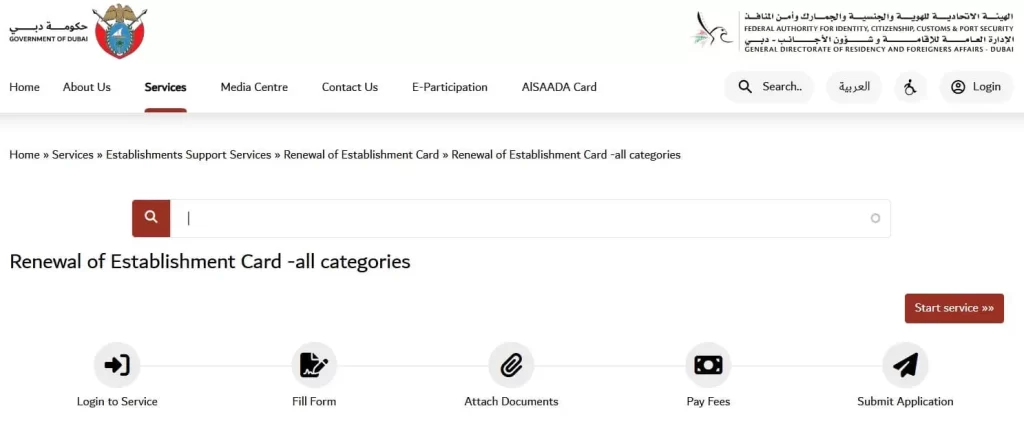
    As with any official document, the establishment card renewal Dubai is essential for maintaining your company’s legal status. To avoid delays, apply for renewal before your card expires.

    Establishment Card Renewal Fees Dubai

    The renewal fees include:

    • Application Fee: AED 50 (USD 13.60)
    • Issuance Fee: AED 100 (USD 27)
    • Electronic Services Fee: AED 10 (USD 2.70)
    • VAT: 5%
    • Knowledge Dirham Fee: AED 10 (USD 2.70)
    • Innovation Dirham Fee: AED 10 (USD 2.70)
    • Expedited Service Charge (if applicable): AED 100 (USD 27)

    These fees are to be paid online via credit card, and the process is efficient, allowing you to complete the transaction easily. 

    How to Renew Establishment Card in Dubai?

    How to Renew Establishment Card in Dubai

    To renew your establishment card in Dubai, follow these steps:

    1. Log in to the MOHRE portal using your company’s details.
    2. Navigate to the “Establishment Card Services” section.
    3. Select the “Renew Establishment Card” option.
    4. Complete the required details and upload any necessary documents.
    5. Pay the renewal fees, including VAT and any applicable service charges.
    6. Upon successful payment, the card will be renewed electronically, and you will receive a notification via SMS or email.

    How to Apply for an Establishment Card in Dubai?

    If you are setting up a business in Dubai and need to obtain an establishment card, the application process is straightforward:

    1. Register your company with the Department of Economic Development (DED) or relevant free zone authority.
    2. Log in to the MOHRE portal.
    3. Go to the “Labour Establishment” section and select “Apply for Establishment Card.”
    4. Fill out the application form with all necessary details.
    5. Submit the required documents, including the trade license and other supporting paperwork.
    6. Pay the applicable fees online.
    7. Upon approval, the establishment card will be issued electronically within two business days.

    Common Mistakes When Applying:

    • Incorrect establishment details or missing documents can delay the process.
    • Ensure fees are paid promptly to avoid application rejection.

    Importance of the Establishment Card in UAE Business Operations

    In conclusion, the establishment card UAE is an essential document for businesses looking to operate and employ workers in the UAE. Whether you are applying for a new establishment card in Dubai, renewing an existing one, or checking the status of your card online, the process is straightforward and vital for staying compliant with the country’s labour laws.

    Impact of Non-Compliance:

    Failure to renew the establishment card can result in fines ranging from AED 500 to AED 5,000 depending on the delay and other penalties.

    If you need assistance with any part of the process, don’t hesitate to contact us at +97144081900, send a WhatsApp message to +971507775554, or email us at info@shuraa.com for prompt assistance. Let us help you navigate the establishment card process efficiently.

    Frequently Asked Questions (FAQs)

    1. What happens if my establishment card expires?

    If your establishment card expires, you may face fines and restrictions on applying for or renewing employee visas until the card is renewed.

    2. Can I renew my establishment card after the grace period?

    Yes, but additional fines and penalties may apply for late renewal. It’s recommended to renew the card within the grace period to avoid extra costs.

    3. What is the average processing time for an establishment card?

    Typically, it takes two business days to process a new establishment card or renewal, provided all documents are in order.

    Disclaimer: The information in this post is for general guidance only and may change due to updates in government policies or regulations.
  • List of PRO Services in Dubai

    List of PRO Services in Dubai

    Navigating Dubai’s business environment requires effective support. PRO services are essential for managing government approvals and regulatory compliance, whether you are establishing or expanding your business.

    This blog provides a comprehensive list of PRO services in Dubai to help streamline operations and facilitate interactions with government authorities. These services support both new and existing businesses in achieving efficient management within a dynamic market.

    Understanding PRO Services in Dubai

    A Public Relations Officer (PRO), or Government Liaison Officer, is essential for businesses in the UAE. They facilitate communication between companies and government authorities, ensuring efficient legal and administrative processes.

    PRO services support visa applications, labour contracts, license renewals, and immigration documentation. These services help businesses maintain compliance and prevent delays or penalties.

    What are PRO Services in Dubai?

    PRO services in Dubai support efficient interactions with government departments, including the Department of Economic Development (DED). They are for obtaining the trade licenses required to operate a business in Dubai.

    Corporate PRO services in Dubai simplify the process of acquiring different types of trade licenses in the following ways:

    • Commercial License: PRO experts manage documentation and procedures for businesses involved in trading goods and services.
    • Industrial License: PRO specialists help companies obtain permits required for manufacturing and production activities.
    • Professional License: PRO professionals facilitate licensing for consultancy, engineering, healthcare, and related services.

    Why Your Business Needs PRO Services

    Navigating Dubai’s regulatory landscape can be challenging without expert support. Corporate PRO services offer specialised expertise, saving time and ensuring compliance with local laws. Whether you are launching a new business or managing an established company, PRO services streamline key operations so you can focus on growth.

    Who Should Use PRO Services?

    PRO (Public Relations Officer) services are essential for businesses in the following categories:

    • New Business Startups: PRO services help manage initial documentation, licenses, and registrations for new ventures.
    • Small and Medium Enterprises (SMEs): PRO services help businesses without in-house resources navigate government processes.
    • Large Enterprises: Corporations in Dubai can outsource government and regulatory tasks to PRO services to enhance efficiency and compliance.
    • International Companies: Multinational companies and foreign investors expanding into Dubai rely on PRO services to ensure a smooth market entry.
    • Freelancers and Consultants: Individuals seeking professional licenses benefit from PRO services for documentation and approval processes.

    List of Essential Pro Services in Dubai, UAE

    Here’s a list of PRO services in Dubai, UAE, mentioned below:

    1. Trade License Assistance: Supporting businesses in obtaining or renewing licenses according to their commercial, industrial, or professional activities.
    2. Visa Services: Managing applications, renewals, cancellations, and permits for employee, family, and investor visas.
    3. Labour & Immigration Services: Handling all employee documentation, including work permits and labour card renewals.
    4. Government Approvals & Clearances: Securing necessary approvals for business activities from the DED and other regulatory authorities.
    5. Document Attestation: Facilitating legalisation and attestation of documents for official use locally and internationally.
    6. Renewals & Amendments: Managing timely renewals and amendments of business licenses, visas, and official documents.
    7. Corporate Compliance: Ensuring businesses meet Dubai’s legal and regulatory requirements to prevent fines or legal complications.
    8. Translation Services: Providing certified translations of official documents for regulatory compliance.
    9. Customs Registration: Overseeing documentation and clearance for companies engaged in import, export, or logistics.
    10. Company Liquidation: Assisting businesses in closing or liquidating operations in compliance with UAE law.
    11. No Objection Certificates (NOCs) and Approvals: Streamlining the acquisition of NOC letters and approvals from relevant authorities for business and personal needs.
    12. Government Liaison: Acting as intermediaries between businesses and government departments to ensure all legal and administrative requirements are fulfilled.
    13. Health Card Applications and Renewals: Assisting employees and residents in obtaining and renewing Dubai Health Authority (DHA) health cards for medical service access.
    14. Emirates ID: Managing applications and renewals of Emirates ID cards, which are mandatory for all residents.
    15. Notary Public Services: Assisting with notarization of legal documents, including agreements, affidavits, and powers of attorney.
    16. Resident Visa: Managing applications, renewals, and cancellations of residency visas for employees and family members in accordance with UAE immigration regulations.
    17. Family Visas: Assisting residents in obtaining family visas to legally sponsor dependents in the UAE.
    18. Health Insurance: Assisting with the enrollment of employees and dependents in mandatory health insurance schemes in Dubai.
    19. Labour Services: Managing all labour-related administrative tasks, including employee contracts and dispute resolution.
    20. Memorandum of Association (MOA): Facilitating drafting, notarization, and modification of MOAs for new or existing businesses to ensure legal compliance.
    21. MOFA Attestations: Validating international documents and managing attestations from the Ministry of Foreign Affairs (MOFA).
    22. Intellectual Property: Assisting with registration of trademarks, patents, and copyrights to protect business ideas and brands.

    These corporate PRO services in Dubai help ensure smooth operations, regulatory compliance, and significant time savings for businesses and individuals.

    Professional Services in Dubai by Shuraa

    Shuraa Business Setup provides comprehensive PRO services in Dubai, managing all legal and administrative requirements for your business, including:

    • Approvals from government agencies
    • Approval of Trade Name
    • Court Agreement letter / Notary
    • Typing LLC contract (Arabic and English)
    • Embassy paperwork
    • Civil defence paperwork
    • Municipality paperwork
    • Labour department paperwork
    • Immigration department paperwork
    • Economic department paperwork
    • Certificate attestation
    • Legal translation
    • UAE business license services
    • Contract clearance
    • Services for visa processing
    • Visa amendment
    • Labour card and immigration card renewal

    PRO Services in Other Emirates

    Enhance your business operations with Shuraa’s corporate PRO services.

    PRO services in Dubai simplify interactions with government entities, helping businesses navigate regulations and maintain compliance. This support saves time and resources, ensuring your company remains in good standing and positioned for success.

    For a seamless business setup in Dubai, rely on Shuraa Business Setup for comprehensive PRO services. We assist with visa processing, labour services, company registration, and document legalisation. Contact our expert team for personalised support.

    Begin your journey with Shuraa Business Setup, your trusted partner for navigating business operations in Dubai.

  • Minimum Wage in UAE? What You Need to Know

    Minimum Wage in UAE? What You Need to Know

    Dubai and the United Arab Emirates are implementing a significant new minimum wage policy specifically for Emirati nationals in the private sector, marking a key step in the Emiratisation strategy. While the UAE has never had a universal minimum wage for all workers, this 2026 regulation establishes a formal wage floor for its citizens. Employers, economists, and expatriate workers are closely monitoring these changes for their broader impact on the labour market.

    Effective January 1, 2026, the Ministry of Human Resources and Emiratisation (MoHRE) requires private-sector employers to pay Emirati employees a minimum monthly salary of AED 6,000, an increase from AED 5,000. This wage floor applies to all new, renewed, and amended work permits for Emirati nationals. Companies must adjust the salaries of current Emirati employees to meet this requirement by June 30, 2026. Non-compliant firms may face penalties from July 1, 2026, including exclusion from Emiratisation quotas and suspension of new work permits.

    What is the Minimum Wage in UAE in 2026?

    The UAE recently implemented a mandatory minimum wage of AED 6,000 per month for Emirati citizens in the private sector, effective January 1, 2026, with a deadline of June 30, 2026, for existing contracts, part of the Emiratisation drive; while no single general minimum wage exists for expatriates, previous salary guidelines for specific qualifications (e.g., university graduates AED 12,000, technicians AED 7,000) served as benchmarks, though the new rule focuses on national employees. 

    For Emirati Nationals (Effective Jan 1, 2026)

    • New Minimum Wage: AED 6,000 per month.
    • Applies To: All new, renewed, and amended work permits.
    • Deadline for Existing Contracts: Employers must adjust salaries by June 30, 2026.
    • Penalties for Non-Compliance: Exclusion from Emiratisation quotas and potential suspension of work permits from July 1, 2026. 

    For Expatriate Workers

    • No Single Minimum Wage: The UAE Labour Law does not set a universal minimum wage for all expatriates.
    • Salary Benchmarks: Previously, guidelines existed for certain qualification levels, such as:
      • University Graduates: AED 12,000/month.
      • Skilled Technicians: AED 7,000/month.
      • Skilled Labourers (Secondary Education): AED 5,000/month.
    • Payment System: The Wage Protection System (WPS) ensures timely and full salary payments through banks, monitored by the Ministry of Human Resources and Emiratisation (MoHRE).

    Key Takeaway: The new AED 6,000 minimum wage represents a major policy change designed to make private-sector roles more appealing to Emirati citizens and increase national workforce participation.

    What is the Average Wage in the UAE in 2026?

    Average salaries in the UAE vary widely depending on industry, experience, education, and location. Although there is no official national minimum wage, the typical monthly salary ranges from AED 12,000 to AED 30,000.

    In 2013, MoHRE introduced salary guidelines that established tiers for various worker categories. These guidelines offer non-binding recommendations to help employers provide fair compensation.

    • University Graduates: Entry-level university graduates typically earn around AED 12,000 per month. Those in finance, engineering, and IT may start at higher salaries, with opportunities for rapid advancement as they gain experience.
    • Skilled Technicians: Electricians, plumbers, and mechanics generally earn about AED 7,000 per month, with salaries influenced by experience, certifications, and sector. Technicians in specialized fields such as aviation or oil and gas often earn higher wages.
    • Skilled Laborers: Construction supervisors, heavy machinery operators, and carpenters typically earn AED 5,000 per month. Salaries vary based on experience and sector.

    Average Wage by Other Categories:

    • Skilled Professionals (e.g., doctors, engineers, IT specialists): AED 20,000 to AED 45,000 per month.
    • Mid-level Professionals (e.g., accountants, marketing managers): AED 10,000 to AED 25,000 per month.
    • Unskilled and Semi-skilled Workers (e.g., construction workers, cleaners, drivers): AED 1,500 to AED 5,000 per month.

    These figures are averages, and actual wages can differ significantly by industry, location, and employer. For instance, salaries vary significantly by region, with major commercial hubs like Dubai and Abu Dhabi typically offering higher compensation packages.

    Salaries in the UAE vary significantly by location, with major commercial hubs like Dubai and Abu Dhabi typically offering higher compensation packages to attract talent. The figures below represent estimated average total monthly compensation (salary + allowances) for mid-level professionals in various emirates and should not be confused with legal minimum wage requirements:

    • Dubai: AED 20,000 to AED 35,000
    • Abu Dhabi: AED 18,000 to AED 32,000
    • Sharjah: AED 15,000 to AED 25,000
    • Ajman: AED 15,000 to AED 20,000
    • Ras Al Khaimah: AED 12,000 to AED 18,000

    These ranges are influenced by the concentration of multinational corporations, free zones, and industry sectors in each emirate.

    Factors Affecting Wage Levels in the UAE

    Several key factors influence wage levels in the UAE:

    • High-Demand Industries: Sectors such as technology, finance, and healthcare typically offer higher salaries due to strong demand for skilled professionals.
    • Skill Level and Education: Higher education and specialized skills generally result in higher wages. Professionals such as doctors, engineers, and IT specialists earn more than unskilled or semi-skilled workers. Advanced degrees and certifications can further increase earning potential.
    • Geographic Location: Salaries vary by region, with major cities such as Dubai and Abu Dhabi offering higher pay than smaller emirates.
    • Company Size and Type: Larger multinational companies usually provide more competitive salaries and benefits than smaller local firms. Wage structures also differ between the private sector, the public sector, and the free zone companies.
    • Economic Conditions: Factors such as GDP growth, inflation, and business confidence impact wage levels across the UAE.
    • Experience: Greater work experience typically leads to higher salaries.

    Wage Protection Laws and Systems in the UAE

    1. Wage Protection System (WPS)

    The Wage Protection System (WPS) is a government initiative in the UAE that ensures timely and transparent salary payments. Its purpose is to protect employee rights and prevent wage disputes.

    Employers must register their companies and employees with the WPS and submit salary details and payment schedules to MOHRE. The system monitors payments and notifies authorities of any discrepancies or delays.

    Key Features of the WPS:

    • The WPS requires all employers to transfer salaries electronically to employees’ bank accounts, ensuring transparency and timely payments.
    • The WPS enforces compliance with UAE Labour Law regulations that strictly limit permissible salary deductions, protecting workers from unlawful or excessive charges.
    • The WPS offers a fair and efficient process for resolving wage disputes between employers and employees.
    • The WPS collects and analyzes wage payment data, enabling authorities to monitor compliance and identify issues.

    As of 2026, the WPS covers additional categories of workers, including those in non-traditional roles. Non-compliant employers face increased penalties, including fines and possible legal action.

    2. Role of the Ministry of Human Resources and Emiratisation (MOHRE)

    The Ministry of Human Resources and Emiratisation (MOHRE) plays a crucial role in regulating wage protection in the UAE. It is responsible for:

    • Implementing and enforcing wage protection laws and regulations.
    • Overseeing the WPS and ensuring its proper functioning.
    • Investigating and resolving wage disputes between employers and employees.
    • Providing guidance and support to both employers and employees on wage-related matters.

    The MOHRE has been actively working to improve the efficiency and transparency of the WPS and has likely introduced new measures to enhance its effectiveness.

    How to Pay Wages to Your Employees in the UAE

    Paying wages in the UAE requires compliance with legal standards and the selection of appropriate payment methods. The following guide outlines key steps.

    1. Comply with the Wage Protection System (WPS): All employers must pay employee salaries through WPS-authorized banks or financial institutions. The system ensures transparency and timely payment as mandated by UAE law.
    2. Choose a Payment Method: Use WPS-approved banks for direct salary deposits. Cheque payments remain an option, though they are less common.
    3. Set Up a Payroll System: Implement payroll software to manage calculations and generate payslips. Maintain accurate records of salaries and deductions.
    4. Pay on Time: Establish a consistent payment schedule and ensure compliance with WPS requirements.
    5. Provide Payslips: Issue payslips that detail salary breakdowns and deductions to promote transparency.

    Related Post: Payroll Process in the UAE for Businesses

    Ensure Compliance with Shuraa

    Understanding wage regulations is essential for both employers and employees in the UAE. Awareness of minimum wage rules promotes fairness, legal compliance, and a more motivated workforce.

    If you are new to doing business in Dubai or considering starting a business, navigating these regulations can be challenging. Shuraa’s expert team is available to assist with company registration, legal requirements, and understanding local laws. Contact us to support your business success in this dynamic market.

    Frequently Asked Questions (FAQs)

    1. Is There a National Minimum Wage in the UAE?

    The UAE does not have a universal national minimum wage for all workers. However, starting January 2026, Emirati nationals in the private sector will have a mandatory minimum wage of AED 6,000 per month, enforced through the Wage Protection System (WPS) to ensure timely payment. Expatriate wages are set by contract, which must meet basic needs, and salary guidelines exist for different qualification levels.

    2. What is a Good Starting Salary in the UAE?

    The average starting salary in the UAE can vary significantly depending on factors such as industry, experience, education, and location. Generally, a good starting salary for a skilled professional in a major city like Dubai or Abu Dhabi can range from AED 10,000 to AED 15,000 per month.

    3. What is the Basic Salary in Dubai?

    In Dubai, “basic salary” refers to the fixed monthly pay before deductions or allowances. Professionals typically earn AED 8,000 to AED 15,000 per month, while skilled technicians and labourers earn AED 4,000 to AED 8,000 per month.

    4. Are There Overtime Payments in the UAE?

    Yes, employees in the UAE are entitled to overtime pay, usually at 1.25 or 1.5 times the basic hourly rate. Overtime regulations may vary by industry and company policy.

    5. What Are the Common Deductions from Salaries in the UAE?

    Common salary deductions in the UAE include:

    • Income tax (if applicable)
    • Social security contributions
    • Pension fund contributions
    • Health insurance premiums
    • Housing allowances (if provided by the employer)

    6. How Can I Report a Wage Dispute in the UAE?

    If you have a wage dispute, report it to the Ministry of Human Resources and Emiratisation (MOHRE). They offer procedures for handling wage complaints and can help resolve disputes between employers and employees.

    Disclaimer: This information is for general guidance and may change with updates to government policies or regulations.

  • What are PRO Services in Dubai

    What are PRO Services in Dubai

    Starting and running a business in Dubai can be challenging, especially if you are unfamiliar with local regulations. PRO (Public Relations Officer) services help businesses handle important government tasks, such as visa processing, license renewals, and document clearance.

    A PRO is a professional who manages government paperwork and procedures. In Dubai, businesses of all sizes need PRO services, from small startups to large international companies. That’s why it’s important for entrepreneurs to understand what PRO services offer.

    At Shuraa, we provide PRO services in addition to business setup support. Whether you are starting a new company, handling employee visas, or renewing trade licenses, we can help. Let’s look at what PRO means in the UAE, why these services matter, and how they help businesses get started and stay running smoothly in Dubai.

    What Are PRO Services?

    PRO stands for Public Relations Officer. This professional helps individuals and businesses manage government paperwork and procedures. In the UAE, PRO services are important because they help people navigate the country’s complex bureaucracy.

    A PRO acts as a link between you and government departments. They know the local laws, regulations, and procedures well, which makes them very helpful for businesses in Dubai.

    For example, a PRO can help a foreign company get the licenses and permits it needs to do business in Dubai, such as trade, industrial, or professional licenses. They handle the paperwork, attend government meetings, and ensure the company complies with all legal requirements.

    Main Roles and Responsibilities of a PRO in Dubai

    A PRO in Dubai helps keep business operations running smoothly. Their main responsibilities include:

    • Visa Processing: Managing visa applications, renewals, and cancellations for employees and their families.
    • Company Setup and Licensing: Helping with business setup, getting the required licenses, and making sure the company stays legally compliant.
    • Labour Card and Employment Visa Processing: Overseeing recruitment, getting labour cards, and handling employment visas.
    • Document Attestation and Legalisation: Making sure documents are officially recognised for use both inside and outside the UAE.
    • Government Liaison: Communicating with government offices to obtain permits, approvals, and clearances for the company.
    • Administrative Tasks: Taking care of paperwork, correspondence, and other tasks related to dealing with the government.

    What Are PRO Services?

    In Dubai, PRO services cover a range of important administrative and legal tasks that help businesses run smoothly. Here is a list of what these services usually include:

    1. Company Setup and Management

    • Business setup and licensing
    • License renewals
    • Amendments to company structure
    • Trade name registration
    • Office space lease agreements
    • DED/Free zone registrations
    • Initial approvals and NOCs

    2. Visa and Permit Services

    • Employment visas
    • Visit visas
    • Residence visas
    • Visa cancellations
    • Visa amendments
    • Labor card processing and renewals
    • Medical fitness tests
    • Emirates ID processing

    3. Document Attestation and Legalization

    • Document attestation for personal and commercial documents
    • Legalization of documents for use abroad
    • Apostille services
    • Translation services

    4. Government Liaison

    • Government correspondence and follow-ups
    • Obtaining NOCs and approvals
    • Dealing with government departments (DED, MOE, MOHRE, etc.)
    • Tax registration and compliance
    • Municipality-related services

    5. Other Administrative Services

    • Tenancy contract registration
    • DEWA, Etisalat, Du connections
    • Ejari registration
    • PRO courier services
    • Bank account opening assistance
    • Office equipment and furniture procurement

    At Shuraa, PRO services can be customised to fit your business needs. Outsourcing these tasks lets your company focus on what it does best and stay compliant with local rules,

    Who Needs PRO Services in Dubai?

    Anyone running a business or living in Dubai can benefit from PRO services.

    • Startups often find the business setup process, getting licenses, and handling employee visas challenging.
    • Established companies also benefit from PRO services, which help with visa management, document attestation, and dealing with government offices.
    • Free zone companies get certain advantages, but they still need PRO services for visa processing, managing labour cards, and other paperwork.
    • Expatriates living and working in Dubai need help with visa processing, residence permits, and other personal documents.
    • Investors in Dubai properties or businesses often need help with legal and administrative steps.
    • Visitors staying longer or coming for business can use PRO services for visa arrangements and other formalities.

    Benefits of PRO Services in Dubai

    Working with a PRO in Dubai brings many benefits for individuals and businesses alike:

    • Efficient Processing: PROs handle time-consuming tasks such as visa applications, document clearance, and government approvals. This lets businesses focus on what they do best.
    • Avoid Penalties: If you don’t follow government rules, you could face heavy fines. PROs help you stay compliant and avoid these penalties.
    • Resource Optimisation: Hiring a PRO usually costs less than keeping a full in-house team for these tasks.
    • Specialised Knowledge: PROs know the local administrative processes well, so they get tasks done right the first time.
    • Centralised Handling: PROs manage all government-related work, giving you a single point of contact for various administrative needs.
    • Focus on Business Growth: With PRO services, businesses can feel confident that their paperwork is handled by professionals, letting them focus on growing their business.

    Choose Shuraa for PRO services in Dubai

    PRO services are important for businesses in Dubai. They handle paperwork and government requirements, so you can focus on growing your company. Handling these tasks alone can be stressful and time-consuming. A reliable PRO helps you avoid problems and ensures you follow all the rules.

    Shuraa Business Setup is ready to support you. We offer PRO services tailored to your business needs. With over 26 years of experience, we have helped more than 100,000 entrepreneurs succeed in Dubai. Our services include company registration, licensing, visa assistance, and office space to help you set up and grow your business.

    By choosing Shuraa, you get a team that supports you at every stage. To learn more about our Dubai PRO services, call us at +971 4 4081900, message us on WhatsApp at +971 50 7775554, or email info@shuraa.com.

  • What is a Certificate of Incorporation in the UAE?

    What is a Certificate of Incorporation in the UAE?

    If you’re planning to start a business in the UAE, one of the most essential documents you’ll need is a certificate of incorporation UAE. This certificate is official proof that your company has been legally registered with the authorities—either in the mainland or in a UAE free zone.

    The certificate of incorporation in UAE is like your company’s birth certificate. It shows that your business exists and allows you to do important things like open a bank account, apply for visas, sign contracts, and start your operations legally.

    Therefore, here we will explain what a certificate of incorporation is, why it’s important for businesses in the UAE, and when you need it during the company setup process.

    What is a Certificate of Incorporation in UAE?

    A Certificate of Incorporation in the UAE is an official document that confirms your company has been legally registered and is recognized by the UAE government. It marks the official beginning of your company’s legal existence and allows you to carry out business activities in the country.

    Whether you’re setting up a business in the mainland or one of the UAE’s many free zones, this certificate is a key step in the business setup process.

    The main goal of the certificate is to provide legal recognition to your business. Once you receive it, your company is officially formed and can:

    • Enter into contracts and legal agreements
    • Open corporate bank accounts
    • Apply for business licenses
    • Hire employees and sponsor their visas
    • Trade locally and internationally (depending on your license type)

    Without this certificate, you cannot legally operate your business in the UAE.

    Key Elements of Incorporation Certificate in the UAE

    The Certificate of Incorporation in UAE includes several key pieces of information:

    • Company Name: The official name of your business.
    • Registration Number: A distinct identifier assigned to your company.
    • Date of Incorporation: The date when your company was officially registered.
    • Registered Office Address: The official location of your company.
    • Jurisdiction: The issuing authority and location of registration (mainland or specific free zone).
    • Type of Company: The business structure you have chosen (e.g., LLC, Freezone company).
    • Nature of Business: What will your company do, or what industry will it operate in.
    • Share Capital: The total amount of money invested in your company by shareholders.
    • Details of Directors and Shareholders: Names and roles of the people who manage and own the company.
    • Duration of the Company: How long is your company intended to operate.
    • Governing Authority’s Stamp and Signature: Official marks from the relevant government body or authority.

    This document is often requested by banks, clients, and government bodies as proof that your business is legitimate and officially formed.

    Who Issues Certificate of Incorporation in the UAE?

    The authority that issues your Certificate of Incorporation depends on where your business is registered:

    1. Mainland Companies: The Dubai Department of Economy & Tourism (DET) in each emirate is responsible for issuing the certificate. For example, if your company is in Dubai mainland, it will be issued by Dubai DET.
    2. Free Zone Companies: Free Zone Companies are certified by their respective zone-specific authorities, such as DMCC, IFZA, JAFZA, DAFZA, Shams, and RAKEZ.

    The certificate is usually issued after you complete all the required steps of company registration, submit necessary documents, and get final approvals.

    Read Also: How to Start a Business in the UAE

    Importance of a Certificate of Incorporation in the UAE

    Obtaining a Certificate of Incorporation is a crucial step for any business aiming to operate legally in the UAE. This document serves as official proof that your company has been registered and recognized by the relevant authorities, whether on the mainland or within a free zone.

    • Legal Recognition and Compliance: The certificate confirms that your business is a legitimate legal entity, allowing you to operate within the UAE’s regulatory framework. Without it, engaging in commercial activities, signing contracts, or opening bank accounts is not permissible.
    • Access to Banking Services: Most banks in the UAE require the Certificate of Incorporation to open a corporate bank account. It assures financial institutions of your company’s legal status and compliance with local laws.
    • Building Trust and Credibility: Having this certificate enhances your company’s credibility with clients, suppliers, and investors. It signals that your business meets all legal requirements, fostering trust and facilitating partnerships.
    • Essential for Licensing and Permits: To apply for trade licenses, visas, or other government approvals, the Certificate of Incorporation is often a prerequisite. It forms the foundation for obtaining the necessary permits to operate your business smoothly.
    • Facilitates International Trade: For businesses engaged in international trade, the certificate serves as a key document when dealing with global partners. It helps establish your company’s legitimacy on an international scale, making cross-border transactions more straightforward.
    • Protection of Intellectual Property: Registering your company with a Certificate of Incorporation can aid in protecting your business’s intellectual property rights, such as trademarks and patents, under UAE law.

    How to Obtain a Certificate of Incorporation in the UAE?

    Here is a step-by-step process on how to get the certificate of incorporation in Dubai or UAE:

    Step 1: Choose the Right Jurisdiction

    Start by selecting the most suitable jurisdiction based on your business goals:

    • Mainland: Allows you to operate anywhere in the UAE.
    • Free Zone: Offers benefits like 100% foreign ownership and tax exemptions but limits operations to within the free zone or international markets.
    • Offshore: Suitable for businesses focusing on international trade without a physical presence in the UAE.

    Each jurisdiction has its own set of rules, authorities, and documentation procedures.

    Step 2: Choose the Legal Structure

    Depending on the type and scale of your business, choose a suitable legal entity such as:

    • Limited Liability Company (LLC
    • Sole Proprietorship
    • Branch of a Foreign Company
    • Free Zone Establishment (FZE) or Free Zone Company (FZC)
    • Civil Company
    • Private Shareholding Company

    This decision affects ownership, liability, and the level of regulatory compliance required.

    Step 3: Pick a Company Name

    Choose a name for your company that will reflect the nature of your business. You should check the guidelines of the Dubai department of economy & tourism (DET). Once you have selected an appropriate name, reserve it with the DET or Free Zone Authority.

    Step 4: Apply for Initial Approval

    Submit a request to the relevant authority (DET, free zone, or offshore registrar) for initial approval. This step includes:

    • Details of shareholders and directors
    • Description of business activity
    • Intended company structure

    Initial approval confirms that your business activity is legally permitted in the UAE and that the company can proceed with registration.

    Step 5: Lease Office Space

    To register your company, you must have a physical address in the UAE:

    • Mainland businesses must secure a tenancy contract (Ejari)
    • Free zone companies can opt for flexi-desks, shared offices, or full office spaces
    • Offshore businesses do not require physical office space in most cases

    Leasing office space is a critical requirement for the issuance of the trade license and Incorporation certificate in UAE.

    Step 6: Apply for a Trade License

    With initial approval, apply for a trade license from the DET or Free Zone Authority. Submit all required documents, including your business Memorandum of Association (MOA), rental agreement, and initial approvals. If you need any help with document preparation or approvals, Shuraa Business Setup experts can assist.

    Read More: How to Get a Dubai Trade License

    Step 7: Pay the Applicable Fees

    The fees vary depending on the jurisdiction, legal structure, and business activity. Costs may include:

    • Registration fees
    • Name reservation fees
    • Initial approval fees
    • Office lease charges
    • License issuance fees

    Once paid, the final set of documents will be processed.

    Step 8: Receive the UAE Certificate of Incorporation

    After successful verification of all documents and payment the DET (for mainland companies), the respective Free Zone Authority, or Offshore Registrar will issue the Certificate of Incorporation.

    This document confirms that your company is officially registered and includes important details such as:

    This certificate, along with the trade license, enables you to legally operate in the UAE.

    Step 9: Post-Incorporation Steps

    After receiving the certificate, businesses should proceed with:

    • Opening a corporate bank account
    • Registering for VAT (if applicable)
    • Applying for visas for owners and employees
    • Obtaining any special permits (for specific sectors like healthcare, education, etc.)

    Working with a reputable business setup firm like Shuraa Business Setup can simplify the entire process. From choosing the right jurisdiction to handling paperwork and obtaining your certificate of incorporation UAE-wide – experts help you avoid errors, reduce setup time, and ensure compliance.

    Documents Required to Get a Certificate of Incorporation in the UAE

    To successfully register your company and obtain the Certificate of Incorporation in the UAE, you’ll need to prepare and submit several essential documents.

    • Passport copies of shareholders and directors
    • Visa and Emirates ID (if applicable)
    • Application form
    • Initial approval certificate
    • MOA (Memorandum of Association)
    • Trade name reservation certificate
    • Tenancy contract/Ejari (if required)
    • No Objection Certificate (NOC), if required 

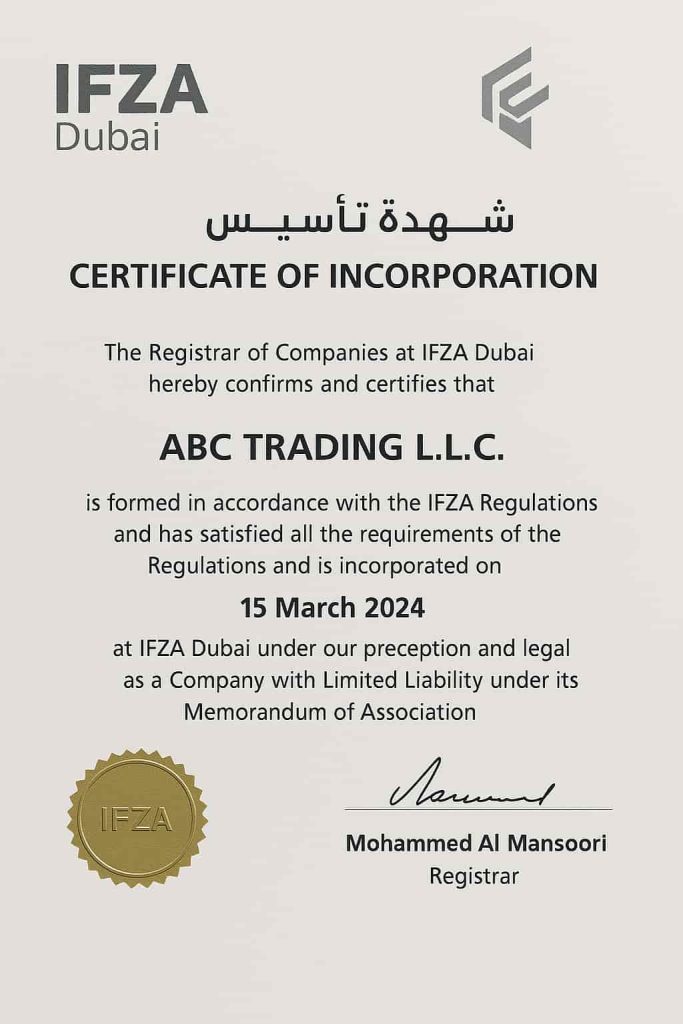
    Certificate of Incorporation in UAE Sample

    [LOGO OF THE ISSUING AUTHORITY]

    [NAME OF FREE ZONE / DEPARTMENT OF ECONOMIC DEVELOPMENT]

    License Number: [1234567]

    Company Registration Number: [FZ12345]

    This is to certify that
    [Company Name LLC / FZE / FZCO]

    has been duly incorporated and registered under the laws and regulations of

    [Free Zone Name / Emirate Name], United Arab Emirates.

    The company has complied with all the legal requirements for incorporation and is authorized to conduct its business activities as per the commercial license issued.

    Date of Incorporation: [DD/MM/YYYY]

    Business Activity: [E.g., General Trading, Management Consultancy, Software Development] 

    Legal Form: [LLC / FZE / FZCO]

    Issued To: [Full Name of Shareholder or Company Representative]

    Registered Address: [Office Number, Building Name, Free Zone or Emirate, UAE]

    This certificate is issued without any liability on the part of the issuing authority and is subject to compliance with all applicable laws and regulations of the UAE.

    Authorized Signatory:

    (Signature)

    Name: [Name of Authority Representative]

    Position: [E.g., Registrar, Director]

    Date of Issue: [DD/MM/YYYY]

    Stamp of the Issuing Authority

    Certificate of incorporation in UAE sample

    How to Verify a Certificate of Incorporation in the UAE?

    Verifying a company’s Certificate of Incorporation in the UAE is important to ensure its legally registered. Here are simple ways to do it:

    1. Use Official Government Portals

    • Dubai Department of Economy & Tourism (DET): Each emirate’s DET website allows you to search for company licenses. For example, Dubai’s DET portal provides options to search by business name or license number.
    • National Economic Register (NER): A centralized platform that provides information on licensed economic sectors in the UAE.

    2. Check Free Zone Authority Directories

    If the company is in a free zone, visit the relevant free zone’s website (e.g., IFZA, DMCC, DIFC, RAKEZ, JAFZA) to find their company directory and verify details.

    3. Utilize the ‘UAE Verify’ Platform

    The UAE Verify platform is a digital service that enables instant verification of digital documents issued by participating UAE authorities. Powered by blockchain technology, it ensures the authenticity and integrity of documents without the need for physical copies. You can verify documents by uploading them to the platform or scanning their QR codes using the UAE PASS app.

    4. Ask for Company Documents

    You can request:

    • Certificate of Incorporation
    • Trade License
    • MOA/AOA (Memorandum & Articles of Association)

    These confirm the company’s legal existence and activities.

    To prevent fraud and ensure authenticity, UAE Certificates of Incorporation incorporate several security features:

    • Many digital certificates include QR codes or barcodes that, when scanned, direct users to official government websites for instant verification.
    • The UAE Verify platform utilizes blockchain technology to register document hashes, ensuring that any tampering is easily detectable. This provides real-time verification of a document’s authenticity and validity.
    • Certificates often feature digital signatures and official stamps from the issuing authority.

    How to Amend Your Certificate of Incorporation in the UAE

    If your company goes through changes like a new business name, address, or shareholder structure, you’ll need to officially update your Certificate of Incorporation. Here’s how to do it:

    1. Identify the Required Amendments

    Determine the specific changes needed, such as modifications to the company name, business activities, shareholder details, or registered address.

    2. Prepare Necessary Documentation

    Gather all necessary documents that validate the proposed changes, which might include:

    • Board resolutions approving the changes
    • Amended Memorandum and Articles of Association (MOA and AoA)
    • Updated trade name reservation certificate (if changing the company name)
    • No Objection Certificates (NOCs) from relevant parties
    • Passport copies and Emirates IDs of new shareholders or directors
    • Proof of updated registered address (e.g., new tenancy contract)

    3. Submit the Amendment Application

    Submit the amendment application along with the required documents to the DET or respective Free Zone Authority.

    4. Pay Applicable Fees

    Pay the necessary fees associated with the amendment process. Fees may vary depending on the nature of the amendment and the jurisdiction.

    5. Receive the Amended Certificate

    Upon approval, the relevant authority will issue:

    • An amended Certificate of Incorporation
    • Updated trade license
    • Revised MOA and AOA

    Certificate of Incorporation vs. Trade License in the UAE

    When setting up a business in the UAE, two essential documents you’ll often hear about are the Certificate of Incorporation and the Trade License. While they’re both important, they serve different purposes.

    Here are the key differences between certificate of incorporation and trade license in UAE:

    AspectCertificate of IncorporationTrade License
    PurposeConfirms the legal formation of the companyAuthorizes the company to carry out business activities
    Issued ByDET (Mainland) or Free Zone AuthorityDET or relevant Free Zone Authority
    ContainsCompany name, registration number, date of incorporationBusiness activity, license number, expiry date
    When IssuedUpon company formation/registrationAfter business activity is approved
    ValidityPermanent (unless amended or cancelled)Needs annual renewal

    The Certificate of Incorporation in UAE is proof that your business legally exists. The Trade License is your permission slip to conduct the chosen business activities in the UAE. In short, the certificate says you exist as a company. The license says you’re allowed to operate in your chosen industry. 

    Shuraa’s Assistance with UAE Business Incorporation

    Certificate of Incorporation in UAE is an important document that shows your company is officially registered and recognized. It’s needed for things like opening a bank account, applying for a trade license, and proving your business is legal and trustworthy. At Shuraa Business Setup, we’re here to help you every step of the way.

    From choosing the right business setup to handling all the paperwork, legal steps, and PRO services, we make the process smooth and hassle-free. With our expert team by your side, you can get your certificate quickly and start running your business with confidence. Contact us for a free consultation today.

    Frequently Asked Questions (FAQs)

    1. What is a Certificate of Incorporation in the UAE?

    A Certificate of Incorporation in the UAE is a legal document issued by the Dubai Department of Economy & Tourism (DET) for mainland companies or a Free Zone Authority for free zone companies, officially confirming your business is a registered legal entity under UAE laws. It serves as proof of your company’s legal existence, authorizing it to operate, enter contracts, open bank accounts, and conduct other business activities. The certificate includes key details such as the company’s name, registration number, date of incorporation, and legal structure.

    2. What does the ‘Date of Incorporation’ mean in the UAE?

    The ‘Date of Incorporation’ refers to the official date when your company was registered and recognized as a legal entity in the UAE. This date is significant for legal and administrative purposes.

    3. How can I Get a Certificate of Incorporation in the UAE?

    To obtain a Certificate of Incorporation in the UAE, you must first choose your business structure and jurisdiction (mainland or free zone), reserve a unique trade name, and prepare documents like Memorandum of Association (MOA) and Articles of Association (AOA). Next, secure a business premise with a lease agreement and obtain initial approval from the relevant authority (DET or Free Zone authority). After submitting your application and paying the required fees, the authority will issue the Certificate of Incorporation, which confirms your company’s legal registration.

    4. Does the Certificate of Incorporation expire in the UAE?

    Typically, the Certificate of Incorporation does not have an expiry date and remains valid as long as the company is active and compliant with UAE laws.

    5. Can I operate my business in the UAE with only a Certificate of Incorporation?

    No, while the Certificate of Incorporation establishes your company’s legal existence, you also need a valid Trade License to legally conduct business activities in the UAE.

    6. What are the consequences of not having a Certificate of Incorporation in the UAE?

    Operating without a valid certificate is illegal and can result in fines, legal actions, and possible business closure.

    7. How to download Certificate of Incorporation in UAE online?

    To download your UAE Certificate of Incorporation online, use the official portal of the relevant authority—the Dubai Department of Economy & Tourism (DET) for mainland companies or the specific Free Zone Authority for free zone companies. Log in to the portal, usually with your UAE Pass, and navigate to the e-services section to find the options to search for your company’s license and download the certificate.

    8. What is the difference between certificate of incorporation and trade license in UAE?

    In the UAE, the Certificate of Incorporation (COI) proves your company’s legal existence as a registered entity, while the Trade License is the official permit allowing you to conduct specific business activities within the UAE’s jurisdiction. The COI is a permanent document confirming your company’s legal status, whereas the Trade License must be renewed annually to remain valid for operations.

    Disclaimer: The information in this post is for general guidance only and may change due to updates in government policies or regulations.

  • Absconding in the UAE: Rules, Consequences, and Amnesty Guide 2026

    Absconding in the UAE: Rules, Consequences, and Amnesty Guide 2026

    The UAE offers many opportunities, but navigating its legal requirements can be challenging. The concept of “absconding” often causes confusion for both employers and employees.

    Absconding in the UAE is a serious issue with significant consequences for both employers and employees. It occurs when an employee leaves their job without notifying the employer or obtaining the required permissions. This can result in legal action, fines, and possible deportation for the employee.

    For employers, absconding can disrupt operations, cause financial losses, and make it challenging to find a suitable replacement.

    Both employers and employees should understand the implications of absconding and follow proper procedures to avoid negative outcomes.

    What is Absconding in the UAE?

    In the UAE, absconding occurs when an employee leaves their job without notice for more than 7 consecutive days, or when a visitor overstays their visa. Employers or sponsors are required to report such cases to the Ministry of Human Resources and Emiratisation (MOHRE) or GDRFA. Consequences can include fines, deportation, a travel ban of one to ten years, and cancellation of work permits.

    This is in accordance with Article 28(1) of Cabinet Resolution No. 1 of 2022. The following are common situations that may be classified as absconding in the UAE:

    • Leaving a Job Without Notice: Employees who resign without the required contractual notice may be considered to have absconded.
    • Overstaying a Visa: Staying in the UAE after a visa expires, without renewal or departure, may be treated as absconding.
    • Working for Another Employer: Sponsored employees must not work for another company without first cancelling their current work permit and labour contract. Otherwise, this may be considered absconding.
    • Fleeing Sponsorship: If a sponsored employee leaves without notifying their sponsor, this may result in an absconding case.

    Absconding in the UAE for Visitors (Visit Visa)

    Absconding occurs when you overstay your visa and do not leave the UAE within the permitted period, including any grace period. Even brief overstays can result in fines and other issues.

    Both residence and visit visa holders may be reported as absconding if they violate visa conditions, such as failing to renew their visa or to leave the country as required.

    Key Aspects of Absconding in the UAE:

    • Overstaying a Visit Visa: If your visit visa expires and you remain in the UAE beyond the grace period, you may be classified as an absconder.
    • Not Leaving After Visa Cancellation: If your residence visa is cancelled and you do not leave within the required timeframe, this may be considered absconding. Unlike employment absconding, there is no minimum absence period. Any unauthorised overstay may be treated as absconding. Resolve any issues before departure to avoid long-term complications.

    Legal Framework Governing Absconding in the UAE

    The legal framework governing absconding in the UAE is established by two main sources:

    Federal Law No. 8 of 1980 (UAE Labour Law)

    This law governs employer-employee relations in the UAE. While it does not specifically mention “absconding,” it outlines employee obligations and the consequences of contract breaches.

    Ministerial Resolution No. (721) of 2006

    This resolution provides guidance on employment absconding. It defines absconding and outlines the procedures employers must follow to report an absconding employee to the Ministry of Human Resources and Emiratisation (MOHRE).

    Separate regulations govern visa overstays for visitors and residents. These matters are typically managed by the General Directorate of Residency and Foreigners Affairs (GDRFA).

    Types of Legal Consequences of Absconding in the UAE

    Absconding in the UAE results in significant consequences for employees, employers, and visa holders.

    1. Employees Absconding

    • Deportation: Employees identified as absconders are deported from the UAE at their own expense.
    • Travel Ban: Authorities may impose a travel ban, restricting re-entry to the UAE or other GCC countries for a specified period or permanently.
    • Blacklisting: Absconding records may be flagged in immigration systems, making it difficult to obtain future visas for the UAE or other countries.
    • Financial Penalties: Employees may be required to pay fines or compensate employers for losses caused by their absence.
    • Difficulty Finding Employment: An absconding record can severely limit future job opportunities in the UAE due to strict labour laws.

    2. Employers Absconding

    • Administrative Burden: Employers must follow formal procedures to report absconding, which can cause delays or complications.
    • Potential Legal Issues: Employers found responsible for an employee’s absconding, for example, due to unfair labour practices, may face legal consequences.
    • Reputational Damage: Frequent absconding cases can damage an employer’s reputation and hinder recruitment.

    3. Visitors Absconding

    • Fines: Authorities may impose daily fines for visa overstays.
    • Deportation: Visitors who abscond are deported at their own expense.
    • Travel Ban: Authorities may impose a travel ban, restricting future travel to the UAE and other GCC countries.
    • Difficulty Renewing Residence Visa: An absconding record can complicate the process of renewing a UAE residence visa.
    • Blacklisting: Absconding records may be flagged in immigration systems, making it difficult to obtain future visas for the UAE or other countries.

    Common Reasons for Absconding

    Employees or visitors in the UAE may abscond for various reasons, but such absences carry significant consequences.

    • Employees may abscond due to unfair treatment, low wages, unsafe conditions, or excessive workloads.
    • Unresolved disputes over salaries, benefits, or contractual obligations can also prompt employees to abscond.
    • Visitors may abscond after unintentionally overstaying, often because they missed visa renewal deadlines.
    • Visitors who lose their jobs before their visas expire may abscond out of fear of deportation or because they cannot renew their visas.
    • Visitors who lack funds before their visa expires may abscond to avoid overstay fines.

    How to Resolve an Absconding Case

    Resolution of an absconding case in the UAE depends on whether the report was filed by an employer for an employment visa or by a travel agent or sponsor for a visit visa.

    1. Verify Your Status

    Before taking any action, confirm the details of the absconding report.

    • For employment visas, check your status on the MOHRE website or app using your passport number or Labour Card ID.
    • For visit visas, use the GDRFA Smart Portal for Dubai or ICP Smart Services for other Emirates to check for active travel bans or circulars.

    2. Resolution for Employment Visa Holders

    If you have an absconding report under a work permit, you have three options:

    Option A: Amicable Settlement (Withdrawal by Employer)

    The fastest resolution is for your employer to withdraw the report voluntarily.

    • Process: The employer must log in to the MOHRE portal or visit a Tasheel centre to submit a withdrawal request.
    • Requirements: A formal withdrawal letter and payment of a fee, typically between AED 2,000 and 5,000, plus administrative costs.
    • Result: Once the report is withdrawn, the work ban is lifted, and you may proceed with visa cancellation or transfer.

    Option B: Proving a “False” or “Malicious” Report

    If the report was filed while you were working, on approved leave, or involved in a labour dispute, you may challenge it.

    • Step 1: File a grievance or labour complaint through MOHRE’s Twa-fouq centres.
    • Step 2: Provide evidence, such as attendance records, medical reports, or communications like emails or WhatsApp messages, showing you were in contact with your employer.
    • Consequence for Employer: If the report is found to be false, the employer faces a fine of AED 5,000 and may be blacklisted by the ministry.

    Option C: Voluntary Reporting for Deportation

    If you cannot settle or succeed in a grievance, you may report to immigration authorities, such as Aweer Immigration in Dubai, to request a safe exit. This will likely result in deportation and a permanent or temporary travel ban, but you will avoid further detention.

    3. Resolution for Visit Visa Holders

    Absconding on a visit visa usually results from overstaying or violating visa terms.

    1. Contact the Sponsor: If a travel agency sponsored your visa, they may have filed the report to avoid fines. Negotiate with the sponsor to pay any outstanding overstay fees so they can withdraw the report through GDRFA or Amer centres.
    2. Amnesty Programs: The UAE occasionally announces amnesty periods, such as in late 2024, allowing violators to leave without fines or bans. Check current ICP updates for active programs.

    4. Final Legal Clearance

    After the report is withdrawn or settled:

    • Settle Fines: Pay all accumulated overstay fines, which are approximately AED 50 per day.
    • Obtain Clearance: Request an official Clearance Certificate or Withdrawal Approval to ensure your name is removed from the blacklist.

    This guide explains how to resolve absconding cases in the UAE by withdrawing reports, proving false accusations, or seeking voluntary deportation.

    Amnesty Programs

    Amnesty programs allow individuals who have overstayed their visas to leave the country without incurring fines or penalties. Some programs also offer options to regularise visa status and remain legally in the UAE, which may require additional fees.

    In some cases, amnesty programs help individuals who have violated visa rules, such as working without a permit, resolve their status and potentially avoid deportation or travel bans.

    Please note that the UAE does not offer regular amnesty programs for absconding cases. However, temporary amnesty programs are sometimes introduced to assist individuals in situations that may otherwise lead to absconding.

    How to Avoid Being Marked as Absconding in the UAE

    To avoid being marked as “absconding” (Huroob) in the UAE, maintain clear communication and comply with Ministry of Human Resources and Emiratisation (MOHRE) regulations.

    1. Maintain Professional Communication (The 7-Day Rule)

    Under the UAE Labour Law, an employer can file an absconding report if you are absent for 7 consecutive days without a valid reason.

    • Always notify your HR or manager in writing, such as by email or WhatsApp, if you are sick or have an emergency. Written notice is essential, as oral communication is difficult to prove in court.
    • Obtain formal leave approval in writing or through the company’s HR portal before leaving the country or stopping work.
    • If you are unwell, obtain a medical certificate from a UAE-registered clinic and submit it to your employer within 48 hours of your absence.

    2. Manage Resignations Properly

    Absconding reports often result from poorly managed resignations.

    • Serve the notice period specified in your MOHRE employment contract, typically 30 to 90 days. Leaving before this period may be considered absconding.
    • Ensure your employer acknowledges receipt of your resignation letter. If they do not, send it by registered post or through a Notary Public.
    • Sign the formal “End of Service” document and return all company property, such as laptops and keys, to avoid potential claims or reports of missing items.

    3. Stay Informed During Disputes

    If you have a dispute with your employer, such as unpaid wages, continue attending work and follow proper procedures.

    • If your employer withholds pay or treats you unfairly, file a formal dispute at a Twa-fouq Centre while you are still employed. This helps protect you from a retaliatory absconding report.
    • If the dispute makes working impossible, request a “NOC” or temporary permission to be absent from the workplace from the MOHRE mediator during legal proceedings.

    4. Monitor Your Visa Status

    Absconding reports can sometimes be filed without the employee’s knowledge.

    • Ensure your mobile number is linked to your Emirates ID to receive SMS notifications from GDRFA or ICP.
    • Periodically review your status on the MOHRE Inquiry Portal if you suspect your employer may take legal action.

    5. For Visit Visa Holders

    • Leave the country or renew your visa at least 24 to 48 hours before your visa expires.
    • If you cannot afford to exit, inform your travel agency. They are legally required to report absconding cases to avoid significant fines on their license.

    Are you currently in a dispute with your employer, or are you planning to resign soon?

    Seek Expert Help When Needed

    It is important for employers and visitors to understand the legal consequences of absconding in the UAE, as it can result in immigration bans, fines, or arrest. Both employers and employees should know their rights and responsibilities. Employers must follow the correct procedures to report and prevent absconding.

    If you are unsure about your rights or facing a complex situation, consult immigration experts such as Shuraa. Our team specialises in UAE labour and immigration laws and can guide you through the process.

    If you are relocating to Dubai or moving your business to the UAE, Shuraa can manage your legal requirements, visas, and paperwork. This allows you to focus on your goals while we help you stay compliant and avoid absconding issues.

    Frequently Asked Questions (FAQs)

    1. What is the penalty for absconding in the UAE?

    Absconding, defined as an absence of more than seven consecutive days without a valid reason or contact, results in the following consequences:

    • Automatic cancellation of the work permit and residency visa.
    • Imposition of a one-year labour ban.
    • Overstay fines of AED 50 per day, standardised nationwide since February 2026.
    • Potential deportation, entry bans of one year or more, or fines up to AED 20,000 for repeat offences.

    2. What is the new rule for absconding in the UAE?

    There have been no significant changes to the core definition of absconding as a seven-day absence in 2025–2026. Key updates include a unified overstay fine of AED 50 per day across all emirates from February 2026, increased penalties of AED 5,000 or more for false employer reports, and fully online MOHRE and ICP processes for faster verification and withdrawal.

    3. How can I remove abscond in the UAE?

    The employer, or both parties, must submit a “Cancellation of Absence from Work Complaint” through the MOHRE portal or app using UAE Pass login, or through GDRFA for Dubai cases.

    The process involves contacting the employer to request withdrawal, submitting the application online with supporting documents, obtaining MOHRE verification (including calls to both parties), paying any overstay fines, and subsequent lifting of the ban.

    If the employer refuses to cooperate, you may file a labour complaint or appeal through MOHRE. Legal assistance may be required.

    4. How can I check my abscond status in the UAE?

    • To check your absconding status, log in to the MOHRE website or app using UAE Pass, navigate to Inquiries, and review your labour complaint or status using your passport or Emirates ID.
    • Alternatively, use ICP Smart Services at smartservices.icp.gov.ae to check your visa or residency status.
    • For Dubai cases, use the GDRFA Dubai app or website.
    • You may also contact MOHRE at 600 590 000.

    5. How much does it cost to remove an absconder in the UAE?

    There is no fixed removal fee; costs may include the following:

    • MOHRE or GDRFA service fees range from AED 115 to 315, though online applications are often free aside from government charges.
    • Overstay fines are AED 50 per day, which can accumulate to significant amounts if the overstay period is extended.
    • Optional services, such as typing centres or legal assistance, may cost AED 500-2,000 or more. Fines can be paid at ICP, GDRFA, the airport, or Amer centres.

    6. What will the company do if I abscond?

    If an employee is absent for more than 7 days without explanation, the employer will attempt to contact them. If unsuccessful, the employer files an absconding report with MOHRE to avoid penalties. This action triggers automatic visa cancellation through ICP or GDRFA, protects the company’s quota and record, and may allow the employer to pursue unpaid dues. Further action is typically not taken unless fraud is suspected.

    7. How many types of absconding are there in the UAE?

    There is one main type of absconding under Federal Labour Law: unexplained absence for more than seven consecutive days.

    Slight procedural differences:

    • Private sector employees (general MOHRE).
    • Domestic workers (dedicated MOHRE services). Overstay on visit/tourist visas is similar but immigration-focused (not always labelled “absconding”).

    For your specific case, please consult the official MOHRE or ICP portals directly, as rules may vary slightly by emirate or contract.

    8. How long does absconding last in the UAE?

    An absconding record can remain on your immigration file for several years, depending on your specific situation.

    9. Can I come back to the UAE after absconding?

    Returning to the UAE after absconding is often difficult. You may face a travel ban and may need to pay fines or resolve outstanding issues before re-entry is allowed.

    10. Can you exit the UAE with an absconding case?

    No, you generally cannot leave the UAE with an active absconding case. An alert on your passport will usually prevent departure until the issue is resolved.

    11. Is there amnesty for absconding in the UAE?

    The UAE occasionally offers amnesty programs for visa violations, but these are not guaranteed and may not cover all absconding cases.

    12. What happens if I overstay my visa in the UAE?

    For visitors, overstaying a visa is considered absconding. You will incur daily fines, may be deported, and could be banned from returning to the UAE or other GCC countries.

    Disclaimer: The information in this post is for general guidance only and may change due to updates in government policies or regulations.

  • SIRA License: How to Get, Cost and Requirements in UAE

    SIRA License: How to Get, Cost and Requirements in UAE

    SIRA, which stands for Security Industry Regulatory Authority, plays a crucial role in regulating the security sector in Dubai, UAE. This authority plays a crucial role in ensuring the safety and security of residents and businesses in the city.

    One of the key requirements for anyone looking to work in the security sector in Dubai is obtaining a SIRA license. This license is mandatory for security guards, consultants, and companies operating in the security industry.

    Obtaining a SIRA license is important for several reasons. First and foremost, it demonstrates that individuals and companies in the security sector are qualified and meet the necessary standards set by SIRA. Additionally, having a SIRA license can enhance credibility and trust among clients and employers that eventually leads to more opportunities for business and career growth.

    If you’re looking to work in a security sector in Dubai, we will help you understand all about SIRA license, how to apply for SIRA license in Dubai, associated costs, and everything essential so you can make informed decision.

    What is the SIRA License in Dubai?

    The SIRA (Security Industry Regulatory Agency) License in Dubai is basically a certification that ensures security personnel and firms operating in Dubai adhere to government regulations and are qualified for their duties. It’s issued by the Dubai government’s Security Industry Regulatory Agency (SIRA).

    Who Needs to Obtain a SIRA License Dubai?

    A SIRA License in Dubai is required for two main categories:

    1. Individuals working in security professions

    This applies to anyone working in security-related jobs in Dubai, such as:

    • Security guards
    • Security dog trainers
    • Personnel involved in safe transportation of valuables or vehicles
    • Security consultants
    • Staff working in security monitoring centers
    • Those installing and maintaining security and surveillance systems

    2. Companies providing security services

    Any business offering security services in Dubai needs a SIRA license. This includes companies that provide:

    • Physical security services (guarding, patrols, access control)
    • Electronic security services (CCTV, alarms, fire detection)
    • Security consulting
    • Security equipment sales and installation

    Even if security services are part of a company’s core business activities (like a hotel offering security to guests), they’d still need a SIRA license.

    Types of SIRA Licenses Available in Dubai, UAE

    There isn’t one single SIRA license that covers everything. Instead, SIRA offers various licenses categorized based on the role or service provided within the security industry.

    Here are some of the most common SIRA Licenses available in Dubai:

    • Security Guard Licenses: Issued to individuals working as security guards. There are different categories of security guard licenses depending on the area of expertise, such as cash escort guards or event security guards.
    • Security Supervisor Licenses: For those supervising security teams and security operations.
    • Security Systems Licenses: Required by companies or individuals installing, maintaining, or monitoring security equipment and systems.
    • Security Consultant Licenses: Granted to security consultants who provide security risk assessments and security solution recommendations.
    • Event Security Licenses: For individuals tasked with security during events or specific occasions.
    • Managerial Security Licenses: Issued to security managers who oversee security departments within organizations.
    • Companies Security Services Licenses: Permits companies to provide various security services.

    Requirements for Obtaining a SIRA License Dubai

    The requirements for obtaining a SIRA License in Dubai differ depending on whether you’re applying as an individual or a company. Here are some of the basic requirements:

    Individual Requirements:

    • Completed SIRA application form
    • Passport copy and Emirates ID (both sides)
    • Colour passport-sized photograph
    • Proof of residency visa (if applicable)
    • Certificate of good conduct (issued by your home country)
    • Medical fitness certificate from a Dubai-approved clinic

    Company Requirements:

    • Completed SIRA application form for companies
    • Trade license issued by the Department of Economic Development (DED)
    • Memorandum of Association (MOA) for the company
    • Detailed business plan outlining security services offered
    • Proof of company bank account

    How to Apply for SIRA License in Dubai

    Obtaining a SIRA License in Dubai involves a few steps, but the specifics can differ depending on whether you’re applying as an individual or a company.

    For Individuals:

    • Identify the Appropriate SIRA License: Research the different SIRA license categories (security guard, supervisor, etc.) and determine the one that aligns with your desired role in the security industry.
    • Meet the Basic Requirements: Ensure you have the necessary documents like a valid passport/Emirates ID, passport photo, residency visa (if applicable), a certificate of good conduct from your home country (attested), and a medical fitness certificate.
    • Training Requirements: Complete any required training programs or courses. SIRA often requires applicants to undergo training related to security procedures, first aid, fire safety, and other relevant topics. Make sure to attend accredited training centers recognized by SIRA.
    • Submit Your Application: Once you have all the required documents and training certificates, submit your application electronically through the SIRA eServices Portal.
    • Collect Your License: SIRA will review your application. Processing times can vary, so be patient. Upon approval, you’ll be notified and can collect your official SIRA License.

    For Companies:

    • Obtain a Trade License: If you’re a security services company, ensure you have a valid trade license issued by the Department of Economic Development.
    • Prepare Company Documents: Gather documents like your company’s trade license, Memorandum of Association (MOA), Articles of Association (AOA), and audited financial statements.
    • Appoint a Security Manager: Your company needs a Security Manager with a valid SIRA Security Manager License.
    • Employee Licensing: Ensure all personnel providing security services possess the required SIRA licenses based on their specific roles.
    • Submit Your Application: Similar to individual applications, submit your company’s application electronically through the SIRA eServices Portal (https://www.sira.gov.ae/en/home.aspx). There will likely be associated service fees.
    • Await Approval and Collection: SIRA will review your application. After approval, you’ll be notified and can collect your official SIRA License.

    Validity of SIRA License

    The validity of a SIRA License in Dubai typically follows a two-year cycle, but there are renewal processes involved.

    Before the expiry date, you or your company (depending on whether you hold an individual or company license) are responsible for initiating the renewal process. This typically involves submitting a renewal application, paying any associated fees, and ensuring you still meet the eligibility requirements.

    In some cases, a SIRA license might require renewal sooner than a year. This could happen if there are changes to your qualifications (e.g., additional security training) or the company’s security personnel.

    Failing to renew your SIRA license before its expiry can lead to penalties and potential suspension of your security operations.

    What is the Cost of Obtaining SIRA License?

    The SIRA License fees in Dubai doesn’t have a single fixed price. It depends on mainly two main factors: License type and Training requirements.

    • License Type: There are various SIRA licenses for a specific role or service within the security industry.  The cost associated with each license type can differ.  For instance, a Security Guard License will generally be less expensive than a Security Manager License.
    • Training Requirements: Some SIRA licenses necessitate attending specific training courses offered by SIRA-approved institutions. These training programs come with their own fees, which contribute to the overall cost of obtaining the license.

    For instance, a Security Guard License application fee might be around AED 1,000 (approx. USD 272), while a Security Manager License could cost around AED 5,000 (approx. USD 1,361). Training course fees can also range depending on the program.

    • Security Guard License: AED 1,000 to AED 1,625 (Basic Training + Application Fee)
    • Security Supervisor License: AED 1,500 to AED 2,900 (Training + Application Fee)
    • Security Manager License: AED 5,000 (Training) + Application Fee
    • Security equipment operator: AED 4.000
    • Security system operator: AED 3.000
    • Event guard security: AED 550

    Secure Your SIRA License with Shuraa

    Obtaining a SIRA License in Dubai might seem like a multi-step process, but understanding the requirements, costs, and renewal procedures can make it much smoother. Remember, adhering to SIRA regulations isn’t just about obtaining a license – it’s about prioritizing safety and security within the emirate. 

    A SIRA license demonstrates your commitment to upholding these high standards and grants you access to a wider range of security service opportunities. If you are considering applying for a SIRA license or any other type of business license in Dubai, seeking consultation from Shuraa Business Setup is highly recommended. 

    Our team of experts will guide you through UAE company registration, application preparation, license acquisition, and even provide essential PRO services and visa assistance. Don’t go through the process alone. Contact Shuraa Business Setup today at +971 44081900 or WhatsApp at +971 507775554 or drop an email at info@shuraa.com

    Frequently Asked Questions (FAQs)

    1. How long is a SIRA License valid for?

    The SIRA License typically has a validity of two years. You will need to renew it before the expiry date to continue working in the security industry in Dubai.

    2. What to expect after gaining SIRA approval?

    Once your SIRA application is approved, you will receive your official license document. You can then legally work in your designated security role within Dubai. Your employer will likely handle any additional company-specific procedures.

    3. How long does it take to gain SIRA approval?

    Processing times can vary depending on application volume and completeness of your documents. Generally, it takes around 2-4 weeks to receive approval after submitting a complete application.

    4. Do I need to undergo any training before applying for a SIRA License?

    Yes, completing a SIRA-approved training course relevant to your desired security role is mandatory. Training providers are available throughout Dubai.

    5. Can I apply for a SIRA license if I am not a resident of Dubai?

    Yes, non-residents can also apply for a SIRA license, but they may need to meet additional requirements and provide extra documentation, such as a valid work visa or residency permit. It’s essential to check with SIRA for specific guidelines in such cases.

    6. How to get SIRA certificate online?

    To get your SIRA certificate online, register on the SIRA eServices Portal, complete the required training (if applicable), submit your application and supporting documents, and pay the necessary fees to receive your certificate or license. The process varies depending on whether you are an individual or a company and what type of SIRA license or certificate you need.

    Disclaimer: The information in this post is for general guidance only and may change due to updates in government policies or regulations.

  • What is a No Objection Certificate (NOC) in UAE

    What is a No Objection Certificate (NOC) in UAE

    A No Objection Certificate (NOC) is a document issued by a government or private organisation that allows someone to carry out certain activities or meet specific requirements. In the UAE, this certificate is especially important for anyone planning to start a business.

    This document shows that the relevant parties do not object to the proposed activity or request, so the person may proceed.

    The NOC is a key part of the UAE’s official process. It acts as a formal confirmation from the authorities that there are no objections to starting a business or carrying out certain activities.

    Without this certificate, it can be difficult to get the licenses, permits, or approvals needed to operate legally in the UAE.

    That’s why it’s important for entrepreneurs to understand what an NOC is and why it matters when setting up a business in the UAE.

    What does NOC mean?

    NOC stands for No Objection Certificate. It is a legal document that shows a company, individual, or organisation has no objections to a certain action or transaction. In the UAE, NOCs are often needed for changing jobs, starting a business, property deals, and other activities.

    Kafala System

    The UAE uses the Kafala system, which is a sponsorship system for expats. Usually, your employer acts as your sponsor and handles your residency visa. To do certain things in the UAE, you often need an NOC from your sponsor, such as for:

    • Changing jobs
    • Starting a business
    • Leaving the country

    The NOC rule helps keep things clear and protects both you and your sponsor. It prevents people from building up debt or breaking visa rules, and it also ensures sponsors are not held responsible if a former employee stays in the country after their visa ends.

    Benefits of Obtaining a No-Objection Certificate

    Getting an NOC in the UAE offers several advantages, such as:

    • Smoother Transitions: An NOC shows that your current employer approves actions such as changing jobs. This helps you avoid problems and makes it easier to move to a new role.
    • Avoid Legal Issues: With an NOC, you show you have met your responsibilities and have no unresolved issues with your current sponsor.
    • Lifting Labour Bans: If you have a labour ban because of past job issues, a NOC from your previous employer can help remove the ban so you can look for new work.
    • Streamlined Processes: Sometimes, having an NOC can speed up visa applications or other steps that check your legal status and work history.

    When is a NOC Required in the UAE?

    You may need a No Objection Certificate (NOC) in the UAE for different reasons, especially if you are changing jobs, starting a business, or handling certain official matters.

    Below are some common situations where you might need an NOC:

    1. Employment:

    This is especially important if you plan to change jobs. In most cases, you will need an NOC from your current employer before joining a new company.

    2. Business Setup:

    The rules depend on where you are. On the UAE mainland, you usually need an NOC from your employer if you want to start a business while still working for them.

    But in many Free Zones, the rules are different. You may not need an NOC to set up a business there.

    3. Business Modifications:

    If you already have a business, you might still need an NOC for activities such as adding a partner, renewing your license, or expanding what your business does.

    4. Official Transactions:

    You may also need an NOC for other official tasks, such as:

    • Opening a bank account or an internet account
    • Obtaining a UAE driving license
    • Buying or selling real estate
    • Renewing or modifying a business license
    • Adding a partner to your business

    5. Visa Applications:

    You usually do not need an NOC to obtain your first work visa, since your employer handles it. However, if you have a UAE residency visa and want to apply for a visa to another country, you might need an NOC.

    6. Lifting Labour Bans

    If you have had problems with your job contract and received a labour ban, you will often need an NOC from your previous employer to remove the ban and continue working.

    Who Issues NOCs in the UAE?

    Who issues your NOC in the UAE depends on the type you need.

    • Employer NOC: This is the most common type and is given by your current employer or sponsor in the UAE. It shows they approve actions like changing jobs or starting a side business.
    • Government Department NOC: Some government departments also issue NOCs for certain procedures. For example, the Telecommunications and Regulatory Authority (TDRA) gives NOCs for e-commerce activities in the UAE.
    • Utility Provider NOCs: Sometimes, utility providers such as the Dubai Electricity and Water Authority (DEWA) require NOCs for property transfers.
    • Free Zone Authority NOC: Free Zones in the UAE have their own rules for NOCs. On the mainland, you might need a No Objection Certificate from your employer to start a business, but a Free Zone may not require this.

    How to Get a NOC in the UAE

    The steps to get a NOC in the UAE can differ based on the type you need and who issues it. Here are some general guidelines:

    Step 1. Identify the type of NOC

    Figure out which type of NOC you need, such as from your employer or a government department. This depends on your situation, like changing jobs or starting a business.

    Step 2. Gather Required Documents

    The documents you need will depend on the NOC type, but usually include:

    • The purpose of needing the NOC
    • Your passport copies
    • Emirates ID copy
    • Proof of employment (for employer-related NOCs)
    • Business license documents (if applicable)
    • Any other documents specified by the issuing entity

    Step 3. Submit Your Application

    If you need an Employer NOC, give your application and documents to your company’s HR department. For a Government Department NOC, follow that department’s process, whether online or in person.

    Step 4. Fee Payment

    You may need to pay a fee to process your NOC application.

    Step 5. Approval and Collection

    Processing times vary by case. After approval, you can either pick up your NOC in person or get it electronically, depending on how the issuer handles it.

    Why is NOC Needed for Establishing a Business in the UAE?

    If you work in the UAE and want to start a business on the mainland, you will probably need an NOC from your current employer or sponsor. This helps keep things clear and prevents any issues with your job contract.

    If you are unemployed or working as a freelancer, you usually do not need an NOC from a previous employer to start your own business.

    If getting an NOC is difficult, you might want to set up your business in a Free Zone. Many Free Zones have simpler processes and do not require NOCs from your employer.

    Do You Need an NOC to Work in the UAE?

    No, you usually don’t need an NOC just to work in the UAE. The need for an NOC mostly arises when your job situation changes or when you want to do something specific. When you start a job in the UAE, your employer, who is also your sponsor, handles the work visa process. In this case, you don’t need to provide an NOC.

    But if you want to change jobs and work for a new employer, you will probably need an NOC from your current sponsor.

    A Smooth Start for Your Business with Shuraa

    The No Objection Certificate, or NOC, is important for starting and running a business in the UAE. It shows that everyone involved agrees with the decision and helps with official processes.

    If you want to start a business in the UAE, it’s a good idea to get advice from Shuraa Business Setup. Our team can guide you through each step and make sure you have all the documents you need to run your business smoothly.

    You don’t have to do it alone. Reach out to Shuraa Business Setup at +971 44081900, WhatsApp us at +971 507775554, or email info@shuraa.com.

    Frequently Asked Questions

    1. Can an NOC be issued for any activity in the UAE?

    No, NOCs are usually given for certain reasons. The most common ones are changing jobs, starting a business, or getting approval for specific transactions.

    2. How long does it take to get an NOC?

    How long it takes to get an NOC depends on who is issuing it and the complexity of your request. It can take anywhere from a few days to several weeks.

    3. Do I need an NOC to cancel my UAE visa?

    No, you do not need an NOC to cancel your visa. But you may still need to settle any final payments or obligations with your employer before your visa can be fully cancelled.

    4. Can I request an NOC for a family member in the UAE?

    NOCs are usually given to people for their own activities. But if you are sponsoring a family member’s visa and your job situation changes, you might need an NOC from your employer.

    5. What happens if my employer refuses to issue an NOC?

    If your employer refuses to give you an NOC without a good reason, you can try to discuss it with them or file a complaint with the Ministry of Human Resources and Emiratization (MOHRE). You may also want to get legal advice in these cases.

    Disclaimer: This information is for general guidance only and could change if government policies or rules are updated.