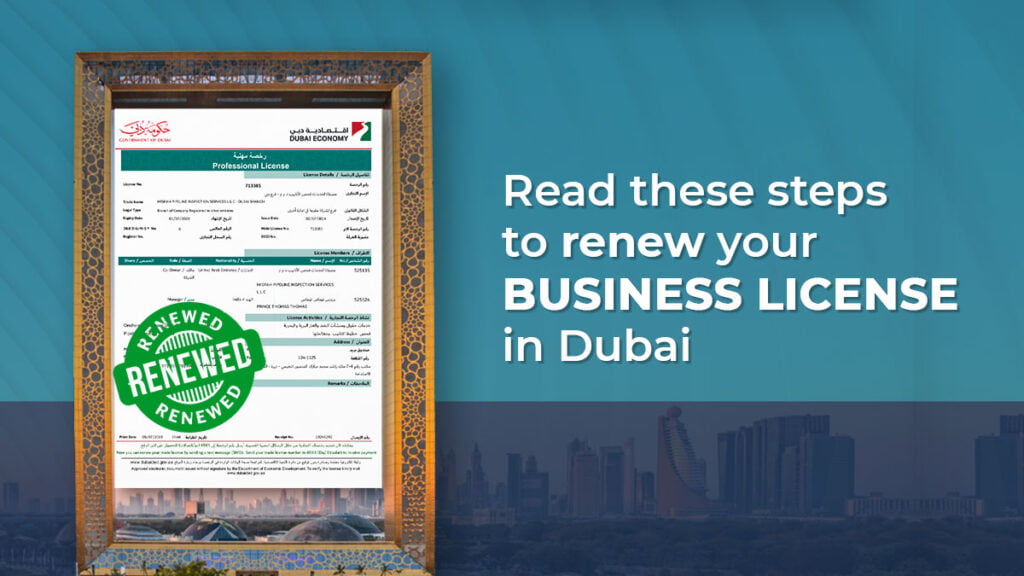
Getting a business license renewed is easier than ever before! Business license in Dubai is renewed annually. You can now renew your business license in Dubai in three simple steps. Thanks to new measures adopted by Department of Economic Development – DED in Dubai.
If you are a businessman or entrepreneur, you could renew your business license on your own. The Dubai Department of Economic Development DED has put forth several initiatives. Like the smart electronic services and registered agents that help you renew your business license in Dubai. Send a SMS and renew business license in Dubai. Moreover, online renewal helps reduce delays and save time and efforts spent in visiting the ministry offices.
These measure where brought in to develop easy business procedures and streamline an accommodating environment.
Here are the three simple steps that would help you renew your business license –
Check the validity of the tenancy contract:
The tenancy contract should have a minimum validity of one month, and the longer the better. Place of business is extremely important when it comes to company license renewal Dubai, thus double-check on the validity of your company’s tenancy contract in order to avoid delays in getting a business license.
Get the approvals for the activity:
Every specific business activity has selective requirements as well as may need certifications and licenses from specific authority. For instance, a car rental company or a private motor vehicle service need an approval from the Dubai Road and Transport Authority (RTA), whereas a private medical clinic needs a certification from the Ministry of Health and Prevention of Dubai and so on. Thus, get approval for the business activity for the respective judicial or governmental department well-in-advance before you apply for the business license.
Apply for business license renewal:
Collaborate all the certifications and the application for the trade license renewal in Dubai. Submit it to Department of Economic Development DED is several ways.
• Renew your business license offline
Department of Economic Development (DED) can renew your business license through various offline modes such as business service provider, authorized service agents, law firms, happiness lounge, etc.
• Renew your business license online
DED has a comprehensive website and e-Services for the business customers through which they can renew business license online. Getting business license renewed online can be reliable with minimal paperwork as well as speeds-up the process.
• You could do it through auto-renewal
In order to improve the country’s investment and business climate, the Economic Department has initiated an auto-renewal process through which the renewal could be fast-tracked. Investors seeking to renew their license only need to send an SMS with their license number to 6969. The business license renewal cost is sent via SMS. The business owners can then pay this fee through offline as well as online methods.
Matter of Concerns:
Delay and non-renewal of Business License in Dubai can attract penalties and even could blacklist the company. Moreover, plans for setting up business in the future might also be jeopardised. Thus, several businessmen feel appointing a business service provider in UAE is a safer and easier option.
Remembering the due date of your business license is not the only factor. Business license renewal takes longer time, especially if the documents are not in order. You need to be certain about the validity of your tenancy contract and certifications involved. Running around the ministries and governmental authorities at the last minute could be tiresome. Therefore, investors and businessmen feel best to outsource the renewal process.
The DED has made the regulations extremely simple for businessmen in Dubai. However, help from a business setup services provider makes administrational procedures even more convenient. A business setup service provider in Dubai significantly improves the quality of company formation and regulation. As a businessman you have instant awareness about the procedure, and you can be carefree on what goes next.
Go with Shuraa Business Setup–one of the well-known and established business setup service providers in UAE.
Shuraa Business Setup helps establish and obtain information about your company from the authority. We also issue and renew commercial registrations, keep a tab on the expiry dates and remind any renewals involved.
Shuraa Business Setup also offer number of administrative services that enable you to easily manage and operate your businesses. To know more speak to our business consultants or drop in a quick inquiry and we will get back to you!
Business licenses in Dubai is compulsory requirement for every type of company formation. Setting up a new business in Dubai can be an exciting prospect and several variables need to be considered. However, the most important of all is business licensing in Dubai.
This article will provide you a complete guide on the various types, structures and procedures involved in Dubai business licensing.
Why do you need a business license in Dubai?
A Dubai based business license validates your company as a legal entity certified to do business. Not just this, the business license also identifies you and your business enterprise. It takes accountability of your commercial proceedings as well as protects the public health and safety. On the other hand, it also allows to the governmental entities to regulate and survey the commercial proceeding in the city.
Watch the video for further details
Who provides business licenses in Dubai?
The Department of Economic Development (DED) is a government body entrusted to license companies or individuals who desire to carry out businesses in Dubai. The Department of Economic Development provides business licenses in Dubai. Dubai DED is the entity that does not only provide business licenses, but also regulates the procedures related to business licensing.
A DED licensed business is generally known as a “local company”. You must note that only mainland companies are registered and licensed by the Department of Economic Development, unlike free zone companies – those are licensed by private authorities.
What are the types of business licenses in Dubai?
There are mainly four types of business licenses in Dubai as well as around the UAE.
Professional license for service-related businesses
Industrial license for manufacturing goods
Tourism license for travel and tours industry
Business licensing is the most initial stage of starting a UAE business, but you also need to know that there are different agencies and jurisdiction that manage the system of business licensing. Watch the video to understand it in detail.
Which is the best type of business license in Dubai?
All the business licenses in Dubai are industry specific. While some licenses would be apt for some businesses, other may not be compatible for the related business activities.
This means that you can apply for a business license depending on the industry, business activity, the structure of the company, etc. However, the suitability of the license is different for each business. Also, the region you decide to set up the business in Dubai also plays an important role to determine the best business license for you. The right way would be to consultant a company formation expert. An expert can analyse and advice as per your commercial needs and future scopes of the company. Click here to consult a company formation expert for FREE Contact us.
How to Get a Business License in Dubai?
So, if you have learnt it all about the various business licensing options available, then you would be surely wondering how to get a business license in Dubai? What documents are required to license your business? Or are there any major conditions for getting a Dubai business license?
Various jurisdictions and business activities have its own licensing requirements. However, if you opt for a mainland license in Dubai then below are the most probable requirements:
One of the business partners needs to be present during the process for applying a business license in Dubai.
Passport copies of all the business partners as well as mangers depending that are required as per the business activity.
A NOC from the sponsor of the company for expat investors or foreign partners.
Copies of the residency visa for all the business partners.
You need to ascertain your business activity and legal structure for the company along with the reservation for the trade name.
Also, an initial approval from the DED and external approvals as required needs to be submitted with the application.
The tenancy contract for the office space and the Ejari also is a requirement to get the business license in Dubai.
All these documents are submitted by a PRO to the Department of Economic Development (DED). And after the fees is paid the license is issued.
Cost of Business License in Dubai, UAE
The cost of a business license in Dubai typically ranges between AED 7,000* and AED 30,000*, depending on the location and type of business setup:
UAE Mainland: AED 12,000* to AED 30,000*
UAE Freezone: AED 7,000* to AED 20,000*
The exact cost can vary based on factors such as business activities, location, and government fees.
How to Renew your Business License in Dubai?
Business license in Dubai needs to be renewed on an annual basis. Companies and commercial entities need to go through the process of documentation for renewal of the business license. Also, the business license must be renewed before the due date as a penalty is charged on late renewals. Getting a business license renewed can be made easier with the help of a business setup service providers in the UAE.
Speak to Shuraa Business Setup
Shuraa Business Setup is the only destination to get all the business licensing services under one roof! At Shuraa, our business setup consultants help you choose the right license for your business. We also make you understand the various process of getting a business license.
Shuraa Business Setup also communicates with the Department of Economic Development (DED) for all your licensing processes and ensure you get every approval that is required for the business. We do not only help you get the business license but also renew it annually so that can save yourself from delays and penalties.
Would you like to know more on business licensing in Dubai or anywhere across the UAE? Need to know the difference between licenses for mainland as well as free zone regions? or may you need to estimate the cost of business trade license in Dubai?
Business licenses in Dubai are one of the crucial elements of starting a business. Company and business licenses in Dubai are monitored and mandated by the Department of Economic Development (DED).
From small and medium enterprises to multinational companies – all types of businesses need to be licensed to operate legally. If you are wondering how much a small business license costs in Dubai, the quick answer is between AED 8000 and AED 30000. However, there are a lot of contributing factors that may collectively influence the small business license cost in Dubai.
Factors influencing Dubai business license costs
The factors influencing Dubai business license fees are as follows:
1. Nature of the business
Business licenses in Dubai are issued based on the nature of the business, also referred to as the business activity or business type. The licensing structure is mainly divided into four business types.
They are commercial licenses issued for trading and commercial entities, licenses issued to businesses offering professional services, industrial licenses issued to manufacturing companies, and tourism licenses issued to travel and tour services. The nature of the business is the prime factor that defines the cost of a business license in Dubai.
2. Number of company partners
The number of company partners in a business could be another factor that may fluctuate the cost of a business license in Dubai. If you have a small business with only yourself as a partner in the company, that would be best to keep the costs lower.
Partnerships also depend on the license that you opt for. Some licenses, such as a commercial license in Dubai, require you to have two partners, while with a professional license, you can be the only partner in the company.
3. Rented office in Dubai
Renting an office space will increase your business license costs by 2.5%. Due to the regulations noted by the Department of Economic Development, businesses must pay 2.5% of the total rent towards the cost of a business license in Dubai. Thus, we ensure you get affordable office space for rent in Dubai.
4. Added approvals
A significant factor that may impact the business license Dubai cost is the required approvals and sanctions. Additional approvals might be necessary depending on the nature of the business activity, which can further raise the total cost of obtaining a business license in Dubai.
These additional approvals are considered indirect costs, meaning they won’t be included directly in the business license fee but will contribute to the overall expenses involved.
5. Speak to an expert
Analysing these factors can be a good idea for a small business to lower its business license cost in Dubai. However, a better way to deal with it is to speak to a business setup consultant or an expert from Shuraa Business Setup.
A business license plays a vital role in the future and scope of your business. The business license you choose does not only define your business activity but also matters when you consider expanding your business.
Overview of Business License Cost in Dubai
In Dubai, obtaining a business license is crucial to operating legally. The Department of Economic Development (DED) or the relevant free zone authorities oversee the issuance of these licenses.
Depending on your business activity, several licenses are available, each with different cost structures. Here’s a breakdown of the main types of business licenses in Dubai:
Commercial License: This license is required for businesses engaged in trading activities. It covers the buying and selling of goods. The cost of a business license in Dubai for a commercial license can vary based on the size and nature of the business.
Professional License: Designed for individuals or companies offering professional services, such as consultancy, legal services, or other expertise-based professions. The cost of this license depends on the business scale and the number of employees.
Industrial License: This license is essential for businesses involved in manufacturing or industrial activities. The fees are influenced by factors such as factory size and the nature of production.
Tourism License: This license is mandatory for businesses operating in the travel and tourism industry. It covers travel agencies, tour operators, and other tourism-related activities, with costs depending on the services offered.
Businesses can make informed decisions by understanding these license types and associated costs. Consulting with business setup experts like Shuraa can provide accurate details and help streamline the licensing process.
Detailed Breakdown of UAE Business License Cost
Commercial License Cost
Initial Approval Fee: AED 200* to AED 400*
Trade Name Reservation Fee: AED 700* to AED 900*
License Fee: AED 10,000* to AED 15,000*
Office Rent: AED 10,000* to AED 50,000* (varies by location and office size)
Total Cost: AED 25,720* to AED 70,720*
Additional Costs
Market Fees: Approximately 5% of annual rent
Agent Fees: AED 7,000* to AED 15,000* annually for foreign investors
Professional License Cost in Dubai
Businesses offering services and professional individuals require a professional license. The cost of a UAE business license includes:
Initial Approval Fee: AED 100* to AED 300*
Trade Name Reservation Fee: AED 620* to AED 720*
License Fee: AED 5,000* to AED 10,000*
Office Rent: AED 10,000* to AED 50,000*
Total Cost: AED 18,720* to AED 66,020*
Additional Costs:
Local Service Agent Fees: AED 5,000* to AED 15,000* for foreign investors
Industrial License Cost
Initial Approval Fee: AED 1,000* to AED 3,000*
Trade Name Reservation Fee: AED 1,500* to AED 2,000*
License Fee: AED 15,000* to AED 25,000*
Office Rent: AED 30,000* to AED 60,000*
Total Cost: AED 50,000* to AED 70,000*
Additional Costs:
Factory Setup Costs: Varies based on factory size and requirements
Environmental Approvals: Costs may increase for activities requiring environmental department approvals
Cost of Business Licenses in UAE Free Zones
The cost of a License starts from AED 6,000- 30,000*.
Ras Al Khaimah Economic Zone (RAKEZ)
0 Visa Package: AED 6,000*
1 Visa Package: AED 12,000* (Visa Free for Lifetime)
2 Visa Package: AED 18,000*
3 Visa Package: AED 25,000*
International Free Zone Authority (IFZA)
0 visa Package: AED 12,900*
1 Visa Package: AED 14,900*
2 Visa Package: AED 16,900*
3 Visa Package: AED 18,900*
Steps to Start a Small Business in Dubai
Getting a small business license in Dubai may appear challenging, but following these steps will make the process more manageable:
Identify Your Small Business Activity: The first step is to Define your business activity. Dubai classifies licenses based on trade, industry, or services. Research the category that aligns with your business operations.
Choose a Business Name: Once you have selected a business activity, the next step is to choose a business name. Pick a unique and easy name according to Dubai’s naming regulations. Ensure it is not already in use and avoid offensive terms. Shuraa’s business setup consultants can assist with name selection.
Decide on a Legal Structure: Choose from legal structures like sole proprietorship or limited liability company (LLC). Each structure has distinct advantages and implications for licensing. Professional guidance can help you make an informed decision.
Register with DED: Apply for initial approval from Dubai’s Department of Economic Development (DED). This involves submitting essential documents, such as business plans, and paying initial fees. Specific industries might need additional permits from other government bodies. Research extra approvals required for your business activity.
Choose a Business Location: Select an office space or a free zone location, considering factors like cost, proximity to your target market, and benefits of the free zone (if applicable).
Visa Requirements: Consider the number of visas required for employees, as this will affect overall costs. Research visa options and fees based on your chosen legal structure.
Each business owner must submit their documents to apply for individual investor visas.
Understand the Costing for Your Small Business License with Shuraa!
In conclusion, understanding the Small Business License Cost in Dubai is essential for anyone looking to start a business in this dynamic city. The costs can vary widely depending on factors such as the type of business, number of partners, office location, and additional approvals required.
Consulting with Shuraa Business Setup can be incredibly beneficial for a smoother and more efficient process. Their expertise in Dubai’s licensing landscape ensures you get accurate cost estimates and comprehensive support throughout the licensing process, helping you establish and grow your business confidently. For personalised assistance, contact Shuraa Business Setup today.
For more information or a free consultation, contact Shuraa Business Setup. Call us on +97144081900 / WhatsApp +971507775554.
1. How much does a small business license cost in Dubai?
A business license in Dubai generally costs between AED 10,000* and AED 30,000*, depending on business activity and structure. The estimated cost of a business in Dubai mainland can be anywhere between AED 12,000* and AED 28,000*. The license cost in Dubai Freezone typically starts at AED 10,000*.
2. What is the cheapest small business license in Dubai?
The cheapest small business license in Dubai starts from AED 5,750*. To know more about the cheapest business license, you can contact Shura business setup.
3. How to get a small business license in Dubai?
To get a business license in Dubai, follow these steps identify your small business activity, choose a business name, decide on a legal structure, register with DED, choose a business location, and visa requirements.
Disclaimer: The information in this post is for general guidance only and may change due to updates in government policies or regulations.
Positioned at the nexus of global commerce, Dubai stands as a beacon for industrial innovation and trade. With its strategic geographic crossroads, visionary infrastructure, and investor-centric regulatory framework, the emirate offers an unrivaled ecosystem for manufacturing excellence. For ambitious entrepreneurs and established corporations alike, Dubai presents a dynamic gateway to regional and international markets.
Launching an industrial venture here, however, requires navigating a structured pathway of registration, licensing, and compliance. A meticulous, well-informed approach is crucial to transform opportunity into operational success.
This comprehensive guide is designed to demystify the entire process. We will walk you through each critical step—from initial business registration and location selection to securing essential industrial permits and operational licenses. Whether you are a seasoned industrialist expanding your footprint or a first-time founder turning a vision into reality, this roadmap will provide the clarity and insight needed to successfully establish and launch your manufacturing company in Dubai.
Key Advantages: Why Dubai is a Premier Hub for Your Manufacturing Company
Dubai has strategically positioned itself as a global leader for industrial investment and manufacturing excellence. For entrepreneurs and corporations looking to establish a robust, scalable, and profitable manufacturing base, the city offers a compelling combination of strategic advantages. Here are the core factors that make Dubai an ideal choice:
1. Unrivaled Strategic Location & Global Connectivity
Situated at the crossroads of Europe, Asia, and Africa, Dubai provides unparalleled access to a market of over 4.5 billion people.
World-Class Logistics Infrastructure: Home to Jebel Ali Port (one of the world’s largest container ports) and Al Maktoum International Airport (a major global cargo hub), Dubai ensures seamless import of raw materials and export of finished goods.
Efficient Supply Chains: Advanced road networks and integrated logistics zones (like Dubai Logistics City) minimize transit times and costs, offering manufacturers a significant competitive edge in global markets.
2. Progressive & Supportive Government Policies
The UAE government actively cultivates industrial growth through visionary policies and incentives.
Foreign Ownership:100% foreign ownership is permitted in industrial sectors across thousands of activities, both in dedicated free zones and on the mainland.
Regulatory Efficiency: Streamlined processes through digital platforms and a commitment to reducing bureaucratic hurdles facilitate a faster, more transparent setup.
Reliable Utilities: Access to high-capacity, reliable power, water, and gas connections through entities like DEWA supports heavy industrial operations without interruption.
4. Dynamic and Skilled Workforce
A diverse, highly skilled, and adaptable talent pool is readily available.
Global Talent Attraction: Dubai’s high quality of life and tax-free income attract top-tier international engineers, technicians, and managers.
Local Development: Significant investments in UAE national education and vocational training (e.g., Emiratisation initiatives in technology and engineering) ensure a growing pipeline of skilled local professionals.
Multicultural Environment: A multicultural workforce fosters innovation and provides the linguistic and cultural fluency needed to manage global operations.
5. Stable, Business-Friendly Economic Environment
Manufacturers benefit from a predictable and secure operational landscape.
Political & Economic Stability: A stable government and resilient, diversified economy reduce investment risk.
Favorable Fiscal Regime: Zero personal income tax, competitive corporate tax structures (9% on taxable income exceeding AED 375,000, with 0% relief for small businesses under AED 3 million revenue until December 31, 2026), and extensive double taxation treaties enhance profitability and ease of cross-border business.
Strong Legal Framework: A transparent, English-language common law system in free zones and continuous legal reforms protect intellectual property and enforce contracts reliably.
In summary, Dubai is not just a location—it is a strategic partner for manufacturing growth. By combining geographic advantage with intentional policy, cutting-edge infrastructure, and human capital, it provides a complete ecosystem where industrial businesses can thrive, innovate, and expand their global footprint.
For a detailed analysis of how these advantages apply to your specific manufacturing activity, consult with our industry experts atShuraa Business Setup.
Mainland vs. Free Zone: Key Comparison
Manufacturing is ideal in free zones for export-focused operations due to customs exemptions, but mainland allows unrestricted UAE trading. Below is a comparison:
Aspect
Mainland
Free Zone
Ownership
100% foreign in most industrial activities (some sectors may require local sponsor).
100% foreign ownership.
Trading
Full access to UAE market without distributors.
Export-oriented; local sales require distributor or mainland branch (5% customs duty).
Location Examples
Industrial areas like Al Quoz, Jebel Ali (non-free zone).
JAFZA (heavy industry), Dubai Industrial City (light manufacturing), Hamriyah (petrochemicals).
Approvals
Dubai Department of Economy & Tourism (DET), Dubai Municipality, MOIAT.
More approvals, potential local partner in restricted activities.
Limited local trading, location-specific rules.
Choose based on your scale: free zones for startups (cost-effective packages), mainland for established firms.
Essential Permits & Licenses for an Industrial Company in Dubai
Establishing an industrial company in Dubai requires obtaining a series of approvals and licenses from multiple government authorities. Compliance is mandatory to operate legally and ensure a safe, sustainable business.
The following are the core permits and licenses you will need to secure:
1. Primary Business License
This is the fundamental legal document authorizing your company’s operations. Depending on your chosen jurisdiction, it is issued by different authorities:
Department of Economy and Tourism (DET): Issues the Commercial/Industrial License for mainland companies.
Relevant Free Zone Authority: Issues the Free Zone Establishment (FZE) License for companies established within a designated industrial free zone (e.g., Jebel Ali Free Zone – JAFZA, Dubai Industrial City).
This license defines your approved activities and is the foundation for all subsequent approvals.
2. Industrial License / Permit
An additional, specialized permit is required to conduct manufacturing or industrial processing activities. This ensures your facility meets industrial standards.
Purpose: Authorizes the physical transformation of materials and the operation of industrial machinery. It involves a detailed review of your factory layout, production processes, and machinery list.
3. Environmental Permit
Mandatory for any operation with potential environmental impact, such as emissions, wastewater discharge, or hazardous waste generation.
Requirements: Submission of detailed operational plans. For medium to high-risk activities, an Environmental Impact Assessment (EIA) study may be required before the permit is granted.
Ensures your industrial facility complies with stringent UAE fire protection and life safety codes.
Issuing Authority: Dubai Civil Defence.
Process: Requires submission of architectural and MEP (Mechanical, Electrical, Plumbing) drawings for plan review, followed by an on-site inspection after construction/renovation to certify all installed firefighting systems (alarms, sprinklers, extinguishers).
5. Dubai Electricity and Water Authority (DEWA) Services Connection
You must secure reliable power and water supplies for your industrial operations.
Prerequisites: Before applying, you typically need a Building Completion Certificate (for new builds) or a Tenancy Contract registered via Ejari, and a No Objection Certificate (NOC) from Dubai Municipality confirming the building’s suitability for industrial use.
Note: Large consumers may require a high-voltage or dedicated industrial substation connection.
6. Additional Sector-Specific Approvals
Depending on your specific industry, further permits are compulsory:
Food & Beverage:Food Trade License and Sanitary Health Card from Dubai Municipality’s Food Safety Department.
Chemicals/Hazardous Materials: Special permits from Dubai Municipality and potentially MOIAT.
Import/Export: Registration with Dubai Customs to obtain a Customs Code.
Critical Compliance Note
These permits are interlinked. For example, you often cannot receive your final Primary Business License without proof of Civil Defence Approval and DEWA connection. Similarly, the Industrial License from MoIAT is contingent on environmental and safety clearances.
Recommendation: Engage a reputable local business setup consultant or PRO service. They can navigate the sequential application process, manage documentation, and coordinate with multiple government departments efficiently, preventing costly delays and compliance issues.
Steps to Establishing an Industrial Business in the UAE
Phase 1: Pre-Application Planning & Definition
1. Define Business Activity & Develop Plan:
Identify your precise industrial activity (e.g., food manufacturing, metal fabrication, pharmaceutical packaging).
Verify that your chosen activity is permitted in your target jurisdiction (Mainland or specific Free Zone).
Prepare a detailed business plan, including financial projections, operational workflow, and market analysis.
2. Reserve Your Trade Name:
Submit 1-3 name options to the relevant authority (DET for Mainland, Free Zone Authority for Free Zone).
Names must be unique, align with the business activity, and include the legal form suffix (LLC for Mainland, FZE/FZC for Free Zones).
Restrictions apply (no offensive/religious terms, no names of existing brands or government bodies).
Phase 2: Initial Approvals & Legal Structure
3. Obtain Initial/Provisional Approval:
Submit a basic application with passport copies and the business plan. Use the Basher platform for faster processing (often 1-3 business days).
For mainland industrial LLCs (commercial or industrial activities), no Local Service Agent (LSA) or local sponsor is required, as 100% foreign ownership is permitted under the 2021 Commercial Companies Law amendments for most non-strategic sectors, including manufacturing. LSA requirements apply primarily to professional licenses (e.g., civil companies or sole proprietorships) or specific restricted activities. If your activity falls under professional services, an LSA may still be needed, but this is not the case for standard manufacturing.
For Free Zones: This is often the formal application to the Free Zone Authority.
Timeline: Typically 1-3 business days.
4. Draft and Notarize Legal Documents:
For Mainland LLC: Prepare the Memorandum of Association (MOA), defining shareholder structure and capital. This must be notarized before a Notary Public in the UAE.
For Free Zone Entities: Prepare the Articles of Association and the Free Zone’s standard incorporation contract.
Other documents may include board resolutions and powers of attorney.
Phase 3: Location & Core License
5. Secure a Physical Facility & Register Lease:
Lease a factory or warehouse in a designated industrial zone (e.g., Dubai Industrial City, ICAD in Abu Dhabi, or within an industrial Free Zone like JAFZA or KIZAD).
Register the lease contract via the official system (Ejari in Dubai, Tawtheeq in Abu Dhabi, or the Free Zone’s internal system).
Ensure the facility size meets the specific authority’s requirements for your activity and desired employee visa quota.
6. Apply for the Industrial License:
Submit the complete application (including initial approval, legal docs, and lease) to DET or the Free Zone Authority.
This step includes a review of your factory layout plans by the licensing and industrial development departments.
Fees: Vary widely (from ~AED 15,000 to AED 50,000+) based on activity, location, and authority. Free Zone packages often bundle license, lease, and visa costs.
Phase 4: Sector-Specific & Operational Approvals
7. Secure Necessary NOCs and Permits:
Environmental Permit: Mandatory clearance from the relevant municipality (e.g., Dubai Municipality) or the Ministry of Industry & Advanced Technology (MoIAT). An Environmental Impact Assessment (EIA) may be required for high-risk activities.
Civil Defence Approval: Fire safety system approval from the local Civil Defence department.
Health/Sanitary Permit: For food, pharmaceuticals, or cosmetics, from the municipality and the Ministry of Health and Prevention (MOHAP).
Utilities: Apply for industrial connections from DEWA (Dubai) or the relevant emirate’s utility provider.
Customs & Import/Export: Register with UAE Customs and obtain an Importer-Exporter Code if you will trade goods across borders.
Phase 5: Post-License Setup
8. Finalize Incorporation & Register for Taxes:
Receive your formal Industrial License and company registration certificates.
Register for VAT (5%) with the Federal Tax Authority (FTA) if annual turnover is expected to exceed AED 375,000.
Understand corporate tax obligations (9% on taxable income exceeding AED 375,000, with 0% relief for small businesses under AED 3 million revenue until December 31, 2026).
Register with the local Chamber of Commerce.
9. Open a Corporate Bank Account:
Approach banks with your complete “company kit” (license, MOA, shareholder/director passports, business plan). This process can be lengthy; prepare for due diligence.
10. Recruit Workforce & Apply for Visas:
Important: For an industrial license (and subsequent federal industrial production license from MOIAT), a minimum of 10 employees (not necessarily skilled; can include general workers) is required, along with a minimum capital investment of AED 250,000. This is a federal requirement under MOIAT for commencing operations in manufacturing. Employee visas and quotas are tied to facility size, but the 10-employee threshold must be met for license approval. This applies to both mainland and free zones, though free zones may have additional activity-specific rules.
In addition to the 10-employee minimum, companies must comply with Emiratisation targets. As of 2026, private sector companies with 20-49 employees must employ at least 2 UAE nationals (increased from 1 in 2024), and companies with 50+ employees must achieve annual growth targets (e.g., 2% annual increase in Emirati workforce in skilled roles). Non-compliance incurs fines up to AED 108,000 per unfilled position annually (escalating from AED 96,000 in 2025). From January 1, 2026, all Emirati employees must earn at least AED 6,000 per month, with a 6-month adjustment grace period (fines apply thereafter). This is enforced by MOHRE and applies to both mainland and free zones. Integrate this into workforce planning during visa applications.
Begin production after passing any final municipal or MoIAT inspections of the actual facility and installed equipment.
12. Annual Renewal & Compliance:
The Industrial License, lease, and visas require annual renewal.
Maintain compliance with all regulatory bodies (environment, civil defence, health).
File timely tax returns with the FTA.
Non-renewal or non-compliance results in heavy fines and potential license cancellation.
Cost Overview: Obtaining an Industrial License in Dubai
Estimating the total cost of establishing an industrial company in Dubai requires considering several variables. The figure often cited for the core government license fee (typically between AED 25,000 to AED 30,000) is just one component of a larger investment. Use free zone calculators (e.g., JAFZA) for personalized quotes; 2026 inflation may add 5-10% to leases.
Breakdown of Key Cost Components:
1. Core Government Licensing Fees:
This includes the Industrial License issuance fee from the Department of Economy and Tourism (DET) or your chosen Free Zone Authority, plus associated registration charges.
Estimated Range: AED 15,000 – AED 35,000. The final amount depends on the specific industrial activity’s risk/impact classification and the chosen jurisdiction (Mainland vs. Free Zone).
2. Approvals & NOC Fees:
Separate fees are payable to various government departments for mandatory no-objection certificates (NOCs) and approvals.
Examples: Environmental permit (Dubai Municipality), Civil Defence approval, Ministry of Industry and Advanced Technology (MoIAT) registration, and municipality inspections.
3. Professional Service Fees:
Most businesses engage a licensed consultant to navigate the complex, multi-agency process. These fees cover application preparation, document attestation, PRO services, and government liaison.
Estimated Range: AED 10,000 – AED 25,000+, depending on the scope of services required.
4. Mandatory Physical Infrastructure:
This is often the most significant cost and is not included in license fees.
Lease: Annual rent for an industrial warehouse/factory in a designated zone (e.g., Dubai Industrial City, JAFZA).
Ejari: Tenancy contract registration fee.
DEWA Deposit & Connection: Substantial security deposits and connection charges for industrial-scale water and electricity.
Other Potential Costs:
Legal translation and attestation of documents.
Local Service Agent annual fee (for mainland LLCs).
Visa and immigration costs for shareholders and employees.
Important Considerations:
Total Setup Cost: The all-inclusive cost to legally establish and ready an industrial facility—covering license, approvals, professional services, and first-year lease—typically starts from AED 70,000 to AED 150,000+, excluding facility fit-out and machinery.
Activity & Location Dependent: Costs vary significantly based on the industry sector (e.g., food processing vs. metal fabrication), the required approvals, and the specific industrial park or free zone selected.
Recommendation: Due to the variable and layered nature of these costs, obtaining a detailed, personalized quotation based on your specific business plan is essential. Consulting with experienced business setup specialists can provide clarity on the full financial commitment and ensure an efficient, compliant licensing process.
Conclusion: Launch Your Industrial Venture in Dubai with Confidence
Dubai’s strategic global position, visionary pro-business policies, and world-class industrial infrastructure create an unparalleled environment for manufacturing and industrial growth. As outlined, navigating the specific requirements—from securing your Industrial License and Environmental Permit to obtaining Civil Defence approval and DEWA connections—requires precise knowledge and systematic execution.
This is where proven expertise makes the critical difference.
With over 26 years of dedicated experience and a legacy of successfully forming more than 100,000 businesses in the UAE,Shuraa Business Setup possesses the deep institutional knowledge necessary to streamline your industrial company setup.
How We Guide Your Success:
End-to-End Licensing: We manage the entire application process with the Department of Economy and Tourism (DET), Free Zones, the Ministry of Industry and Advanced Technology (MoIAT), and all relevant authorities.
Approvals & Compliance: Our experts secure all mandatory NOCs and permits from Dubai Municipality, Civil Defence, and other regulatory bodies, ensuring full compliance from day one.
Strategic Location Advisory: We help you select the optimal industrial zone or free zone based on your activity, logistics needs, and cost parameters.
Let us transform the complexity of establishment into a clear, efficient pathway. Partner with Shuraa to build a solid, compliant foundation for your industrial enterprise in Dubai and across the UAE.
Ready to Start Your Manufacturing Journey?Contact Shuraa Business Setup Today:
1. How to set up a manufacturing business in Dubai?
Setting up a manufacturing business in Dubai involves choosing a location (mainland or a free zone like Dubai Industrial City), defining your industrial activity, getting initial approvals from DED/relevant authority, securing an industrial license, finding & leasing a suitable facility (with Ejari), and obtaining specific approvals (Municipality, Civil Defense, Ministry of Economy, DEWA).
The process requires comprehensive documentation (passport copies, MoA, tenancy contract) and adherence to environmental & safety standards, culminating in final registration, bank account setup, and visa processing for staff.
2. How much does it cost to start a manufacturing company in Dubai?
Starting a manufacturing company in Dubai can cost anywhere from AED 25,000* for basic setups to several million for large-scale operations, with typical ranges often falling between AED 100,000 and AED 500,000 for small- to medium-sized ventures, depending heavily on your chosen Free Zone vs. Mainland, required machinery, warehouse size, and number of visas. Key expenses include license fees (industrial license), office/warehouse rent, machinery, permits, and staff visas, with free zones offering cost-effective options like flexi-desks.
3. What support is there for registering an industrial or manufacturing company in Dubai?
Dubai offers significant support for registering an industrial or manufacturing company, primarily through the federal “Operation 300bn” strategy and various local incentives. Key support mechanisms include financial incentives, customs exemptions, dedicated industrial zones, and streamlined processes. For more details, visit u.ae.
4. What are the requirements for an industrial license in the UAE?
An industrial license requires a minimum of 10 employees (including general workers) and AED 250,000 capital investment, as per MOIAT’s federal rules. Submit your business plan, trade name reservation, MOA, lease contract, and factory layout to DET (mainland) or a free zone authority. Additional approvals include environmental impact assessments (EIA) for high-risk activities and fire safety from Civil Defence. Fees range from AED 15,000-50,000. This applies nationwide, ensuring compliance for production operations.
5. Can foreigners own 100% of a manufacturing business in Dubai?
Yes, 100% foreign ownership is allowed for most manufacturing activities under the 2021 Commercial Companies Law amendments. No local sponsor or Local Service Agent (LSA) is needed for industrial LLCs on the mainland or in free zones. Exceptions apply to strategic sectors like defense or telecom—verify your activity via u.ae. This makes Dubai attractive for international investors, with full profit repatriation and no personal income tax.
6. Mainland vs. Free Zone: Which is better for manufacturing in Dubai?
Choose mainland for unrestricted UAE trading and local sourcing (e.g., Al Quoz zones), ideal for domestic-focused firms. Free zones like JAFZA or KIZAD suit export-oriented manufacturing with 100% ownership, duty-free imports, and streamlined approvals—but local sales need a distributor (5% customs duty). Mainland offers flexibility; free zones provide incentives like 0% tax in qualifying setups. Assess based on your market: exports favor free zones for cost savings.
7. What permits are needed for a manufacturing business in Dubai?
Key permits include: Environmental clearance (Dubai Municipality/MOIAT, with EIA for chemicals), Civil Defence fire safety approval, health/sanitary permits (MOHAP for food/pharma), and utility connections (DEWA). Register for customs if importing/exporting. These NOCs are secured post-license application and can add 1-2 weeks. Ensure factory layout complies during inspections to avoid delays.
8. How many employees do I need to start manufacturing in the UAE, and what about visas?
MOIAT mandates at least 10 employees for an industrial license, tied to facility size for visa quotas. Visas are sponsored via MOHRE (mainland) or free zone portals, costing AED 3,000-5,000 each. Comply with Emiratisation: Companies with 20-49 employees need 2 UAE nationals; 50+ must hit 2% annual growth in skilled Emirati roles (fines up to AED 108,000 for non-compliance). From January 1, 2026, Emiratis must earn at least AED 6,000/month (6-month grace). Plan recruitment early to meet thresholds.
9. What taxes apply to industrial companies in the UAE?
Register for 5% VAT with the FTA if turnover exceeds AED 375,000 annually. Corporate tax is 9% on taxable income over AED 375,000 (effective 2023), with exemptions for qualifying free zone entities and 0% relief for small businesses under AED 3 million revenue until December 31, 2026. No personal income tax, but import duties (5% standard) apply unless in free zones. File annual returns; consult FTA for deductions on R&D or machinery.
10. How long does it take to set up an industrial company in Dubai?
The full process takes 4-8 weeks: 1-3 days for trade name/initial approval, 1 week for legal docs and lease, 1-2 weeks for license and permits, plus 1-2 weeks for bank account/visas. Digital platforms like Basher can shorten core licensing to 1-2 weeks, but industrial approvals (e.g., EIA) extend to 4-8 weeks total. Delays occur with EIAs or inspections—engage a PRO consultant to streamline.
11. What are the benefits of starting manufacturing in Dubai/UAE?
Dubai offers strategic location (global trade hub), 100% foreign ownership, tax incentives (0% in free zones), and access to FTAs. Subsidized utilities, no currency controls, and Operation 300bn initiative boost efficiency. With over 2,000 permitted activities, it’s ideal for sectors like food, metals, and pharma. Annual renewals ensure ongoing compliance for sustainable growth.
Disclaimer: The information provided in this blog post is for general informational and guidance purposes only. It does not constitute legal, financial, or professional advice. Business regulations, licensing requirements, fees, and processes in Dubai and the UAE are subject to change by the relevant authorities. Readers are advised to seek personalized consultation from qualified professionals or official government sources before proceeding.