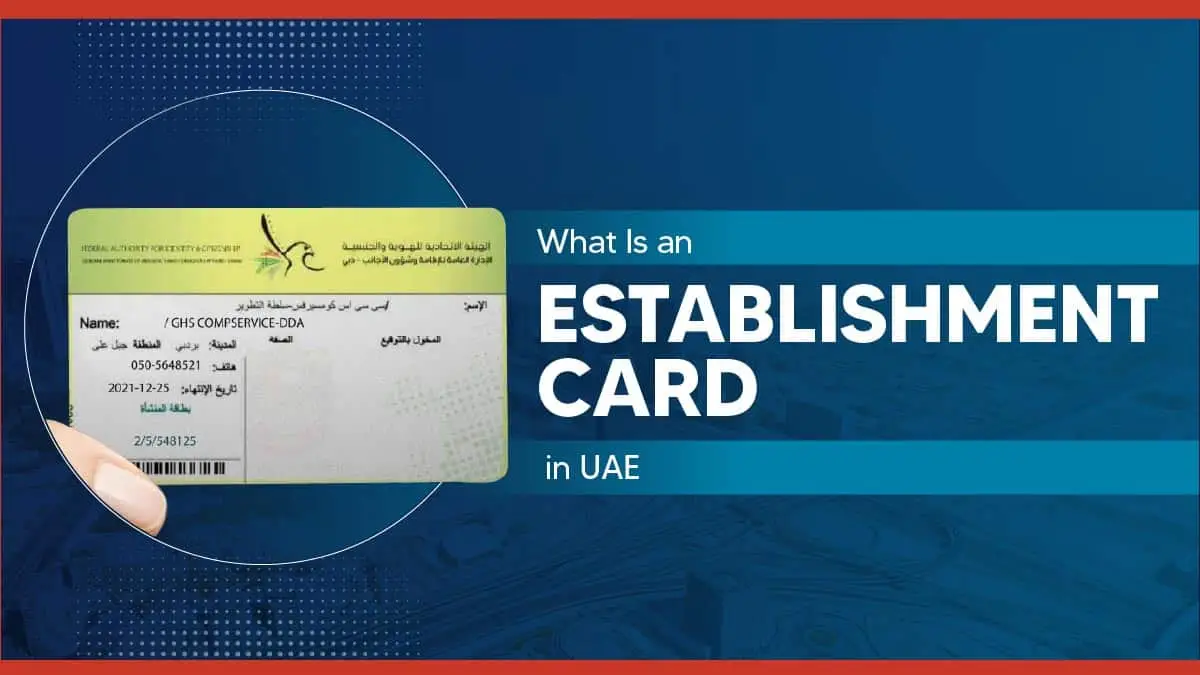
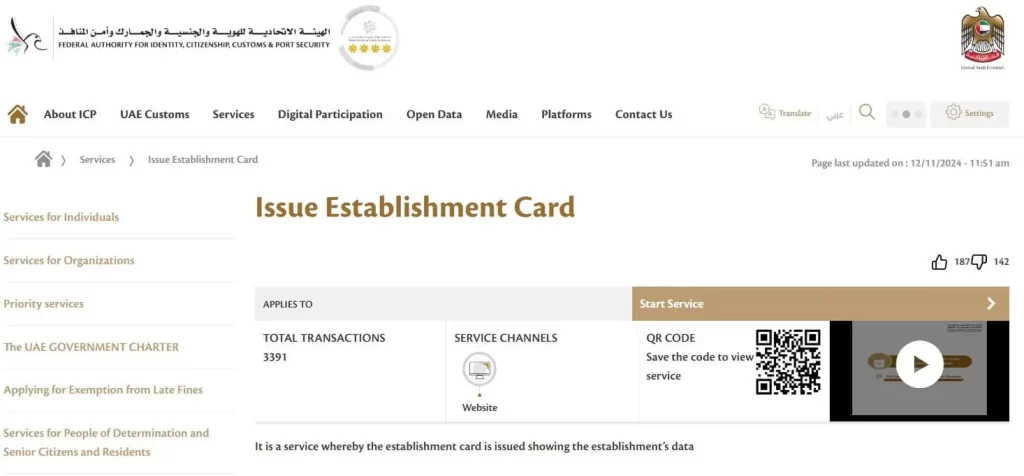
An Establishment Card is an essential document for companies operating in the UAE, particularly regarding hiring employees and managing labour relations. This establishment card in UAE is issued by the Ministry of Human Resources and Emiratisation (MOHRE) and is required for companies to legally employ workers in the country.
In this blog, we will explore everything you need to know about the establishment card in the UAE, including how to check, renew, and apply for it in Dubai.
What Is an Establishment Card?
An establishment card is a document linking a company to the UAE Ministry of Human Resources and Emiratisation (MOHRE). It is required for companies recruiting foreign workers and all businesses intending to hire employees in the UAE.
It allows the government to monitor and regulate employment practices, ensuring companies comply with the UAE’s labour laws.
What is an Establishment Card Number in UAE?
The establishment card number is a unique identifier assigned to every company registered in the UAE. This number is essential for tracking and processing employee visa applications and labour-related activities.
Dubai Establishment Card: Key Points
In Dubai, the establishment card is essential for companies to access the labour market. The card is issued to legal entities and enables them to employ staff. Whether setting up a business or already running one, obtaining a Dubai establishment card is necessary to manage labour contracts and employee visas.
Benefits of Having an Establishment Card
Legal Employment: Enables companies to hire employees legally in the UAE, ensuring compliance with labour laws.
Facilitates Visa Processing: Streamlines the process of applying for and renewing employee visas.
Access to MOHRE Services: Provides access to essential services offered by the Ministry of Human Resources and Emiratisation.
Improved Labour Relations: Helps maintain organised and transparent labour practices, fostering trust and compliance.
Business Credibility: Enhances a company’s reputation as a legitimate and compliant business entity.
Ease of Renewals and Updates: Simplifies the process of updating or renewing business-related permits and documentation.
Grace Period for Establishment Card Renewal
Companies are typically given a grace period of 30 days after the card’s expiry date to renew it. Failure to renew within this period may result in fines or legal consequences.
How to Check Establishment Card Online?
To check the status of your establishment card UAE, you can easily access the information online. Follow these simple steps:
Visit the official MOHRE website for services and resources.
Log in to your company’s account.
Navigate to the “Establishment Services” section.
Select “Check Establishment Card Status.”
Enter the required details, such as your establishment number or UID.
How to Download Establishment Card Online?
The process to download an establishment card Dubai is straightforward:
Locate your establishment card under the relevant section.
Click the “Download” option to get your establishment card in PDF format.
The card can now be printed or saved for future reference.
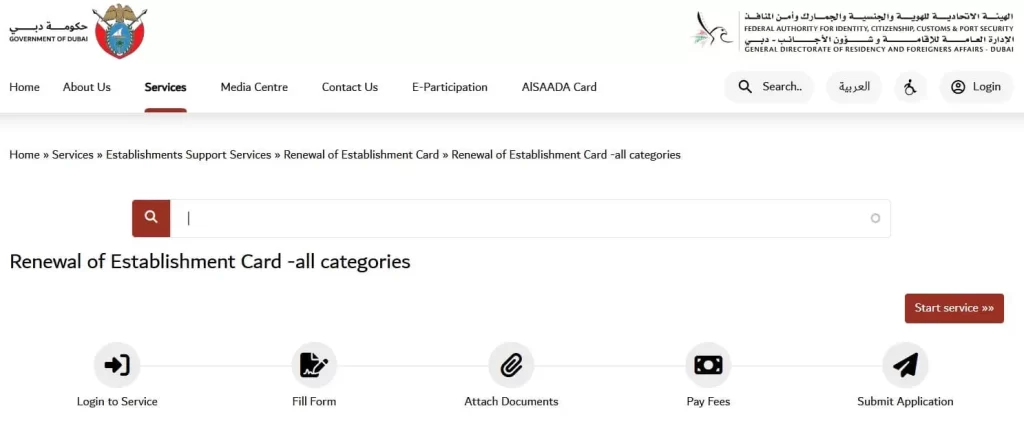
Establishment Card Renewal in Dubai
As with any official document, the establishment card renewal Dubai is essential for maintaining your company’s legal status. To avoid delays, apply for renewal before your card expires.
Establishment Card Renewal Fees Dubai
The renewal fees include:
Application Fee: AED 50 (USD 13.60)
Issuance Fee: AED 100 (USD 27)
Electronic Services Fee: AED 10 (USD 2.70)
VAT: 5%
Knowledge Dirham Fee: AED 10 (USD 2.70)
Innovation Dirham Fee: AED 10 (USD 2.70)
Expedited Service Charge (if applicable): AED 100 (USD 27)
These fees are to be paid online via credit card, and the process is efficient, allowing you to complete the transaction easily.
How to Renew Establishment Card in Dubai?
To renew your establishment card in Dubai, follow these steps:
Log in to the MOHRE portal using your company’s details.
Navigate to the “Establishment Card Services” section.
Select the “Renew Establishment Card” option.
Complete the required details and upload any necessary documents.
Pay the renewal fees, including VAT and any applicable service charges.
Upon successful payment, the card will be renewed electronically, and you will receive a notification via SMS or email.
How to Apply for an Establishment Card in Dubai?
If you are setting up a business in Dubai and need to obtain an establishment card, the application process is straightforward:
Register your company with the Department of Economic Development (DED) or relevant free zone authority.
Go to the “Labour Establishment” section and select “Apply for Establishment Card.”
Fill out the application form with all necessary details.
Submit the required documents, including the trade license and other supporting paperwork.
Pay the applicable fees online.
Upon approval, the establishment card will be issued electronically within two business days.
Common Mistakes When Applying:
Incorrect establishment details or missing documents can delay the process.
Ensure fees are paid promptly to avoid application rejection.
Importance of the Establishment Card in UAE Business Operations
In conclusion, the establishment card UAE is an essential document for businesses looking to operate and employ workers in the UAE. Whether you are applying for a new establishment card in Dubai, renewing an existing one, or checking the status of your card online, the process is straightforward and vital for staying compliant with the country’s labour laws.
Impact of Non-Compliance:
Failure to renew the establishment card can result in fines ranging from AED 500 to AED 5,000 depending on the delay and other penalties.
If you need assistance with any part of the process, don’t hesitate to contact us at +97144081900, send a WhatsApp message to +971507775554, or email us at info@shuraa.com for prompt assistance. Let us help you navigate the establishment card process efficiently.
Frequently Asked Questions (FAQs)
1. What happens if my establishment card expires?
If your establishment card expires, you may face fines and restrictions on applying for or renewing employee visas until the card is renewed.
2. Can I renew my establishment card after the grace period?
Yes, but additional fines and penalties may apply for late renewal. It’s recommended to renew the card within the grace period to avoid extra costs.
3. What is the average processing time for an establishment card?
Typically, it takes two business days to process a new establishment card or renewal, provided all documents are in order.
Disclaimer: The information in this post is for general guidance only and may change due to updates in government policies or regulations.
If you are considering building your career in Dubai, a 2-year employment visa is essential. Before relocating, it is important to understand the full application process and associated costs.
This 2026 legal guide provides detailed information on the 2-year employment visa for Dubai, including pricing, eligibility, requirements, and the application process. It covers both mainland companies and free zones to help ensure a smooth transition.
What is a 2-Year Employment Visa in Dubai?
A UAE employment visa permits foreign nationals to live and work in the country under employer sponsorship. The 2-year visa is the most common, granting work authorisation for two years and is renewable.
This visa links your residency to your employment contract and is managed by your employer throughout the application and renewal process.
Key Benefits of a Dubai Employment Visa
A 2-year employment visa offers several key benefits:
Job Security & Stability: Advance your career for two years without the need for frequent visa renewals.
Legal Residency: Live and work in Dubai with full access to resident services.
Family Sponsorship: Sponsor your spouse, children, and parents to reside with you, subject to salary requirements.
Banking and Finance: Open bank accounts and apply for loans or credit cards with a valid visa.
Travel Flexibility: Enter and exit the UAE freely throughout your visa’s validity.
Pathway to Long-Term Residency: This visa may serve as a foundation for long-term options such as the Golden Visa.
Key Requirements for UAE Employment Visa
Passport: A copy of your passport with at least six months of validity.
Job Offer/Contract: A signed and official job offer letter approved by MOHRE.
Qualifications: Attested educational certificates relevant to the position, typically required for higher-skilled roles.
Medical Fitness: A passing medical report from a government-approved health centre in the UAE, including tests for HIV, TB, and other conditions.
Photographs: Recent passport-sized colour photographs with a white background.
Age: Applicants are generally required to be between 18 and 65 years olHealth
Insurance: Valid health insurance (DHA-approved if applying in Dubai).
2026 Dubai 2-Year Employment Visa Pricing
The cost of a 2-year Dubai employment visa ranges from approximately AED 3,000* to AED 15,000*. Employers are legally required to cover most fees, including the work permit, medical test, and Emirates ID. Total costs may vary depending on typing, insurance, and government service charges.
Cost Breakdown (Standard Case):
Fee Component
Approximate Cost (AED)*
Notes
MOHRE Fees
2,000 – 3,000
Includes work permit issuance and quota approval.
Entry Permit
500 – 1,000
Medical Fitness Test
500 – 800
Mandatory for all applicants.
Emirates ID
370 – 570
Cost depends on validity period.
Residence Visa Stamping
500 – 1,000
Health Insurance
1,000 – 2,000
Varies significantly by coverage. Often paid by employer.
Estimated Total Cost
~AED 3,000 – 15,000
Starting from ~AED 3,000
Note: The figures shown reflect standard government fees. Additional service charges may apply if you use a typing centre or business setup consultant.
Understanding the ‘Azad Visa’ and Its Risks
An “Azad visa” is not a recognised or legal visa category in the UAE. It refers to an illegal, unregulated arrangement, often involving other countries, in which individuals obtain residency permits without a legitimate employment relationship with a sponsor.
Important Legal Notice: Using this arrangement to live or work in Dubai is a serious offence. UAE authorities strictly prohibit this practice and impose severe penalties, including fines up to AED 50,000, deportation, and a long-term re-entry ban. To work legally in Dubai, you must obtain an employment visa sponsored by a licensed UAE company.
Types of Employment Visas in the UAE
Standard Employment Visa (2 Years): The most widely issued visa, sponsored by a mainland or free zone employer.
Green Visa (5 Years): A self-sponsored visa for skilled professionals, freelancers, and investors that provides greater employment flexibility.
Golden Visa (5 or 10 Years): A long-term, self-sponsored residency available to investors, exceptional talents, and outstanding students.
Temporary Work Permit: Issued for short-term contracts or project-based assignments.
Mainland vs Free Zone Visa: Key Differences
Your choice between a mainland or free zone company will directly affect your visa conditions and career flexibility. The following comparison outlines the main differences:
Feature
Mainland Company Visa
Free Zone Company Visa
Sponsorship
Sponsored directly by the employer.
Sponsored by the Free Zone Authority.
Job Mobility
Can work for any mainland employer in the UAE.
Typically restricted to working within the sponsoring free zone.
Cost
Generally has a higher employment visa cost due to additional MOHRE fees.
Often more cost-effective with streamlined fee structures.
Processing Time
Can take longer (2-4 weeks) due to MOHRE procedures.
Often faster (1-3 weeks) due to centralized authority.
Family Sponsorship
Standard rules apply (min. salary AED 4,000 or AED 3,000 + accommodation).
Same rules, but some free zones may have specific requirements.
Dubai Work Visa Eligibility Criteria
To qualify for a 2-year employment visa in Dubai, you must generally meet these criteria:
A Valid Job Offer: From a UAE-licensed company.
Educational Qualifications: A minimum of a high school diploma is often required. Higher qualifications can place you in a better category.
Age: Must be at least 18 years old.
Professional Fit: Your job role must align with the company’s licensed activities.
Step-by-Step Guide to Getting Your 2-Year Employment Visa
Job Offer & Contract: Obtain a job offer and sign your employment contract.
Entry Permit Application: Your employer will apply for and obtain your entry permit.
Enter the UAE: Arrive in Dubai using your entry permit.
Medical Fitness Test: Complete the required medical examination at an approved health centre. This test screens for communicable diseases, including Tuberculosis (TB) and HIV/AIDS. You must pass this test to continue your residence visa application.
Emirates ID Application: Submit your biometrics and complete the application process.
Visa Stamping: Your residence visa will be stamped in your passport.
Receive Emirates ID: Your ID card will be delivered, completing your residency process.
Required Documents for Dubai Employment Visa
To apply for a 2-year employment visa in Dubai, the following documents are typically required:
Employer documents: valid trade license, previous visa cancellation (if applicable), and No Objection Certificate (NOC).
5 Common Visa Application Mistakes (And How to Avoid Them)
Even a minor error can delay your two-year Dubai employment visa by several weeks. Below are the most common mistakes to avoid:
1. Incomplete Document Attestation
The Mistake: Submitting educational certificates that are not properly attested by the UAE Embassy in your home country and the Ministry of Foreign Affairs in the UAE.
How to Avoid: Begin the attestation process early using official channels or a trusted service provider.
2. Medical Test at Non-Approved Centres
The Mistake: Taking the medical fitness test at a clinic that is not authorised by the UAE government.
How to Avoid: Consult your employer for guidance to a government-approved health centre, such as an Amer or Tasheel centre.
3. Unresolved Previous Visa Cancellation
The Mistake: Applying for a new visa before your old UAE residence visa and Emirates ID have been officially cancelled.
How to Avoid: Obtain an official visa cancellation document from your previous employer before applying.
4. Incorrect Photograph Specifications
The Mistake: Using passport photos with a colored background, that are outdated, or do not meet the strict size requirements.
How to Avoid: Have new photos taken at a professional studio in Dubai that follows UAE visa requirements, including recent images, a white background, and specific dimensions.
Frequently Asked Questions (FAQs)
1. What is the total cost for a 2-year employment visa in Dubai?
The cost for a 2-year Dubai residence visa typically starts at AED 6,000*. This includes government fees, medical testing, Emirates ID, and insurance. For a detailed breakdown, please contact our experts.
2. How long does it take to get a 2-year Dubai work visa?
Processing a 2-year Dubai work visa usually takes 2 to 3 weeks from application to issuance, assuming all documents are complete.
3. What is the difference between a mainland and a free zone employment visa?
A mainland visa allows employment with any UAE mainland employer, while a free zone visa limits you to work within that specific free zone. The application process and governing authorities differ for each.
4. Can I sponsor my family on a 2-year employment visa?
Yes, you can sponsor your spouse and children if you meet the minimum salary requirement, typically AED 4,000 or AED 3,000 with accommodation.
5. What is an ‘Azad Visa’ in Dubai, and its cost?
An ‘Azad Visa’ or ‘free visa’ is an illegal arrangement where a sponsor issues a residency visa without real employment. It provides no labour law protection and can lead to severe penalties. We strongly advise obtaining employment visas only through legitimate companies.
6. How can I apply for the 2 years employment visa in Dubai online?
You can apply for a 2-year Dubai employment visa online through official UAE government portals or authorised service providers. The process includes submitting documents, completing the application, and paying the required fees.
7. Can I transfer my 2-year employment visa from a free zone to a mainland company in Dubai?
Yes, you can transfer your employment visa, but this requires approval from both employers and the relevant authorities. Because regulations differ between free zones and mainland companies, we recommend consulting an expert.
8. What happens if I lose my job during my visa validity?
If you lose your job, your employer will cancel your work permit and residence visa. You will then have a grace period to find new employment or exit the country.
For standard employment visas: The grace period is 30 days from the date of cancellation.
For Green Visa and Golden Visa holders: The grace period is 90 days from the date of cancellation.
It is important to act within this period, as overstaying will result in daily fines.
9. Can I work part-time on my employment visa?
No, a standard 2-year employment visa does not allow part-time work. You are legally required to work only for your sponsoring employer. To take on additional work, you must obtain a separate freelance or part-time work permit, each with specific eligibility criteria.
10. How to check my visa status online?
You can check your visa status and validity online through the official portals of the following authorities:
Federal Authority for Identity, Citizenship, Customs & Ports Security (ICP) for residence visas.
The relevant Free Zone Authority’s portal if you are under a free zone.
You will need your passport number and either your date of birth or application number.
11. What are the consequences of overstaying my visa?
Overstaying your UAE visa is a serious offence. Consequences include:
Accumulating fines (currently AED 50 per day for first-time offenders after the grace period).
Travel bans that prevent you from re-entering the UAE.
Potential legal action and detention.
Difficulty obtaining future UAE visas. It is crucial to regularise your status before your visa expires.
Conclusion: Your Trusted Partner for a SeamlessVisa Process
Navigating the two-year Dubai employment visa process can be complex, but you do not have to manage it alone. Understanding the requirements and costs is the first step toward building your career in the UAE.
Allow Shuraa Business Setup to manage the process for you. We streamline each step to ensure your application is compliant and efficient. Our experts handle everything from document preparation to coordination with government authorities.
Contact Shuraa today to schedule a free consultation.
Disclaimer: The information in this post is for general guidance only. Costs, processes, and requirements are subject to change in response to updates from the UAE government authorities. Always consult an official expert, such as Shuraa Business Setup, for the most current and accurate advice.
Dubai’s advertising sector is evolving quickly, presenting strong opportunities for entrepreneurs to establish agencies in a competitive market. With the industry expected to surpass $1.1 billion and continue growing, now is an ideal time to obtain your advertising agency license and position your business for success.
Understanding Dubai’s 2026 Advertising Ecosystem
Dubai’s advertising market supports both traditional and digital agencies. With over 99% internet penetration and a diverse population of more than 3.5 million, agencies can create campaigns that reach a wide range of audiences using advanced digital platforms.
Dubai’s business-friendly environment, including 0% corporate tax (outside new thresholds) and no personal income tax, supports agency growth and profitability. The SME ecosystem, representing over 90% of businesses, offers a consistent client base for branding and marketing services.
License Types: Choosing Your Path to Market Access
Mainland Advertising License
A mainland license permits unrestricted operations across Dubai and the UAE. It is suitable for agencies serving local clients, bidding for government contracts, or establishing multiple locations. Key advantages include:
Unrestricted market access across all seven emirates
Ability to conduct business with both government and private sector clients
Option to open multiple branches throughout the UAE
No limitations on the number of client contracts or project types
Free Zone Advertising License
Free zones provide specialised environments for agencies focused on digital services, international clients, or niche markets. They offer 100% foreign ownership with no local sponsor required. Key free zones for advertising agencies include:
Dubai Media City: Tailored for media, advertising, and creative businesses with premium facilities and networking opportunities
Dubai Internet City: Ideal for digital marketing, tech-driven campaigns, and e-commerce advertising specialists
Choose between the mainland and free zone based on your target clients, ownership goals, and expansion plans. The mainland is best for agencies seeking full UAE access, while free zones suit digital-focused agencies with international clients.
Advertising Agency Licensing Process Steps for 2026
1. Jurisdiction Selection and Strategic Planning
Start by determining whether a mainland or free zone setup aligns with your business objectives. Consider client locations, team visa needs, and long-term growth plans. This decision shapes all subsequent steps in setting up your agency.
2. Trade Name Reservation and Approval
Choose a unique name that reflects your agency’s brand and complies with UAE naming rules. Avoid offensive terms, religious references, or implied government links. Submit your chosen name to the DET (for mainland) or the relevant free zone authority.
3. Initial Approvals and Documentation
Obtain initial approval from the relevant authority (the DET for the mainland, the free zone authority otherwise). This confirms your business activity is permitted and allows you to proceed with office space and other requirements. Prepare the following documents:
Passport copies of all shareholders and managers
Proposed business plan outlining services
Proof of address for all partners
Professional credentials (especially important for specialised advertising services)
4. Office Space Acquisition and Ejari Registration
Obtain office space that meets your jurisdiction’s requirements. For mainland setups, register your tenancy contract through the Ejari system. Free zones offer flexible options, including shared offices, coworking spaces, and private offices, to suit your agency’s needs.
5. License Application and Specialised Approvals
Submit your complete application package to the relevant authority. Depending on your specific advertising services, you may require additional approvals from:
National Media Council (NMC): For content creation, media planning, and broadcasting-related advertising services
Dubai Municipality: For agencies offering outdoor advertising, billboards, or public space activations
Roads and Transport Authority (RTA): For advertisements on public transportation, taxis, or roadside displays
Telecommunications and Digital Government Regulatory Authority (TDRA): For digital advertising and online campaign regulations
6. Final Payment and License Collection
After approval, pay the required fees and collect your official advertising agency license. Display this document prominently in your office as proof of authorisation.
7. Post-Licensing Requirements
Once you receive your license, complete these essential steps:
Register with the Ministry of Human Resources and Emiratisation (MOHRE) if hiring staff
Secure necessary insurance policies for your business and employees
Documents Required for Your Advertising Agency License in Dubai
To obtain your advertising agency license, you must submit a complete set of documents. Requirements may differ based on your choice of Mainland or Free Zone setup and whether you apply as an individual or a company. The following is a standard checklist:
Document Type
Description & Notes
Typically Required For
Application Forms
Completed and signed official forms from the DET (Mainland) or the specific Free Zone Authority.
All Applicants
Passport Copies
Clear, colored copies of the passports for all shareholders and managers. Must be valid for at least 6 months.
All Applicants
Passport-Sized Photographs
Recent photographs with a white background for all shareholders and managers.
All Applicants
Visa Copies
Copy of UAE entry visa or residence visa (if already residing in the UAE). If applying from abroad, this will be processed after initial approval.
All Applicants (if applicable)
Initial Approval Certificate
The official document granted after your initial application and trade name reservation are accepted.
All Applicants
Trade Name Reservation Certificate
Proof that your chosen company name has been approved and reserved.
A legally attested lease agreement for your physical office space. For Mainland, it must be registered via the Ejari system.
All Applicants
Memorandum of Association (MOA) / Local Service Agent (LSA) Agreement
For Mainland: MOA outlines company structure. An LSA agreement is needed if a local partner is involved. For Free Zone: Usually not required, as the authority acts as the registrar.
A detailed plan outlining your agency’s services, target market, and financial projections. Often required for Free Zone applications and bank account opening.
Often Required
Educational/Professional Certificates
Copies of degrees or professional credentials, especially relevant for specialized advertising services.
Recommended
Important Note: This checklist is general. Please confirm the specific requirements with your licensing authority (DET or Free Zone) or business setup consultant, as regulations may change.
Pro Tip: Before submission, ensure all documents are clear, valid, and, if required, translated into Arabic by a certified translator and notarised. Having a consultant, such as Shuraa Business Setup, review your documents can help prevent delays due to incomplete or incorrect paperwork.
2026 Advertising Agency License Cost Breakdown
The cost of an advertising agency license in Dubai varies by jurisdiction, office location, and services offered. Below is a breakdown of expected expenses:
Cost Component
Mainland (Approx. AED)
Free Zone (Approx. AED)
Notes
Trade Name Registration
500 – 1,000
500 – 1,500
Varies by name complexity
Initial Approval Fees
1,000 – 2,000
1,000 – 3,000
Depends on authority
License Issuance
10,000 – 15,000
7,500 – 20,000
Free zone costs vary by location
Office Space (Annual)
30,000 – 100,000+
15,000 – 75,000
Size and location dependent
Ejari Registration
215
Usually included
Mandatory for mainland
Additional Approvals
2,000 – 10,000
1,000 – 5,000
NMC, RTA, etc. as needed
Investor Visa
4,000 – 6,000
3,000 – 5,000
Includes medical, Emirates ID
PRO Services
3,000 – 8,000
2,000 – 6,000
Optional but recommended
Total Estimated Cost
50,715 – 142,215+
30,000 – 115,500+
Excluding office deposits
You can reduce advertising agency license costs in the UAE by using the following strategies:
Selecting cost-effective free zones like IFZA for startups
Utilising flexi-desk or shared office solutions initially
Bundling services through experienced setup consultants
Phasing additional service approvals as your agency grows
Note: The costs provided are for reference only. For exact pricing, please use our cost calculator.
Specialised Considerations for 2026 Operations
Digital Advertising Compliance
As regulations for digital spaces increase, ensure your agency complies with:
Data protection regulations governing client information and campaign analytics
Digital advertising standards for social media, influencers, and online content
E-commerce advertising guidelines for product promotions and online sales funnels
Cultural Sensitivities and Localisation
To succeed in Dubai’s multicultural market, ensure your campaigns include:
Understanding of religious observances and cultural events when planning campaign calendars
Multilingual capabilities to reach diverse audience segments effectively
Awareness of content restrictions regarding imagery, messaging, and endorsements
Emerging Technology Integration
Strengthen your agency’s competitive position by incorporating:
AI-driven campaign optimisation tools and analytics platforms
Immersive advertising formats, including AR/VR experiences
Programmatic advertising capabilities for automated media buying
Navigating Common Setup Challenges
Physical Office Requirements
A physical office is still required for advertising agency licensing in Dubai, though flexible solutions are available:
Mainland businesses can utilise business centres with registered addresses
Free zones offer cost-effective “flexi-desk” arrangements with meeting room access
Some jurisdictions permit home offices for specific license types (verify current regulations)
Freelance Alternatives
Solo practitioners can obtain freelance permits in free zones such as Dubai Media City and Dubai Design District. These permits allow you to offer advertising services legally without forming a full company, though they limit employee hiring and some client engagements.
Ongoing Compliance
Maintaining your license requires:
Annual renewal with updated documentation
Timely renewal of employee visas and related documents
Adherence to changing advertising regulations and content guidelines
Proper financial record-keeping for potential audits
Start Your Agency with Top-Rated Business Setup Firm in the UAE
While you can manage the licensing process independently, partnering with a consultancy like Shuraa Business Setup, with over 26 years of local expertise and a proven track record of having successfully formed over 100,000 businesses in the UAE, offers significant advantages.
Our deep knowledge ensures a seamless, error-free setup from navigating approvals to securing your ideal office space.
Navigating complex approval processes across multiple government departments
Avoiding costly mistakes in documentation or procedural missteps
Securing optimal office spaces within approved budgetary parameters
Expediting visa processing for you and your team
Providing ongoing compliance support as regulations evolve
Their expertise is especially helpful when securing specialised approvals from entities such as the National Media Council or RTA, which have specific requirements for advertising businesses.
Your Next Steps Toward Agency Ownership
Dubai’s advertising market offers strong opportunities for agencies that combine creativity with strategic market insight. The licensing process is detailed but follows a clear path that many entrepreneurs navigate successfully each year successfully.
When preparing to start an advertising agency in Dubai, develop a comprehensive business plan that addresses:
Your specific service offerings and competitive differentiation
Target client segments and acquisition strategies
Financial projections accounting for all licensing and operational costs
Team structure and talent acquisition plans
Compliance frameworks for your specific advertising activities
With careful planning and execution, your agency can become part of Dubai’s creative ecosystem, helping brands connect with audiences in a leading global market.
If you are ready to launch your advertising agency, Shuraa Business Setup can help streamline the licensing process. Contact them at +971 4 4081900, WhatsApp +971 50 7775554, or info@shuraa.com to get started.
Dubai is one of the top places in the world for starting a business, attracting entrepreneurs globally. If you’re thinking about starting your own business here, one of the first questions you’ll likely have is: ‘What is the minimum investment to start a business in Dubai?’
Understanding the minimum investment in Dubai is essential for budget planning and avoiding surprise costs. The amount you’ll need depends on factors like the type of business, setup location (Mainland, Free Zone, or Offshore), office space requirements, and visas for yourself and employees.
But don’t worry – we’ll break down the key factors that affect minimum investment to start business in Dubai, so you can have a clear idea based on your budget and goals.
Minimum Investment to Start a Business in Dubai
The minimum investment to start a business in Dubai typically ranges from AED 50,000 to AED 300,000 or more depending on the type of business and the location you choose. This investment covers essential costs like business licensing, office space, and government fees.
The DED typically requires AED 300,000 in capital for most businesses, though some sectors have lower entry requirements, making them suitable for small investments.
Dubai’s Free Zones provide a more affordable, simplified approach to business setup. You can establish a business with a minimum investment as low as AED 10,000, a popular option for startups seeking to minimize costs.
Factors Affecting the Minimum Investment
Several factors influence the minimum investment to start a business in Dubai:
1. Type of Business Activity
Industry choice, like trading, consultancy, or manufacturing, can impact costs. Some activities may need more capital or special permits.
2. Business Location (Mainland vs. Free Zone)
Mainland setups often require higher investments due to office space and local sponsorship fees. In contrast, Free Zones offer more cost-effective options for those who don’t need a large office or local market presence.
3. Office Space Requirements
Choosing between physical, shared, or virtual office spaces affects costs. Free Zones offer flexible office packages that are often more budget-friendly.
4. Visa and Residency Costs
The number of investor and employee visas needed will add to the total minimum investment in Dubai. Mainland setups might have higher visa costs than Free Zone setups.
5. Government Fees and Documentation
Government fees for business licensing and permits vary based on jurisdiction and business activity.
Minimum Investment for a Mainland Business Setup in Dubai
Setting up a mainland business in Dubai offers the flexibility to operate across the UAE market. This setup is ideal for businesses aiming to trade directly within the UAE. The minimum investment to start a business in Dubai mainland ranges from AED 50,000 to AED 300,000 or more, depending on your industry.
Business Setup Process in Dubai Mainland
Here’s a step-by-step process for setting up a business in Dubai mainland:
Determine Business Activity: Identify the nature of your business to ascertain the appropriate license type.
Secure Office Space: Lease physical office space, as it’s mandatory for mainland companies.
Final License Issuance: Submit all documents to the DED and pay the necessary fees to obtain the trade license.
Cost Breakdown for Mainland Business Setup
Trade License: The cost of acquiring a business license will depend on the business activity and jurisdiction. A standard business license in Dubai Mainland usually starts from AED 18,500.
Office Space Rental: Annual rents can vary widely depending on location and size, starting from AED 15,000 for a small office.
Registration and Documentation: Other costs include registration with the DED, notarization of documents, and attestation fees, which can total between AED 5,000 to AED 10,000 depending on the specifics of your business structure.
Employee Visas and Insurance: Visa costs for employees and shareholders are an additional investment. Each visa could cost around AED 3,000 to AED 5,000, and mandatory health insurance also needs to be considered.
The minimum investment to start a business in Dubai for foreigners varies significantly based on the industry and the scale of the operation. For instance, consultancy and professional services businesses generally have lower overheads, with minimum investments ranging from AED 30,000 to AED 50,000, while establishing a retail shop or trading company can be more expensive due to the need for commercial space and inventory.
Minimum Investment for a Free Zone Business Setup in Dubai
Dubai’s free zones provide an excellent opportunity for entrepreneurs who want a cost-effective and flexible way to start their business. One of the biggest advantages of setting up a business in a free zone is the relatively low cost of entry.
The application fees begin at around AED 5,000. The minimum investment for a free zone setup can be as low as AED 10,000, and it can go up to AED 50,000 or more based on your office needs, the number of visas required, and the type of trade license.
Free zone companies benefit from 0% corporate and personal income tax for a specified period (usually renewable) and 0% import and export duties within the free zone.
Cost Breakdown and Minimum Investment for Free Zone Setup
The cost to set up a business in a Dubai free zone varies depending on factors like the location, type of license, and the business package chosen. However, the overall costs for free zone business setups are generally lower than mainland businesses.
License Fees: The cost of obtaining a business license in a free zone can range from AED 10,000 to AED 30,000. The exact fee depends on the business activity and the specific free zone.
Office Space: While free zones offer flexible office solutions, the costs vary. Flexi-desks (shared office spaces) start at around AED 10,000 annually, while private offices can range from AED 15,000 to AED 50,000 or more.
Registration Fees: Depending on the free zone, registration fees typically range from AED 5,000 to AED 15,000.
Visa Costs: Each visa in a free zone cost approximately AED 3,000 to AED 5,000, including processing fees. Free zones often offer packages that include a set number of visas.
Additional Costs: Businesses should also account for other expenses such as document attestation, health insurance, and legal translation, which can add AED 3,000 to AED 5,000 to the total setup cost.
Many Free zones in Dubai such as IFZA, DMCC, and DIFC offer various startup packages designed to cater to entrepreneurs, small businesses, and freelancers. These packages provide cost-effective options, particularly for businesses looking to minimize initial investments.
Minimum Investment for an Offshore Business Setup in Dubai
Establishing an offshore company in Dubai offers a cost-effective and flexible solution for international business operations such as trading and holding assets like real estate or intellectual property. The minimum investment required to set up an offshore company in Dubai typically starts at around AED 12,500 and can vary based on specific requirements and additional services needed.
It’s also essential to note that offshore companies in Dubai are not permitted to conduct business within the UAE
How to Choose the Right Setup Based on Your Budget
Choosing the right business setup in Dubai requires careful consideration of your investment capacity and business goals.
1. Assess Your Investment Capacity
Before diving into the various business setup options, take a moment to evaluate your financial resources. Consider how much capital you can allocate to starting your business, factoring in initial setup costs, operational expenses, and unforeseen costs.
2. Understand the Types of Business Setups
If you are willing to invest between AED 50,000 to AED 300,000 or more, a mainland business setup might be suitable for you.
For those with a lower budget, free zones offer a more cost-effective solution, starting with investments as low as AED 10,000. This option is ideal for startups and small businesses that focus on international trade or services.
If your goal is asset protection or international trading, an offshore setup can be initiated with a minimum investment of around AED 12,500.
3. Match Your Business Type to Your Setup
Consider the nature of your business and its operational needs when choosing a setup. For example:
A mainland setup is ideal if you plan to engage directly with customers in Dubai.
A free zone setup may be more advantageous, offering benefits like tax exemptions and flexibility in operations.
4. Analyze the Potential for Return on Investment (ROI)
Before making a final decision, consider the potential ROI of your chosen business setup. Assess how quickly you expect to break even and start generating profit.
5. Consult a Business Setup Expert
Understanding the business setup process in Dubai can be complex due to regulatory requirements and the variety of options available. Consulting with business setup experts like Shuraa can provide valuable insights and guidance tailored to your specific needs. A professional can help assess your financial situation and guide you towards budget-friendly business setup in Dubai.
How Shuraa Can Help Reduce the Cost of Starting a Business in Dubai?
The minimum investment to start a business in Dubai doesn’t have to be overwhelming or excessively costly. With Shuraa’s help, you can access a wide range of services that make the setup process easier and more affordable. Our packages are tailored to fit different budgets, so you get the right support without any hidden fees or surprises.
From registering your company and getting the necessary licenses to finding flexible office spaces and handling visa applications, our team is here to guide you at every step. We also share useful tips on how to save money, helping you use your resources wisely to build a strong business.
If you’re ready to start your business and make your dreams come true, contact our business setup expert today at +971 4 4081900, WhatsApp at +971 50 7775554, or info@shuraa.com for a personalized consultation. Together, we can create a plan for your business success and get you off to a great start.
The UAE Golden Visa is more than just a residency permit; it’s a gateway to an elevated lifestyle and endless possibilities in the UAE. This prestigious visa is designed for investors, exceptional talents, and high-achieving individuals, opening doors to career growth and business expansion.
Furthermore, from world-class healthcare and education to exclusive networking opportunities. The UAE Golden Visa immerses you in the country’s booming and progressive environment.
An important fact about the UAE Golden Visa is that it grants long-term residency for up to 10 years and allows holders to live, work, and study in the UAE without needing a national sponsor.
As a result, this provides unparalleled stability and freedom. Making it desirable for investors, professionals, and families seeking long-term opportunities in the UAE.
In this blog, we will guide you through the UAE golden visa; continue to read more about it.
What is the UAE Golden Visa?
The UAE Golden Visa is a long-term residence visa introduced in 2019. It is designed for investors, skilled professionals, scientists, and students. This visa allows you to live, work, and study in the UAE for 10 years, and you don’t need a local sponsor.
Additionally, Golden Visa holders can bring their family members, including spouses, parents, and children. However, this visa aims to attract talented individuals and investors, particularly to vibrant cities like Dubai.
In short, the UAE Golden Visa offers long-term stability and a range of opportunities in the UAE. Keep reading to learn more about the eligibility criteria and benefits.
Benefits of UAE Golden Visa
The UAE Golden Visa offers a range of various benefits. It helps individuals and families experience long-term residency and opportunities in the UAE.
Long-Term Residency: Enjoy a residency period of 10 years, with the option for renewal, providing long-term stability in the UAE.
No Local Sponsor Required: Unlike other visas, the Golden Visa does not require a local sponsor, simplifying the application process.
Family Sponsorship: Bring your family members, including spouses, parents, and children, to live with you in the UAE.
Business Opportunities: Gain access to a growing business environment with opportunities for entrepreneurship and investment.
Education and Healthcare: Benefit from world-class education and healthcare services available in the UAE.
Ease of Travel: Travel in and out of the UAE without restrictions, making managing your international business and personal commitments easier.
Pathway to Citizenship: Although not a direct path to citizenship, holding a Golden Visa can enhance your chances of securing other residency or citizenship options in the future.
Who Is Eligible to Apply for a UAE Golden Visa?
The following individuals are eligible to apply for a UAE Golden Visa:
Real estate Investors
Entrepreneurs
Researchers and Specialised Talents
Highly Talented Students
Executives and C-suite employees
These categories highlight the UAE’s commitment to attracting top talent and fostering innovation across multiple sectors.
UAE Golden Visa Requirements
The UAE Golden Visa is available for several categories including chief executives, entrepreneurs, investors, eminent students, and scientists.
Real estate Investors
Invest at least AED 2 million in a UAE-based investment fund or national bank or real estate.
Forming a company in the UAE with a minimum capital of AED 2 million.
Minimum investment parameters start from AED 1 million.
Own a company that contributes at least AED 250,000 annually in taxes to the UAE government.
Entrepreneurs
Own an innovative business project valued at least AED 500,000.
Obtain approval letters from a UAE auditor, relevant authorities, and a qualified business incubator.
Other Eligible Individuals
Medical professionals, specialists, and researchers in critical fields may apply based on their qualifications and experience.
High-achieving students from UAE universities or internationally recognised institutions may be eligible.
5-years visa is only applicable for retirees in UAE with property over 1 million worth.
Apply for a Golden Visa in the UAE
Before applying for the Dubai Golden Visa, check your eligibility. Here’s a step-by-step guide to start your application:
Visit the Official Website: Go to the official website of the Dubai government.
Select Services: Click on the “Services” option on the homepage.
Choose eChannels Residency and Citizenship: In the drop-down menu, select “eChannels Residency and Citizenship.”
Access Smart Services: You’ll be redirected to the ‘Browse Smart Service’ page.
Select Golden Residency: Click on the “Golden Residency” option.
Pick Your Visa Type: Scroll down and select the Golden Visa service you want to apply for.
Start Your Application: Click “Start Service” to start your application process.
The application process involves several steps:
Fill in Personal Information: Enter your details accurately.
Attach Documents: Upload all required documents.
Review Your Application: Check your application for errors or missing information.
Pay Application Fees: Complete your application by paying the necessary fees.
Documents required for a UAE Golden Visa Application
When applying for a UAE Golden Visa, prepare the following documents:
Passport Copies
Previous UAE Visas
Photographs
Proof of Eligibility
Financial Statements
Health Insurance
Residence Verification
Police Clearance
Note: Additional documents may be requested based on your specific circumstances and category.
How do you apply for a UAE Golden Visa Online via ICA?
Applying for a UAE Golden Visa online through the ICA is a straightforward process to streamline your path to long-term residency.
Select Service: Choose ‘Golden Visa’ under ‘Public Services’ and then select ‘Visa to Finalise the Procedures of Golden Residency.’
Submit Information: Provide the required details and upload documents.
Pay Service Charge: Complete the payment and await approval.
Note: If applying from outside the UAE, you will receive an entry permit valid for 6 months, extendable for another 6 months, to finalise your Golden Residency.
How do you apply for a UAE Golden Visa Online via GDRFA?
Applying for a UAE Golden Visa online through the GDRFA is a simple and efficient process to secure long-term residency in Dubai.
Visit the GDRFA Dubai Website: Access the official GDRFA Dubai website.
Choose Service: Go to the Golden Visa section and select ‘Investor Residency Visa (Golden Visa).’
Start Your Application: Click ‘Start Service’ and log in. Submit the required information and upload your documents.
Complete Payment: Pay the service charge. The authority will review your application and inform you of the next steps.
Cost of a UAE Golden Visa
A 10-years UAE Golden Visa costs range from AED 2800* to 4800*. However, the overall cost will depend upon the place of application (inside or outside of UAE), medical test cost, emirates ID fees etc.
UAE Golden Visa Restrictions
Securing a UAE Golden Visa is selective and needs to be more straightforward. It’s available to investors, entrepreneurs, individuals with exceptional talents, medical professionals, and top students. Here are the main restrictions:
Property Investment: A minimum of AED 2 million is required for investors.
Entrepreneurs: Must have at least AED 500,000 in capital.
Students: High school students need a minimum of 95%, and graduates must have a GPA of 3.75 or higher.
Health Insurance: Mandatory for all applicants.
Educators: Must have approval and a performance certificate from their educational institution.
Note: Applications can be made online, but approval is not guaranteed.
How Shuraa Business Setup Can Help You Get Your UAE Golden Visa
The UAE Golden Visa is your gateway to a prosperous life and opportunities in the UAE. This prestigious visa, available for up to 10 years, offers long-term residency without needing a local sponsor.
It’s designed for investors, exceptional talents, and high-achieving individuals, providing access to world-class amenities, business prospects, and more.
Shuraa Business Setup simplifies the Golden Visa process for you. We guide you through every step, from checking your eligibility to handling paperwork.
With our expertise, you can focus on your new opportunities in the UAE while we manage the complexities of obtaining your Golden Visa.
Visit the official website to track your Golden Visa Dubai application status after submission.
2. What is the Processing Time for a UAE Golden Visa?
Processing typically takes a few weeks to a month to get a UAE Golden Visa.
3. Can Film Stars Obtain a UAE Golden Visa?
Yes, film stars can get a UAE Golden Visa under the ‘Persons with Specialized Talents’ category, provided they have accreditation from the Ministry of Culture and Youth.
Disclaimer: The information in this post is for general guidance only and may change due to updates in government policies or regulations.
Starting a bed space business in Dubai may sound like a profitable idea in the city’s booming real estate market. With a growing population and a constant influx of expatriates and job seekers, Dubai continues to demand affordable and convenient accommodation solutions. Unsurprisingly, this topic sees high interest among expats and budget-conscious residents.
But here’s the deal—bed space or separate partitioning of flats is illegal in Dubai. Authorities actively monitor and penalise such setups. If you’re considering entering this market, it’s crucial to understand the legal implications and explore safer, compliant alternatives.
This blog is for educational purposes only and aims to inform investors and property owners about the risks associated with the bed space rental business in Dubai, along with compliant ways to benefit from the real estate market.
Understanding Bed Space Businesses in Dubai
A bed space business involves renting out individual sleeping areas within a shared room, often divided into small sections or separate partitions. These spaces are typically compact—sometimes as little as 1.6 square meters—and come with shared bathrooms and kitchens.
While they provide low-cost housing for blue-collar workers, such partition businesses in Dubai violate local housing and safety regulations. These setups are commonly found in older buildings, labour accommodation areas, or residential apartments not zoned for such high-density use.
Is Bed Space Business Legal in Dubai?
No, the bed space business, when done through partitioning residential flats, is not legal in Dubai.
Partitioning or modifying a residential unit to accommodate multiple tenants in violation of the property’s approved floor plan is strictly prohibited under the Real Estate Regulatory Agency (RERA) and Dubai Municipality regulations.
The following actions are considered illegal:
Creating separate partitions within residential flats to house multiple individuals.
Renting out bed spaces without landlord approval and Ejari registration.
Exceed the maximum number of occupants allowed per unit.
Legal Risks and Penalties of Partition Businesses in Dubai
Running an illegal bed space rental business in Dubai comes with serious risks:
Hefty Fines: Authorities can impose fines ranging from AED 10,000 to AED 100,000, depending on the severity of the violation.
Eviction Orders: Tenants and landlords may be subject to eviction without notice.
Utility Disconnection: Dubai Electricity & Water Authority, or DEWA, may disconnect electricity and water supplies to units that have been illegally modified.
Blacklisting of Landlords: Repeat offenders risk blacklisting and legal action.
Property Damage and Safety Hazards: Partitioning may cause structural damage or violate fire and health codes, endangering lives.
Why Are Business Partitions Common Despite Being Illegal?
Many newcomers to Dubai, particularly low-income workers and job seekers, seek affordable housing. This demand has given rise to a shadow market for bed space rentals, especially in older areas of the city.
However, Dubai has been stepping up enforcement in recent years, cracking down on illegal bed space setups and tightening regulations through community inspections, whistleblower hotlines, and building audits.
Legal and Compliant Alternatives to Bed Space Rentals
If you’re looking to invest or operate in Dubai’s rental market, here are compliant alternatives you can explore:
Licensed Staff Accommodation: Instead of illegal partitions, consider licensed staff accommodation options that the Dubai Municipality and DTCM regulate. These are purpose-built housing facilities for workers and are legal when operated under proper licensing.
Co-living Spaces (RERA Registered): Dubai now promotes modern, shared-living concepts, such as co-living spaces, which offer private rooms with shared facilities, all by official guidelines. These require registration and licensing through RERA and DTCM.
Short-Term Rentals (DTCM License): Convert your property into a legally licensed short-term rental or vacation home. This model works well for furnished apartments and offers flexibility and good ROI when fully compliant with Dubai Tourism (DTCM) licensing norms.
How to Set Up a Legal Alternative to a Bed Space Business in Dubai
If you’re keen on entering the rental space legally and profitably, here are three compliant business models and the step-by-step process to set each up:
1. Staff Accommodation Business
Steps to Set Up:
Step 1: Choose a Designated Zone: Select locations such as Al Quoz, Sonapur, or Jebel Ali that are approved for staff accommodations.
Step 2: Obtain Initial Approval: Apply for initial approval from the Department of Economic Development (DED) or Dubai Municipality.
Step 3: Secure the Property: Lease or purchase a building that complies with worker housing standards.
Step 4: Apply for a Trade License: Submit the required documents and obtain your trade license for the relevant activity.
Step 5: Meet Safety and Fit-Out Requirements: Ensure the property complies with fire safety, hygiene, and density regulations.
Step 6: Register Tenants & Ejari Contracts: Issue Ejari contracts for transparency and legal compliance.
2. Co-Living Space Business
Steps to Set Up:
Step 1: Select a RERA-approved Property: Choose a residential property that permits co-living operations.
Step 2: Get Approvals from RERA & DTCM: Apply for shared living approvals and licensing.
Step 3: Modify the Property Legally: Redesign for private rooms with shared common areas, following zoning laws.
Step 4: Apply for a Co-Living Trade License: Register your business under the correct activity.
Step 5: Install Safety and Security Systems: Implement CCTV, fire alarms, and access controls.
Step 6: Comply with Tourism Licensing: For short stays, ensure compliance with DTCM regulations, including guest reporting.
3. Short-Term Rental Business
Steps to Set Up:
Step 1: Buy or Lease a Residential Property—Opt for high-demand areas such as Marina, JLT, or Downtown.
Step 2: Register with Dubai Tourism (DTCM): Create an account and apply for a Holiday Home License.
Step 3: Obtain a Unit Permit: Obtain a separate permit for each unit or property you wish to list.
Step 4: Comply with Furnishing & Service Standards: Fully furnish the unit and offer hotel-like amenities.
Step 5: List on Booking Platforms: Advertise through Airbnb, Booking.com, or other portals.
Step 6: Ensure Guest Registration: Record guest details and stay duration on DTCM’s platform.
Which Legal Route Is Right for You?
Choosing between staff accommodation, co-living, or short-term rentals depends on your capital, target audience, and investment goals. Each model has its own licensing authority and operational guidelines, but all three are fully compliant with Dubai’s evolving real estate laws.
Let Shuraa Business Setup guide you through the documentation, licensing, compliance, and setup process, enabling you to build a sustainable and risk-free rental business.
How Shuraa Can Help You Stay Compliant
At Shuraa Business Setup, we don’t assist in illegal bed space business setups in Dubai, but we do help property owners and investors structure legal and profitable ventures. Our team offers:
License Consultation: Get expert guidance on RERA, DED, or DTCM licensing options depending on your property type and business model.
Compliance Checks & Property Management: Ensure your setup meets local laws and safety codes.
Property Sourcing & Legal Structuring: We help you find suitable real estate and structure your investment for long-term returns.
Think Smart, Stay Legal
Starting a bed space business in Dubai may seem tempting, especially given the strong demand for affordable housing. However, operating illegally can cost you more than you earn, including fines, evictions, and reputational damage.
Dubai’s property laws are evolving, and there are smarter, compliant ways to profit from the real estate market.
If you’re considering rental income, don’t risk your investment. Let Shuraa help you explore the legal path from licensed staff housing to short-term rental conversions and co-living setups.
1. Is starting a bed space business in Dubai legal?
No, operating a bed space business is generally not permitted in Dubai residential areas due to strict housing and tenancy regulations. Violating these rules can lead to fines, eviction, or legal action by authorities.
2. Do I need a trade license to start a bed space business in Dubai?
Yes, if you’re planning to legally operate a shared accommodation or worker housing facility, you must obtain the relevant trade license from the Department of Economic Development (DED) or the Dubai Municipality, depending on your setup.
3. What are the zoning regulations for shared accommodation in Dubai?
Dubai has designated zones for worker accommodations and shared housing. These include specific industrial areas such as Sonapur, Al Quoz, or Jebel Ali. Setting up a bed space business outside these areas is prohibited.
4. What are the penalties for running an unlicensed bed space business?
Running an illegal bed space setup can lead to fines of up to AED 100,000, disconnection of utilities, blacklisting of your property, and possible imprisonment.
5. Can I invest in legal alternatives to the bed space business?
Yes. Instead of informal bed space rentals, consider investing in licensed staff accommodations, co-living developments, or worker housing projects, which comply with Dubai’s regulations and offer long-term profitability.
Disclaimer: The information in this post is for general guidance only and may change due to updates in government policies or regulations.
The United Arab Emirates (UAE) has emerged as a leading destination for professionals, investors, and entrepreneurs. The UAE’s Golden Visa program, introduced in 2019, provides long-term residency to foreign talent without requiring a local sponsor.
Key benefits of the UAE Golden Visa include 10-year residency, full business ownership, family sponsorship, and access to high-quality healthcare and education. The program is designed to provide security, flexibility, and long-term opportunities in a dynamic environment.
The program has experienced significant growth. In 2023, Dubai issued 158,000 Golden Visas, nearly double the 79,617 granted in 2022 and more than triple the 47,150 issued in 2021. This increase underscores the program’s appeal, including long-term residency, business ownership, and family sponsorship.
The following sections outline these advantages in detail to illustrate why the UAE Golden Visa is a compelling option.
What is the UAE Golden Visa?
The UAE Golden Visa, introduced in 2019, is a long-term residency program aimed at attracting and retaining top global talent. It allows recipients to live, work, and study in the UAE with increased stability and flexibility.
Unlike standard residency visas tied to employment or sponsorship, the Golden Visa offers greater control and independence. Eligible individuals can stay in the UAE for up to 10 years, with the option to renew their stay.
Eligibility for the UAE Golden Visa
The Golden Visa is available to:
Investors in public investments or real estate
Entrepreneurs running startups or businesses in the UAE
Skilled professionals such as doctors, engineers, scientists, and creatives
Outstanding students and graduates with excellent academic performance
Humanitarian workers and frontline heroes
The UAE Golden Visa is issued for 5 or 10 years, based on the applicant’s category and eligibility. It is automatically renewed if eligibility requirements are maintained.
16 Key Benefits of the UAE Golden Visa (2026)
The UAE Golden Visa provides numerous benefits to attract and retain talented individuals, investors, and their families. Below are the top 16 advantages:
1. Long-Term Residency (5 or 10 Years)
A key benefit of the UAE Golden Visa is long-term residency for 5 or 10 years, depending on the applicant’s category. Unlike standard visas that require renewal every 2 to 3 years, the Golden Visa offers extended validity and automatic renewal as long as eligibility is maintained.
This long-term security is ideal for those who want to build a stable life or business in the UAE, without the hassle of frequent visa renewals.
2. No Need for a Local Sponsor
Traditionally, foreigners in the UAE require a local sponsor to live and work in the country. The Golden Visa eliminates this requirement, allowing for self-sponsorship.
This benefit is particularly valuable for entrepreneurs, freelancers, and investors, as it enables independent visa management and the flexibility to change jobs or start new ventures without restrictions.
3. Family Sponsorship
Golden Visa holders may sponsor their immediate family members, including:
Spouse
Children of any age (unmarried daughters and sons up to 25 or older in some cases)
Domestic workers such as nannies, drivers, and helpers
Unlike standard visas, which often restrict children’s ages, the Golden Visa offers greater flexibility, making it easier for families to reside together in the UAE without frequent renewals or separations.
In the event of the primary visa holder’s death, family members may remain in the UAE until their permits expire.
4. Stay Outside the UAE Without a Visa Cancellation
Most UAE residency visas are cancelled if the holder remains outside the country for more than 180 days. Golden Visa holders are exempt, allowing them to travel or live abroad temporarily without risking their residency status.
5. Property Ownership Rights
Golden Visa holders may own freehold property in the UAE, enabling unrestricted investment in the local real estate market and supporting permanent residency.
6. Access to Public Services
Golden Visa holders may access public healthcare and education services in the UAE, subject to the emirate and visa category.
In some cases, visa holders also receive exclusive benefits such as:
Priority access in government services
Discounted school fees
Special offers on property and banking services
These benefits make life in the UAE more affordable and convenient, particularly for families planning long-term residence.
7. Tax Benefits
The UAE’s favourable tax environment includes no personal income tax, allowing residents to retain all earnings. The absence of capital gains and inheritance taxes further enhances its appeal as a residency destination.
8. Multiple Entry Permit for Initial Setup
Before the Golden Visa is granted, eligible applicants receive a multiple-entry permit valid for six months, allowing them to:
Enter and exit the UAE as needed
Finalise medical tests, Emirates ID, and other residency formalities
Explore business or housing opportunities
This permit serves as a useful transition tool, especially for those relocating to the UAE or establishing a business for the first time.
9. Esaad Privilege Card
Eligible Golden Visa holders receive the Esaad Privilege Card, an initiative by Dubai Police, which provides substantial discounts and benefits across several sectors, including:
Education: Up to 40% off school fees at certain schools and up to 80% at some universities, making quality education more affordable.
Healthcare: Discounts of up to 70% on healthcare services, ensuring access to medical care at reduced costs.
Hospitality and Entertainment: Significant discounts on hotels, restaurants, theme parks, and other venues, enhancing the overall lifestyle experience.
Real Estate: Exclusive discounts on selected real estate projects, facilitating property investments.
Retail and Automobile Services: Up to 70% discounts across retail and automobile services, contributing to substantial savings on everyday expenses.
The Esaad card extends benefits to first-degree relatives, including spouses, parents, and children, allowing the entire family to enjoy these privileges. The card is also recognised in 92 countries, making it valuable for international travel and expenses.
10. Strong Incentives for Professionals and Talents
The UAE Golden Visa is also tailored for highly skilled professionals, including:
Creative professionals in arts, culture, and design
Outstanding students and graduates
Researchers and academics
These professionals often receive fast-track approvals and, in some emirates such as Dubai or Abu Dhabi, are offered additional benefits such as:
Invitations to join innovation hubs and research centres
Access to networking opportunities and funding
Recognition and support from government authorities
11. Business and Investment Opportunities
Golden Visa holders may establish and operate businesses in the UAE without a local sponsor, enabling full ownership and fostering a favourable environment for business growth and innovation.
The UAE’s strategic location also provides access to markets in the Middle East, Africa, and Asia, offering significant opportunities for expansion.
12. Attractive Savings and Mortgage Rates
Financial institutions in the UAE offer Golden Visa holders attractive savings and reduced fixed mortgage rates. For example, First Abu Dhabi Bank provides exclusive fixed rates as low as 2.49% per year with fee waivers, making property investment more accessible.
13. Eligibility for Real Estate Investment Benefits
Golden Visa holders investing in real estate, particularly properties valued at AED 2 million or more, receive exclusive benefits such as:
Special property investment packages
Flexible mortgage plans from UAE banks
Access to premium property developments
These benefits encourage long-term investment in the UAE real estate market, offering strong returns and opportunities for wealth creation.
14. Encouragement for Innovation and Startups
Entrepreneurs under the Golden Visa scheme receive support for launching and scaling businesses, which may include:
Access to incubators and accelerators
Invitations to pitch to investors and VCs
Government grants or innovation awards
The UAE aims to attract global entrepreneurs, and the Golden Visa is a key step in building a startup-friendly ecosystem.
15. Driver’s License Facilitation
Golden Visa holders in Dubai may take the UAE driver’s test without additional lessons if they hold a valid license from their home country. Those with licenses from approved countries are automatically eligible for a UAE driver’s license, streamlining the process.
16. Recognition and Prestige
Receiving the UAE Golden Visa is a mark of recognition by the government, acknowledging an individual’s contributions and potential. This status can enhance professional reputation and provide access to exclusive networking opportunities within the UAE’s business and cultural communities.
The prestige of the Golden Visa can also facilitate collaborations and partnerships, reflecting the trust and endorsement of UAE authorities.
What are the requirements for the UAE Golden Visa?
Eligibility for the UAE Golden Visa falls under several categories, each with specific requirements:
1. Investors
Individuals who invest in the UAE, such as through real estate or public investments, may qualify. For example, property investments of AED 2 million or more meet the eligibility criteria.
2. Entrepreneurs
Owners of successful start-ups or those with innovative business plans that contribute to the UAE economy may be eligible.
3. Skilled Professionals
Highly skilled professionals in fields such as science, engineering, healthcare, and information technology are eligible to apply. An advanced degree, relevant experience, and a minimum monthly salary of AED 30,000 are typically required.
4. Exceptional Talents
Individuals with exceptional abilities in art, culture, sports, or digital technology may be considered. Endorsement from relevant UAE authorities is typically required.
5. Outstanding Students and Graduates
High-achieving students from UAE secondary schools, UAE universities, or leading international universities may be eligible based on academic performance.
6. Humanitarian Pioneers
Individuals recognised for significant contributions to humanitarian work, including distinguished members of international and regional organisations, may qualify.
7. Frontline Heroes
Workers who have made significant contributions during crises, such as healthcare professionals, may be eligible for consideration.
8. Scientists & Researchers
Candidates must be recommended by the Emirates Scientists Council and hold a PhD or master’s degree in key fields such as engineering, technology, life sciences, or natural sciences from top universities.
9. Teachers and Educators
Must be employed in the UAE as a teacher or educator. Recognised for excellence in the education sector, with recommendations from the UAE educational authorities. Certain priority subjects or positions may receive special consideration. Longstanding service and contributions to the UAE education system are highly valued.
The Golden Visa is available to individuals who meet one of the following criteria:
Investors: Individuals with substantial investments in the UAE.
Entrepreneurs: Owners of successful projects or startups in the UAE.
Skilled Professionals: Experts in science, engineering, healthcare, education, or information technology.
Outstanding Students and Graduates: High-achieving students from UAE secondary schools or universities, or graduates from the top 100 universities worldwide.
Humanitarian Pioneers: Individuals with significant contributions to humanitarian causes.
Frontline Heroes: Workers who have shown exceptional service during crises, such as healthcare professionals in pandemics.
2. Gather Required Documents
Required documents may vary by category, but typically include:
Passport copy
Passport-sized photograph
UAE residence visa, if applicable
Emirates ID, if applicable
Attested educational certificates
Proof of employment, salary slips, or investment documentation
Recommendation or recognition letters for professionals or creatives
Business or property ownership documents, if applying as an investor or entrepreneur
3. Submit Application
Submit your application through one of the following official portals:
ICP (Federal Authority for Identity, Citizenship, Customs & Port Security): https://icp.gov.ae
GDRFA (General Directorate of Residency and Foreigners Affairs, Dubai): https://gdrfad.gov.ae
Select your preferred emirate and submit the application online or through an accredited typing centre.
4. Obtain Entry Permit (if applying from outside the UAE)
If applying from abroad, you will receive a six-month multiple-entry permit to visit the UAE and complete the residency process.
5. Complete Medical & Emirates ID Process
Once in the UAE, you must:
Undergo a medical fitness examination
Register your biometric data
Apply for your Emirates ID
6. Golden Visa Issuance
After completing all formalities, your Golden Residency Visa, valid for 5 or 10 years, will be stamped in your passport, and you will receive your Emirates ID.
Is the UAE Golden Visa Right for You?
The UAE Golden Visa offers significant benefits, including long-term residency, the ability to live and work, family sponsorship, and the option to run your own business. It is ideal for investors, skilled professionals, students, and those seeking a secure future in the UAE.
If you are considering making the UAE your home or expanding your business here, the Golden Visa presents an excellent opportunity.
At Shuraa Business Setup, we simplify the Golden Visa process. Our team manages eligibility checks, documentation, and approvals to ensure a seamless experience for you.
Are you ready to begin your Golden Visa application?
1. What are the benefits of the Dubai Golden Visa?
The Dubai Golden Visa provides 5- or 10-year renewable residency without the need for a local sponsor. It allows foreign professionals to live, work, and study in the UAE. Key benefits include full business ownership, family sponsorship regardless of age, unlimited domestic helpers, extended stays outside the UAE, and access to the Esaad privilege card.
2. Who is eligible for a UAE Golden Visa?
Eligible applicants include scientists, athletes, investors, entrepreneurs, startup owners, and individuals recognised for exceptional contributions during crises.
3. What are the Golden Visa UAE benefits for family members?
Golden Visa holders may sponsor their spouse, children of any age, and, in some cases, domestic staff, providing added security and stability for families.
4. Are there Golden Visa travel benefits?
Yes, Golden Visa holders receive multiple-entry permits, streamlined re-entry to the UAE, and, in some cases, expedited visa processing for other countries due to their residency status.
5. Is the Golden Visa valid across all emirates or only in Dubai?
The UAE Golden Visa is valid in all seven emirates, including Abu Dhabi, Dubai, and Sharjah.
6. What’s the Minimum Salary Requirement for a UAE Golden Visa?
As of 2026, skilled professionals and executive directors must have a basic monthly salary of at least AED 30,000 to qualify for the UAE Golden Visa.
7. Can Golden Visa holders apply for UAE citizenship?
The Golden Visa provides long-term residency but does not grant a direct path to citizenship.
8. Is medical insurance required for Golden Visa holders and their families?
Yes, medical insurance is mandatory for both the visa holder and sponsored family members.
As the digital age continues to expand, so does the online job market in the UAE. With more and more people looking for ways to earn money from the comfort of their own homes, the answers for how to make money online in the UAE are becoming increasingly diverse.
From freelance writing and graphic design to virtual tutoring and e-commerce, there are countless ways for residents of the UAE to make money online.
Therefore, we are here to explore the various opportunities available for making money online in the UAE, their benefits, how to earn money online in the UAE, and more.
12 Practical Ways to Earn Extra Money Online in the UAE
In the UAE, various online opportunities exist to generate income. Freelancing, e-commerce, and content creation are popular options. You can also explore online tutoring, social media management, or becoming a virtual assistant. Additionally, selling digital products, participating in online surveys, or becoming an influencer can be lucrative.
Here’s a more detailed look at some of the options:
1. Freelancing:
Freelancing involves offering your professional skills and services to clients on a project-by-project or contract basis, rather than working as a full-time employee. It allows you to choose the type of work you take on, set your own rates, and manage your schedule independently.
Popular Freelance Services
Content Writing & Copywriting, Graphic Design, Web & App Development, Digital Marketing, Virtual Assistance and Consulting & Coaching etc.
Top Freelance Platforms
Upwork, Fiverr, Freelancer.com, Toptal, PeoplePerHour and many more.
Key Benefits of Freelancing
Flexibility – Work from anywhere, set your own hours, and choose projects that interest you.
Higher Earning Potential – Set competitive rates and take on multiple clients to maximize income.
Global Opportunities – Work with clients from different countries without geographical restrictions.
Skill Growth – Gain experience across industries and continuously upgrade your expertise.
Independence – Be your own boss and build a career tailored to your strengths.
Freelancing is a great way to turn your skills into a sustainable income while maintaining control over your professional journey. Whether you’re looking for a side hustle or a full-time career, freelancing offers endless possibilities!
2. E-commerce:
E-commerce (electronic commerce) is the buying and selling of goods or services over the internet. It allows businesses and individuals to reach customers globally without the need for a physical store. Whether you want to sell handmade products, source items from suppliers, or even run a digital storefront, e-commerce provides endless opportunities for entrepreneurs.
Popular E-Commerce Business Models
Dropshipping, Handmade & Craft Sales, Private Labeling, Wholesaling & Reselling, Print-on-Demand (POD), Digital Products etc.
Top E-Commerce Platforms
Amazon, Etsy, Noon (Middle East Focus), Shopify, eBay, Souq (Now Amazon.ae) etc.
Global Reach – Sell to customers worldwide without geographical restrictions.
Flexibility – Run your store from anywhere with an internet connection.
Scalability – Easily expand product lines or target new markets as you grow.
Automation Potential – Use tools for order processing, marketing, and inventory management to streamline operations.
Ready to start? Research your niche, choose the right platform, and launch your online store today!
3. Content Creation:
Content creation involves producing engaging material—videos, blogs, social media posts, podcasts, and more—to attract and monetize an audience. In the UAE, where digital media consumption is high, creators can leverage platforms like YouTube, Snapchat, TikTok, and LinkedIn to build a strong online presence.
Types of Content You Can Create
Video Content, Blogging & Writing, Podcasting, Social Media Content, Photography & Visual Art, E-books & Online Courses etc.
How Content Creators Make Money
Ad Revenue – Earn from ads displayed on your content (YouTube AdSense, blog display ads).
Affiliate Marketing – Promote products and earn commissions for sales (Amazon Associates, Shopify affiliates).
Sponsorships & Brand Deals – Partner with companies for paid promotions or sponsored content.
Selling Digital Products – E-books, templates, presets, or online courses (via Gumroad, Teachable).
Memberships & Subscriptions – Offer exclusive content through Patreon, Substack, or OnlyFans.
Crowdfunding & Donations – Receive support from fans via Ko-fi, Buy Me a Coffee, or PayPal.
Merchandise Sales – Sell branded products (T-shirts, mugs) through Printful or Teespring.
Legal Considerations in the UAE
✔ Media Licensing – Commercial content may require a freelance permit or media license (e.g., from Dubai Media City or twofour54 Abu Dhabi). ✔ Cultural Sensitivity – Avoid controversial topics; adhere to UAE’s content regulations. ✔ Tax Implications – VAT may apply to earnings; consult a local financial advisor.
Why Start Content Creation in the UAE?
High Internet Penetration – Over 99% of the UAE population uses social media.
Online tutoring involves teaching students virtually via video calls, pre-recorded courses, or interactive e-learning platforms. With the UAE’s strong emphasis on education and a large expat community seeking language and skill-based learning, online tutors can earn a steady income while working flexible hours.
Popular Online Tutoring Niches in the UAE
Language Tutoring – English, Arabic (Modern Standard & Emirati dialect), French, Hindi, Urdu.
STEM Subjects – Math, Physics, Chemistry (Aligned with UAE/UK/US curricula like CBSE, IGCSE, IB).
Test Preparation – IELTS, TOEFL, SAT, EmSAT (UAE’s standardized test).
Professional Skills – Coding (Python, AI), Digital Marketing, Finance (ACCA, CFA).
Tax-Free Income – No personal income tax on earnings (unless registered for corporate tax).
Global Clientele – Teach Middle Eastern, Asian, and Western students from home.
Pro Tip: Use LinkedIn and UAE Facebook groups (e.g., Dubai Tutors) to find students. Offer a free trial class to attract learners!
5. Virtual Assistant Services:
A Virtual Assistant (VA) provides professional administrative, technical, or creative support to businesses and entrepreneurs remotely. In the UAE’s fast-growing digital economy, VAs are in high demand, especially among startups, influencers, and small businesses looking for cost-effective support.
Popular Virtual Assistant Services in the UAE
Administrative Support, Social Media Management, Customer Support, Digital Marketing Assistance, Personal & Lifestyle Assistance etc.
How Virtual Assistants Make Money in the UAE
Hourly Rates (AED 50–150/hour) – Common for general admin tasks.
Project-Based Fees – One-time tasks like setting up a CRM or managing a product launch.
Niche Specialization – High-paying roles (AED 100–300/hour) for real estate, legal, or financial VAs.
Top Platforms to Find VA Jobs in the UAE
Upwork & Fiverr – Global freelancing platforms with UAE clients.
LinkedIn & Facebook Groups – Join “Dubai Virtual Assistants” or “UAE Freelancers” for local opportunities.
Bayt & Nabbesh – Middle East-focused job portals.
Direct Clients – Network with Dubai startups, influencers, and small businesses.
Why Become a Virtual Assistant in the UAE?
High Demand – UAE businesses and entrepreneurs need remote support.
Flexible Work – Choose your hours and work from home (or anywhere).
No Commute – Save time and money by working online.
Diverse Clients – Work with local startups, influencers, or international companies.
Scalable Income – Start part-time and expand into a full-time VA agency.
6. Online Surveys and Paid Research:
Earn money by sharing your opinions through online surveys, product testing, or market research studies. Companies in the UAE and globally pay for consumer feedback to improve their products/services.
Valued Opinions – Pays via vouchers (Noon, Amazon.ae).
Opinion Bureau MENA – Cash rewards for surveys.
YouGov UAE – Earn points redeemable for cash/discounts.
YSense – Offers surveys + microtasks.
Note: Earnings are part-time (AED 50–500/month). Best for supplemental income.
7. Influencer Marketing:
Influencer marketing involves collaborating with brands to promote their products or services on your social media platforms. In the UAE—a hub for luxury, fashion, and tech—businesses actively partner with influencers to reach engaged audiences. Whether you’re a nano-influencer (1K–10K followers) or a macro-influencer (100K+), you can monetize your online presence through sponsored posts, affiliate sales, and brand deals.
Why Influencer Marketing Works in the UAE
High Social Media Penetration – Over 10.5 million UAE users are active on Instagram, TikTok, and Snapchat.
Luxury & Lifestyle Focus – Brands in fashion, beauty, travel, and tech invest heavily in influencer campaigns.
Government Support – Dubai’s Creative Economy Strategy encourages digital content creators.
Diverse Audience – Reach Arabic, English, South Asian, and Western expats.
Top Niches for UAE Influencers
Luxury & Fashion, Beauty & Skincare, Travel & Hospitality, Food & Dining, Tech & Gadgets, Business & Finance etc.
How UAE Influencers Make Money
Sponsored Posts – Charge AED 500–50,000 per post (based on followers/engagement).
Affiliate Marketing – Earn commissions via Noon, Amazon.ae, or brand-specific links.
Brand Ambassadorships – Long-term deals with monthly retainers (common in fashion/beauty).
Event Appearances – Get paid to attend/product launches (Dubai Mall events, Expo City).
YouTube Ad Revenue – Monetize vlogs or haul videos (if you have 1K+ subscribers).
Best Platforms for UAE Influencers
Instagram & TikTok, Snapchat, YouTube, LinkedIn, Twitter (X) etc.
Pro Tip: Join UAE Influencer Groups on Facebook or LinkedIn to network with brands!
8. Social Media Management
Social Media Management (SMM) involves creating, scheduling, analyzing, and engaging with content on platforms like Instagram, LinkedIn, and TikTok to help businesses build their brand presence. In the UAE—where 90% of the population uses social media daily—companies urgently need experts to manage their accounts professionally.
Why SMM is Booming in the UAE?
✔ High Digital Adoption – UAE has one of the world’s highest social media penetration rates. ✔ Thriving Business Hub – Startups, influencers, and multinationals need SMM support. ✔ Government Push for Digital – Initiatives like Dubai’s Paperless Strategy increase online business demand.
Services You Can Offer
Content Creation, Community Management, Paid Ads (Meta & TikTok Ads), Influencer Collaborations, Analytics & Reporting etc.
Top Platforms for UAE Clients
Instagram & TikTok – For lifestyle, fashion, and food brands.
LinkedIn – B2B and corporate clients (Dubai’s business scene).
Snapchat – Popular among Emirati youth.
Facebook & Twitter (X) – For older demographics and customer service.
How Much Can You Earn?
Freelance SMM Managers – AED 2,000–8,000/month per client.
Agency Owners – AED 10,000–30,000+/month with multiple clients.
Upselling Add-Ons – Charge extra for ads, influencer outreach, or video editing.
Pro Tip: Specialize in high-paying niches like real estate, luxury brands, or UAE tourism to stand out!
Other Opportunities:
9. Online Photography Contests:
The UAE’s vibrant photography scene offers regular contests like the Hamdan bin Mohammed bin Rashid Al Maktoum International Photography Award (HIPA) or Xposure UAE, where winners can earn cash prizes (often AED 10,000+) and global exposure. Platforms like GuruShots or ViewBug host virtual contests—ideal for smartphone photographers. Local themes (desert landscapes, Dubai architecture, or cultural festivals) tend to perform well.
10. Stock Photos and Videos:
UAE-based creators can sell images of iconic landmarks (Burj Khalifa, Sheikh Zayed Mosque), business setups, or multicultural lifestyles on platforms like Shutterstock, Adobe Stock, or Alamy. High demand exists for Arabic-themed content (traditional attire, Ramadan, Eid) and corporate/travel visuals. Pros earn $0.25–$100 per download, with consistent uploads boosting passive income.
11. Dropservicing:
A low-cost business model where you act as a middleman—outsource services (web design, SEO, or social media management) to freelancers on Fiverr or Upwork, then resell to UAE clients at a markup. For example, offer Arabic-to-English translation services by hiring bilingual freelancers and charge clients (e.g., law firms, hotels) premium rates. Use LinkedIn or local freelancing platforms like Nabbesh to find clients.
12. Transcription Services:
With the UAE’s booming media and legal sectors, transcriptionists convert interviews, court hearings, or corporate meetings into text. Bilingual (Arabic/English) transcribers earn AED 20–50 per audio hour on platforms like Rev or TranscribeMe. Local opportunities include working with Dubai Media City production houses or law firms needing accurate documentation.
Key UAE-Specific Tips
For stock media, avoid photographing sensitive locations (military/government buildings).
Dropservicing may require a freelance permit if dealing with UAE clients regularly.
Transcriptionists should familiarize themselves with Gulf Arabic dialects for accuracy.
Why Choose the UAE to Start an Online Business?
The UAE offers a wealth of benefits for entrepreneurs looking to launch an online business. This includes:
Tax Advantages: The UAE has a tax-friendly environment for businesses. There’s typically no personal income tax, making it attractive to retain a larger share of your profits.
Government Support: The UAE government actively supports entrepreneurship and innovation. Initiatives like free zones and business incubators provide resources and guidance for startups.
Full Ownership and Repatriation: You can have complete ownership of your online business in the UAE. Additionally, there are typically no restrictions on repatriating your business profits.
Tech-Savvy Population: The UAE has a high internet and smartphone penetration rate, with a large population comfortable shopping online.
Turn Your Passion into Profit with Shuraa
UAE offers a wealth of opportunities to turn your skills and ideas into income. The key is to identify your strengths, interests, and available time to choose the path that resonates with you. For those looking to establish their online business in the UAE, seeking assistance from Shuraa Business Setup can make the process smooth and hassle-free.
We offer a comprehensive suite of services, from company registration and licensing to PRO services and legal guidance. Let us handle the administrative burdens while you focus on building your online business.
Don’t wait any longer! Contact Shuraa Business Setup today at +971 44081900 or WhatsApp at +971 507775554 or drop an email at info@shuraa.com. Together, let’s make it happen.
1. How to make some extra money online in the UAE?
UAE offers many opportunities to make money online including freelancing, virtual assistant, online selling, online tutoring, social media management, etc.
2. How to start your business in Dubai, UAE?
The UAE offers a business-friendly environment. Here’s a simplified process:
Choose your business activity
Select a legal structure. Free zones offer benefits like tax exemptions and full ownership.
Register your business online or through designated authorities in your chosen free zone.
Obtain necessary licenses
Open a corporate bank account
Consult an expert at Shuraa Business Setup for assistance throughout the process.
3. How to make money in UAE on a visit visa?
Unfortunately, earning income through online work is generally not permitted on a visit visa. Visit visas are intended for tourism or short-term visits. Working on a visit visa can lead to legal repercussions.
4. Can I freelance online in the UAE on a visit visa?
No, freelancing online in the UAE requires a valid work visa that allows freelance activities. Working on a visit visa is strictly prohibited.
5. What work-from-home jobs are available in the UAE?
Several work-from-home online jobs are available in the UAE. Consider options like virtual assistant, online tutor, content creator, social media manager, data entry specialist, or online translator.
Crowdfunding in Dubai has become a popular way for individuals and businesses to raise funds for their projects or ventures. In simple terms, crowdfunding is the practice of funding a project or venture by raising small amounts of money from a large number of people, typically via the internet.
This method allows for a diverse group of investors to support a project, making it a great way to gather financial support without relying on traditional sources like banks or investors.
In recent years, crowdfunding has been gaining popularity in Dubai and the UAE as more and more entrepreneurs and startups turn to this alternative form of financing. With a growing number of platforms dedicated to crowdfunding in the UAE, individuals and businesses are finding new ways to bring their ideas to life with the help of the community.
If you’re too considering crowdfunding to start your business in Dubai, we will explain all you need to know about crowdfunding in Dubai, how it works, the benefits and challenges, popular crowdfunding platforms, and much more.
What is Crowdfunding in Dubai?
Crowdfunding in Dubai is the process of raising money for a project by collecting smaller contributions from a large number of people, typically through online platforms. This allows even innovative ideas with limited initial capital to get funded.
Online platforms play a crucial role by connecting project creators with potential investors. They handle aspects like campaign creation, secure transactions, and ensure regulatory compliance. Some well-known Dubai-based platforms include Eureeca (for equity crowdfunding) and SmartCrowd (for real estate crowdfunding).
DubaiNEXT, a government-launched platform, utilizes the “all-or-nothing” model. This model means that the entrepreneur seeking funding sets a specific fundraising goal. If the campaign reaches its target amount within the timeframe, the entrepreneur receives all the pledged funds.
However, if the goal isn’t met, no funds are collected, and no contributions are taken from investors. This model incentivizes creators to set realistic goals and actively promote their campaigns.
Types of Crowdfunding Available
There are four main types of crowdfunding available, each suited to different fundraising goals and project types:
1. Reward-Based Crowdfunding
This is the most common type of crowdfunding, where people contribute funds to a project in exchange for a reward, such as a product, service, or experience. This is a great way for businesses to pre-sell products, validate demand, and build a community of early supporters.
For example, a musician raising money to produce their new album might offer rewards like digital downloads, signed CDs, or even exclusive concert tickets.
2. Donation-Based Crowdfunding
This type of crowdfunding is used to raise money for causes or charities. Donors contribute funds without expecting anything in return. This is a great way to raise money for social causes, medical expenses, or disaster relief.
3. Equity-Based Crowdfunding
This type of crowdfunding allows people to invest in a company in exchange for ownership (equity) in the company. This can be a great way for startups to raise capital, but it is also a higher-risk investment for contributors. Equity crowdfunding is subject to stricter regulations than other types of crowdfunding.
4. Debt-Based Crowdfunding
This type of crowdfunding allows people to loan money to a business or individual. The borrower repays the loan with interest over time. This is a way for businesses to raise capital without having to give up equity in the company.
Beside these, there can be other models like Property-based crowdfunding or real estate crowdfunding. It is a way for individuals to pool their money together to invest in real estate projects.
This allows people with smaller investment capital to participate in the real estate market. Property Crowdfunding has particular requirements, like listing only residential properties and a cap of US$ 5 million on the value of a single property listing.
Regulatory Authorities Overseeing Crowdfunding
Dubai’s crowdfunding landscape is overseen by multiple regulatory authorities.
Securities and Commodities Authority (SCA): The SCA is the primary regulator for securities offerings in the UAE. It plays a role in ensuring compliance for equity-based crowdfunding platforms.
Central Bank of the UAE (CBUAE): The CBUAE plays a broader role in financial regulation, and its approval might be necessary for certain crowdfunding activities, especially those involving debt or loan-based platforms.
Financial Services Regulatory Authority (FSRA) in Abu Dhabi Global Market (ADGM): The FSRA governs financial activities within the ADGM free zone, including crowdfunding platforms operating there. It offers specific licenses for different crowdfunding models like investment-based, loan-based, and property-based crowdfunding.
Dubai Financial Services Authority (DFSA) (Dubai International Financial Center): Similar to the FSRA, the DFSA regulates financial activities within the Dubai International Financial Center (DIFC) free zone. It also offers various crowdfunding licenses tailored to specific models like investment-based, loan-based, and property-based crowdfunding.
How to Start a Crowdfunding Platform Startup in Dubai?
In Dubai, obtaining a crowdfunding license depends on where you choose to operate your platform, the UAE mainland or a free zone like the Dubai International Financial Center (DIFC).
However, here’s a general of starting a crowdfunding platform in Dubai:
1. Define Your Niche and Model
Research existing platforms and identify a gap in the market. Choose your crowdfunding model: reward-based, donation-based, equity-based, or debt-based. Each has its own regulations and target audience.
2. Choose a Legal Structure
Choose a legal structure for your business, considering factors like liability and scalability. Consult with a business lawyer or business setup consultant like Shuraa specializing in the UAE for guidance.
3. Regulatory Compliance & License
Research and understand the regulations governing crowdfunding platforms in the UAE. This will depend on your chosen model and location (mainland Dubai or a free zone). Secure any necessary licenses from the relevant authorities (SCA, CBUAE, FSRA, or DFSA). This process typically involves submitting detailed documentation and business plans.
Free zones like the DIFC offer a more established framework for crowdfunding activities. The regulatory authority in this case is the Dubai Financial Services Authority (DFSA).
4. Develop Your Crowdfunding Platform
Invest in secure and user-friendly technology to build your platform. Consider features like project creation tools, secure payment gateways, and communication channels.
5. Team Building and Operations
Assemble a team with expertise in technology, finance, marketing, and legal matters. This ensures smooth platform operation, regulatory compliance, and effective marketing campaigns to attract project creators and investors.
Legal considerations & Compliance for Crowdfunding Platform
Crowdfunding platforms operate within a framework of regulations designed to protect investors and ensure the integrity of the fundraising process.
Platforms must ensure all project creators provide clear and concise information about their ventures.
Platforms may need to provide educational resources or implement investor qualification requirements to ensure people understand the risks involved in certain offerings.
Regulations often cap the amount an individual can invest within a specific timeframe.
Platforms may need to register with relevant authorities like the SCA or financial services regulators in their jurisdiction.
Platforms need robust KYC/AML procedures to verify investor identities and prevent fraudulent activities.
Regulations may differ depending on the crowdfunding model (equity, debt, reward-based). Equity-based crowdfunding typically has stricter regulations.
Popular Crowdfunding Platforms in UAE
There are several noteworthy platforms facilitating crowdfunding within the UAE, including:
DubaiNext: This government-backed platform focuses on empowering SMEs and youth-oriented projects. It operates on an “all-or-nothing” model, where campaigns must reach their target funding goal to be successful.
Eureeca: A well-established platform in the MENA region, Eureeca connects startups with potential investors seeking equity in return for their funding. It emphasizes rigorous screening of projects, making it a good choice for investors seeking potentially high-growth opportunities.
SmartCrowd: This platform focuses on fractional ownership of real estate projects. Investors can buy shares in properties, earning rental income and potentially benefiting from long-term appreciation.
Catapult: This platform caters to the MENA region and allows for reward-based and equity-based crowdfunding. They operate with a focus on early-stage ventures and social impact projects.
Beehive: This is the first and only peer-to-peer lending platform regulated in the MENA region. It operates under the Dubai Financial Services Authority (DFSA) within the Dubai International Financial Centre (DIFC) free zone. Small and medium-sized enterprises (SMEs) can list loan requests on the platform.
Benefits of Crowdfunding for UAE Startups
Crowdfunding allows startups to raise capital from a large pool of individual investors, bypassing the limitations of traditional bank loans or venture capitalists. This can be especially helpful for early-stage startups with limited track records.
Here are some of the other benefits to the entrepreneurs and investors:
A successful crowdfunding campaign can serve as a valuable market validation tool.
Crowdfunding campaigns can generate significant media attention and online buzz.
Startups can choose reward-based campaigns (offering perks or products) or equity-based crowdfunding (giving investors ownership stakes).
Crowdfunding platforms typically charge lower fees compared to traditional fundraising methods like investment banking or venture capital firms.
The Dubai government has also shown interest in supporting SMEs (small and medium-sized enterprises) through initiatives like DubaiNext. This suggests potential governmental support for the growth of crowdfunding as a viable financing alternative.
Launch Your Business with Shuraa’s Expert Guidance
Crowdfunding in Dubai can be a great way to raise funds for your business or project. Whether you are a startup looking for funding or an established business seeking to expand, crowdfunding can be a valuable tool. It allows you to reach a wide audience of potential investors and supporters and can help you bring your ideas to life.
If you need assistance with your business licensing needs or have any questions about crowdfunding in Dubai, don’t hesitate to seek consultation from Shuraa Business Setup. Our team of experts can guide you through the entire process, from selecting the most suitable crowdfunding platform to handling business licensing and registration requirements.
Yes, crowdfunding is legal and gaining traction in the UAE. The UAE Cabinet approved crowdfunding activity for both the public and private sectors. Regulations are still evolving, but several platforms operate under the watchful eye of authorities like the Central Bank of the UAE (CBUAE) and the Dubai Financial Services Authority (DFSA).
2. What are the Regulations for Crowdfunding in Dubai?
Regulations can vary depending on the type of crowdfunding and location (mainland Dubai vs. free zones). It’s advisable to consult with a legal professional like Shuraa, specializing in UAE financial regulations for the latest information.
3. Is Crowdfunding Right for My Business Idea in Dubai?
Crowdfunding isn’t a one-size-fits-all solution. Consider factors like your funding needs, target audience, and the long-term vision for your business. Analyze your idea and research successful crowdfunding campaigns in your industry to see if it’s a good fit.
4. What are the Eligibility Requirements for Crowdfunding in Dubai?
Eligibility varies depending on the platform and the type of crowdfunding. Generally, you’ll need to be a resident of the UAE or a registered business entity. Platforms might have minimum investment amounts or specific requirements for project types.
Are you establishing a business in the United Arab Emirates? Opening a bank account is essential! We’ve curated a list of the top 8 International Banks in Dubai.
The UAE boasts a significantly higher than the global average in terms of total early-stage entrepreneurial activity and job creation expectations. Establishing a business in Dubai presents an enticing opportunity for entrepreneurs worldwide.
From obtaining debit and credit cards to managing finances, UAE banks cater to every financial requirement. Continue reading to discover which bank aligns best with your needs and explore the available banking options. This blog by Shuraa Business Setup offers insights into the top 8 international banks in Dubai for 2026. Dive in to learn more.
Top 8 International Banks in Dubai
If you’re seeking an offshore bank that offers investment banking services, personal loans, credit cards, debit cards, and top-tier banking amenities, you’ve come to the right place.
When selecting an international bank in UAE, you have numerous options. Whether you’re establishing an offshore company in the UAE or have recently relocated to the Emirates, consider choosing a bank from the following list:
1. HSBC Middle East
HSBC Middle East, a subsidiary of HSBC Holdings, is a prominent bank in the UAE and GCC region, offering a range of services:
Extensive Regional Network: HSBC operates across key Middle Eastern countries and financial centres, providing localised services with global reach.
Wealth Management and Private Banking: Specialised services tailored to high-net-worth individuals include investment advice and exclusive banking solutions.
Corporate and Investment Banking: Support businesses with corporate finance, advisory services, trade finance, and treasury solutions.
Trade and Infrastructure Financing: The key player in financing trade and infrastructure projects, supporting regional economic development.
Digital Innovation: Focus on digital banking tools to enhance customer experience and streamline operations.
Sustainable Finance: Commitment to supporting environmentally sustainable projects and initiatives.
Local and International Expertise: Blending global expertise with local knowledge to provide tailored financial solutions.
HSBC’s operations in the Middle East align strongly with the region’s economic landscape, emphasising innovation and comprehensive service offerings for individuals, businesses, and corporations.
2. Citibank
Citibank’s private banking services, offered through its Citigold Private Client division, present several advantages:
Global Reach: Citibank’s operations in over 100 countries provide access to international markets and diverse investment opportunities.
Tailored Wealth Management: Customised solutions, including investment advice, portfolio management, and financial planning to meet individual goals.
Diverse Investment Portfolio: A wide array of investment products across various asset classes, including Islamic banking options for Muslim clients.
Personalised Support: Access to dedicated advisors for personalised assistance and expertise.
Comprehensive Financial Solutions: Exclusive banking solutions such as premium accounts and special lending rates.
Estate Planning and Trust Services: Guidance with estate planning, trust services, and wealth transfer strategies.
Exclusive Benefits: Access to exclusive events, lifestyle benefits, and bespoke experiences.
Cutting-Edge Digital Tools: Advanced digital banking tools for convenient account access and portfolio management.
Citibank combines tailored financial services with global resources, making it an appealing choice for sophisticated wealth management and exclusive banking benefits.
3. Emirates NBD
Emirates NBD, a leading bank in the Middle East, specialises in private banking services designed for high-net-worth individuals:
Shariah-Compliant Options: Emirates NBD provides Shariah-compliant banking products and services, catering to specific Islamic finance needs.
Customised Wealth Management: Tailored solutions include investment advisory, portfolio management, and financial planning to meet individual client objectives.
Diverse Investment Opportunities: Access to a wide range of investment products across various asset classes and geographies, ensuring adequate portfolio diversification.
Dedicated Relationship Management: Personalised attention from dedicated relationship managers, offering expert advice and support aligned with clients’ financial goals.
Estate and Succession Planning: Assistance in estate and succession planning to manage and transfer wealth across generations effectively.
Exclusive Banking Solutions: Private banking clients enjoy elite bank accounts, preferential loan rates, and customised financing solutions, along with access to exclusive events, luxury experiences, and premium concierge services.
Strong Local and International Presence: With a robust presence in the UAE and an expanding global footprint, Emirates NBD caters to local and global financial needs.
Emirates NBD’s private banking services blend personalised wealth management with exclusive client benefits, making it the preferred choice for high-net-worth individuals seeking comprehensive financial services and advice in the Middle East.
4. Habib Bank AG Zurich
Habib Bank AG Zurich (HBZ) is a leading international bank in UAE with a diverse range of financial services:
Comprehensive Suite of Services: Offers personal and commercial banking, corporate finance, trade finance, and wealth management, including Islamic banking products.
Global Presence: Headquartered in Zurich, operates in key financial centers globally, serving various clients.
Tailored Banking Solutions: Robust personal and business banking offerings provide customised solutions to meet customer needs.
Digital Innovation: Committed to advanced online and mobile banking services for client convenience and efficiency.
Trade Finance Focus: Expertise in trade finance, particularly in regions like the Middle East and Asia.
Compliance and Security: Emphasis on regulatory compliance and security for trust and reliability.
Community Engagement: Actively involved in community development and social responsibility initiatives.
HBZ’s approach combines personalised service, innovative solutions, compliance, and community involvement, establishing itself as a trusted global banking partner.
Comprehensive Financial Solutions: Personal and commercial banking, wealth management, insurance, investor services, and global capital market offerings.
Global Footprint: RBC serves clients worldwide from its Toronto headquarters, with access to a vast network of ATMs across 30+ countries.
Tailored Wealth Management: Renowned expertise in crafting customised solutions for high-net-worth individuals and institutional investors.
Cutting-Edge Digital Banking: A pioneer in digital innovations, offering advanced tools for seamless banking and investment management.
Community and Environmental Commitment: Prioritising sustainability and community impact while delivering responsible banking practices.
Capital Market Leadership: Robust presence in global capital markets, providing corporate and investment banking solutions.
RBC’s approach combines comprehensive services, innovation, sustainability, and client-centricity, positioning it as a trusted leader in Canada and beyond.
6. Noor Bank
Explore the key features of Noor Bank’s Shariah-compliant financial services:
Specialised Islamic Banking: Noor Bank offers Shariah-compliant personal and corporate banking solutions, wealth management, and treasury services.
Islamic Finance Principles: Dedicated to upholding Islamic finance principles, ensuring compliance with Shariah law and ethics.
Personal and Corporate Finance: Provides Islamic mortgages, personal and business finance, and asset-based financing aligned with Islamic finance principles.
Tailored Wealth Management: Bespoke services catering to high-net-worth individuals with Shariah-compliant investment options.
Wide Client Base: A strong UAE presence serves individuals, large corporations, and SMEs with tailored financial solutions.
Global Network: Branches in Abu Dhabi, Sharjah Free Trade Zone, Al Ain, and an international presence in the UK, North Africa, and Saudi Arabia.
Digital Banking Innovations: Prioritises digital innovation, offering advanced online and mobile banking platforms for convenience.
Community Engagement: Actively engages in community development and corporate social responsibility initiatives, contributing to UAE’s socio-economic development.
Noor Bank’s approach combines adherence to Islamic banking principles with innovation and customer service, establishing it as a prominent Islamic banking institution in the UAE and beyond.
7. Dubai Islamic Bank
Dubai Islamic Bank (DIB), the inaugural Islamic bank globally and a significant player in the UAE provides an extensive array of Shariah-compliant financial services. Central facets of DIB’s operations encompass:
Trailblazing Islamic Banking: As the world’s first Islamic bank, DIB sets standards in Shariah-compliant banking, guided by stringent adherence to Islamic finance laws and ethical standards.
Personalised Financial Solutions: From Islamic mortgages to investment banking, DIB offers tailored services for individuals and corporations, ensuring ethical and interest-free banking solutions.
Robust Retail Network: DIB’s extensive retail banking network in the UAE caters to a diverse clientele with a suite of Sharia-compliant products and services.
Digital Innovation: DIB embraces digital transformation with advanced online and mobile banking services, enhancing accessibility and customer experience.
Community Engagement: Actively involved in community development and corporate social responsibility initiatives, contributing to the UAE’s social and economic progress.
DIB’s commitment to Islamic banking principles, innovative financial solutions, and community service solidifies its position as a leader in Shariah-compliant finance locally and globally.
8. Standard Chartered Bank
Standard Chartered Bank, a prominent global banking group with robust operations in Asia, Africa, and the Middle East, provides diverse financial services. Below are some pivotal aspects of its operations and offerings:
Global Network with Local Expertise: Operating in multiple countries, with a strong foothold in emerging markets such as the UAE, providing a combination of worldwide accessibility and regional expertise.
Strategic Focus on Emerging Markets: Providing specialised services tailored to the unique financial needs of fast-growing and dynamic regions.
Innovative Digital Banking Solutions: Recognised for cutting-edge digital platforms, enhancing the banking experience for individual and corporate clients.
Tailored Wealth Management: Offering customised financial solutions for high-net-worth individuals and families.
Sustainable Finance and Responsible Banking: Supporting projects and initiatives contributing to sustainable economic growth and environmental conservation.
Community Engagement and CSR: Actively participating in community development initiatives focusing on education, health, and environmental sustainability.
Corporate and Institutional Banking Expertise: Comprehensive services for corporate and institutional clients, including trade finance and risk management solutions.
Standard Chartered Bank’s commitment to empowering global finance through innovation and sustainability makes it a valuable banking partner worldwide.
Dubai International Financial Centre (DIFC)
The DIFC is a crucial financial hub in Dubai, accommodating numerous top International Banks in Dubai like Citibank, Standard Chartered, and Emirates NBD, among others. This internationally acclaimed financial zone provides a distinctive environment with multiple advantages:
Hub for Leading Banks: Houses top global banks like Citibank, Standard Chartered, and Emirates NBD, making it a pivotal financial hub.
Tax Benefits: Offers a 50-year tax-free guarantee on income and profits, fostering business growth and profitability for international financial institutions.
Full Foreign Ownership: Allows banks to have 100% foreign ownership, granting them control over regional operations without local partnership requirements.
Strategic Location: Serves as a strategic location for central banks, providing access to a wide range of international banking services and expertise in the Middle East.
Regulatory Environment: Governed by the Dubai Financial Services Authority (DFSA) under English common law, ensuring a stable legal framework for international businesses.
Gateway to Emerging Markets: Provides access to emerging markets in the Middle East, Africa, and South Asia, facilitating expansion opportunities for banks like Emirates NBD.
Robust Infrastructure: Equipped with state-of-the-art infrastructure and business-friendly services, enabling efficient banking operations and client service delivery.
By establishing themselves in the DIFC, banks leverage these benefits to offer comprehensive services to businesses and individuals locally and globally. The DIFC’s blend of tax efficiency, full foreign ownership, regulatory practices, and strategic location cements its status as a cornerstone of Dubai’s financial landscape and an attractive destination for global banking institutions.
Choosing the Right International Banks in Dubai for Business
When selecting the best international banks in Dubai for your business, consider the following factors:
Industry-Specific Expertise: Seek a bank with experience in your sector to ensure tailored financial solutions that meet your industry’s unique needs.
Reputation in the OFC Market: Evaluate the bank’s reputation, stability, customer service quality, and regulatory compliance within the offshore financial centre market.
Competitive Exchange Rates and Fees: Compare exchange rates and fees for international transactions to minimise costs associated with cross-border business activities.
Additional Services: Assess the range of supplementary services the bank offers, such as mobile banking, trade finance solutions, and asset management, to enhance your business operations.
Ease of Doing Business: Consider account opening procedures, digital banking services, and dedicated customer support to ensure a seamless banking experience.
Network and Global Reach: Look for a bank with a robust global network to facilitate international transactions and access a wide range of financial services essential for businesses with international reach.
By carefully evaluating these factors, you can choose an international bank in Dubai that effectively aligns with your business objectives and supports your growth strategies.
The company registration process in Dubai typically involves:
Determining the legal entity type for your Dubai business.
Choosing a trade name.
Applying for a business license.
Securing office space through rental or purchase.
Obtaining necessary pre-approvals.
Officially registering your business.
While opening a local bank account isn’t explicitly listed as a step, it’s implicitly required since you’ll need to manage your UAE business’s finances. Moreover, you can open an account with offshore banks, offering flexibility and potential tax advantages for companies seeking to optimise financial management within legal frameworks.
Guide to Opening a Bank Account in Dubai
Below are the points which will help you to open a Bank Account in Dubai:
Physical Presence: Schedule an appointment with your chosen bank and plan a visit to the UAE, as most banks require your physical presence for account opening.
Required Documentation: Prepare essential documents, including your passport, address, and income proof. Banks will conduct a credit check and identity verification during the appointment.
Selecting the Right Account Type: Choose from various offshore banking options based on your needs. Options include offshore trusts or foundations for tax advantages and numbered accounts for anonymity.
Getting Started: Reach out to a bank in Dubai to arrange an appointment and ensure all necessary paperwork is ready for a smooth process.
Ease of Setup: With adequate preparation and the necessary documents, setting up an account in Dubai can be simple and effective.
Remember to consult with a business solutions specialist or financial advisor for the best choice tailored to your financial needs. With careful planning, your offshore bank account in Dubai can be operational quickly.
Benefits & Pitfalls of Offshore Banking:
Here are the benefits of Offshore Banking, along with the associated drawbacks:
Advantages:
Offshore financial centres offer favourable tax regimes and confidentiality protections, reducing taxable income and protecting privacy.
Offshore banks often provide higher interest rates due to less regulation and competition, benefiting savers.
Different legalities and regulations can make obtaining loans and structuring transactions easier, minimising taxes for account holders.
Access to a broader range of investment options, including foreign currencies and stocks, helps diversify portfolios and hedge against risks.
Pitfalls:
Offshore banks have faced scrutiny for facilitating tax evasion and money laundering.
They are subject to different regulations than banks in developed countries, making them riskier investments.
Considerations:
Evaluate the risks and benefits of offshore banking before deciding.
While they offer advantages, offshore banks require careful consideration, particularly for high-net-worth individuals.
Open Your Bank Account in Dubai
Exploring Dubai’s banking scene, featuring prominent institutions like HSBC, Citibank, Emirates NBD, and Standard Chartered, highlights the city’s stature as a premier financial centre. The Dubai International Financial Centre (DIFC) stands out for its tax advantages and global banking presence, providing substantial benefits for businesses and individuals.
If you seek assistance in selecting the ideal bank in Dubai, feel free to reach out and schedule a consultation. Shuraa Business Setup, Dubai’s leading business setup expert, caters to entrepreneurs and skilled professionals throughout the United Arab Emirates. We offer comprehensive business setup and bank account opening services.