Did you know that, per a market intelligence company study, the UAE is witnessing growth in online gaming? With companies offering gaming experiences through advanced virtual reality (VR) technology, the popularity of online games is skyrocketing. The UAE’s online games market is estimated to reach US$50.60 million in the coming years. Starting a gaming business at Dubai World Trade Centre is easy.
The market will continue to grow at a CAGR of 4.09%. Achieving a volume of US$57.07 million by 2027. This trend highlights the immense potential of the gaming business in the UAE. The momentum is expected to accelerate in the coming years.
Shuraa Business Setup can help you start your business in this booming hub. By providing expert guidance on starting your gaming business in the UAE. In this blog, we will help you set up a gaming business in the UAE. With the help of Shuraa, we will help you to transform your vision into a successful business in the UAE’s gaming market.
Dubai World Trade Centre – Free Zone
Dubai World Trade Centre was established in 2015. It’s a free zone located in Dubai’s Central Business District. It offers a unique blend of world-class facilities, excellent connectivity, and a supportive business environment.
The DWTC Free Zone hosts over 2,000 companies spanning 40 industries, including construction, healthcare, IT, media, and trading. Recent statistics show a significant surge in DWTC license renewals, which increased by over 250% in the first half of 2023. The DWTC authorities have also launched the ‘Intelak Incubators’ initiative to support and nurture startups.
Business Activities Permitted in DWTC Free Zone
The DWTC Free Zone supports a wide range of industries. Here are some of the key business activities permitted:
Trading
Consultancy
Information Technology
Media & Advertising
Education & Training
Logistics & Warehousing
What is the Scope of Starting a Gaming Business in DWTC?
There are various ways to start a gaming business in DWTC. Consider starting an online video game store or opening a physical gaming venue. You can also create a subscription service for online players to interact and have fun. Each business has its pros and cons, so it is important to develop a well-thought-out business plan that defines your organisation’s focus.
Conducting market research on the latest industry developments is important. Producing content that appeals to regional tastes has become increasingly important. Leveraging popular local game designers and organisations can significantly benefit your gaming business.
Gaming Free Zones
A gaming business free zone license allows you to start a shop or any gaming-related service in the UAE’s commercial sector.
When starting your gaming business in Free Zone. You can choose from over 50+ trade zones in the city. Some of the benefits include:
Tax exemptions
Import and export privileges
Full company ownership
Benefits of Starting a gaming business at Dubai World Trade Centre
Below are the benefits of Starting a Gaming Business at the Dubai World Trade Centre
Good Location: Located in Dubai’s Central Business District, providing excellent connectivity and accessibility.
Top-Class Infrastructure: Access to state-of-the-art facilities, including modern office spaces, meeting rooms, and event venues.
Tax Advantages: Enjoy tax exemptions on corporate and personal income.
100% Ownership: Full company ownership without needing a local partner.
Business Support Services: Better support services, including administrative, legal, and visa assistance.
Diverse Industry Ecosystem: Be part of a community with over 2,000 companies from over 40 industries.
Flexible Licensing Options: Variety of licensing options for different business activities.
Starting a gaming business at the Dubai World Trade Centre offers these advantages, positioning your business for success in a booming market.
How to start a gaming company at Dubai World Trade Centre?
Most online gaming companies boom when incorporated within a free zone. The exception is if you plan to launch a physical store or site where players can buy or play games. In such cases, a location near major residential areas is important for easy access.
The incorporation process is straightforward. You’ll need to submit a business plan outlining the nature of your business. You can then operate from a physical site, a virtual office, or a business centre.
1. Planning Your Gaming Business
Start by developing a comprehensive business plan detailing costs, target markets, and strategic goals. This foundational step will guide your subsequent decisions and ensure you are well-prepared for the challenges ahead.
2. Forming a Legal Entity
Register your business as a legal entity, such as a corporation, LLC, or company, to ensure proper structure and liability protection. This step is important for starting your company’s legal identity and facilitating smooth operations.
3. Registering for Federal Taxes
Get the necessary tax registrations to operate in the UAE. Proper tax registration makes compliance with local regulations and avoids potential legal issues.
4. Opening a Financial Account
Establish a business bank account for efficient financial management. A dedicated financial account helps in maintaining clear financial records and simplifies transactions.
5. Get a Professional Gaming License
Apply for a gaming license to operate your business legally. This license authorises and regulates your gaming activities by the appropriate authorities.
6. Creating an Online Presence
Develop a website for your online gaming platform to reach your target audience. An engaging and functional website attracts and retains players, provides an ideal gaming experience, and builds your brand’s online presence.
Following these steps, you can start a solid foundation for your gaming business in the UAE.
Required documents for starting a business at Dubai World Trade Centre
The documents required for starting a business in the Dubai World Trade Centre are as follows:
Passport size photo
Passport size copy front and back
Trade names of the company
Cost of license for starting a business in Dubai World Trade Centre
The cost of a license to start a business in the Dubai World Trade Centre starts at 25000* AED. The cost of setting up a business depends on the nature of your business. You can contact our Shuraa experts for the exact cost. They will help you with the cost.
How will Shuraa help you with your gaming business in UAE?
Learn how Shuraa Business Setup can assist your gaming business in the UAE! We specialise in hassle-free business setup solutions. It will make it simple for you to enter the gaming market here. With a young and enthusiastic gaming community, the UAE offers an opportunity for foreign investors.
We handle all the paperwork and set up everything you need to start smoothly. Starting a business in the UAE is straightforward, making it an exciting destination for entrepreneurs. Contact us at +97144081900 or message us on WhatsApp at +971507775554. You can also email us at info@shuraa.com for more information.
To start a business in Dubai, you must register your company with the Dubai Municipality. Additionally, you must register all food products manufactured or imported into Dubai. The city is an excellent place to start a business because of its prime location and strong infrastructure. Over the past 10 years, Dubai has experienced significant growth in the UAE.
Before forming a company, you should know how to register it. What primary documents are required for a Company Registration in Dubai Municipality? Get to know the rules and regulations of Dubai. Follow specific legal steps.
If you think this is too much for you, don’t worry; our experts at Shuraa Business Setup will help you with each step. Continue to read more about company registration in the Dubai municipality; this guide will help you better understand it.
List of activities that need Dubai Municipality approval
Here are the activities that need Dubai Municipality approval:
Starting a construction project
Running a medical clinic
Operating a food or beverage establishment
Running a retail store
Manufacturing or selling goods
Getting a trade license
Organising events
Operating a nightclub or entertainment venue
Transporting waste
Expanding and renovating a building
Storing dangerous goods
Importing or exporting food products
Note: If you aren’t sure whether your activity requires approval, consult with our Shuraa experts today
Procedure of Company Registration in Dubai Municipality
If you want to register your Admin account, follow the steps mentioned below:
Now, fill in the required company and admin user details, attach the necessary documents, and accept the terms & conditions.
Enter Company Details
You must provide the company’s information. You need to provide the license number, issuing authority, address, license members, and importer code.
Enter User Details
Provide personal details, identity information, address, contact details, and verify your contact number/email.
Get Confirmation
After verifying the details, you will receive a registration confirmation notice with a reference number.
Get Approval
Next, The Dubai Municipality team will verify and approve the details. After approval, you will receive further login steps via email.
Set your Password
Follow the instructions to set your account password. A confirmation notification will be sent to you.
Log In
You can now log in to the portal with your new credentials.
If you want to register your business Account, follow the steps mentioned below:
Create a Business User Account
Only business users can access certain services and roles. The company admin needs to create a business user profile in the portal.
Admin Login
The company admin logs in and selects “Management of Company Users.”
Add Sub-User
The admin adds the sub-user details and selects the services and roles needed (e.g., related to food products).
Confirmation Email
The sub-user will receive a registration confirmation email with instructions on how to set their password.
Access E-Services
Once you set the password, the business user can access the e-services on the Dubai Municipality portal.
Tips for getting Dubai Municipality Approval
Before getting approval from the Dubai Municipalities, you must remember these points.
Make sure you have all the required documents before you submit your application. If documents still need to be included, it will take time to get the approvals.
Sometimes the approval can take time. So, you need to be patient throughout the approval process.
The Dubai Municipality will ask questions about your application. You need to prepare your answers beforehand, understand your activity well, and explain why you want approval for it.
Note: You need to take care of everything, like the documents, be thorough with your business, and be confident about it. This will help you get approval fast.
How to Register with FIRS System?
After completing the registration, you can activate your FIRS services by emailing the Dubai Food Trade Commission. The required documents are below.
A signed and stamped IRS Application form
A copy of your UAE Trade License
An Authorization Letter from the company to the Dubai Municipality Food Safety Department declaring the details of the person handling all matters related to the food trade control section.
The Emirates ID of the company representative
Authorised Food Trade Representative
Dubai Municipality requires only authorised Food Trade PICs (Persons in Charge) to handle the follow-up on imported consignments with the Food Safety Department. At least one person from the company must be nominated and apply for PIC training provided by Dubai Municipality. Paying the necessary fees before the company registers in the FIRS portal.
Alternatively, the company can submit an undertaking letter (on company letterhead and stamped) stating that one person will apply for PIC training within three months from the current date.
Getting your company registration in Dubai Municipality can be challenging. We hope this guide gives you some idea about the Dubai Municipality. Our experts are well-trained in the concept of Dubai Municipality Registration.
If you have any questions regarding the Dubai Municipality registration, contact our experts at +97144081900 or send a WhatsApp message to +971507775554. Alternatively, email info@shuraa.com for prompt assistance.
Investing can be confusing, with its risks, rewards, and all the financial terms. You might have come across the term “SPV” or Special Purpose Vehicle if you’re looking into investing or starting a business.
In this blog post, Shuraa Business Setup will explain SPVs in simple language. We’ll cover what they are, why they matter, and how they can affect your investment plans.
We’ll also look at their history and legal background, especially how they relate to business in the United Arab Emirates (UAE). Let’s get started and make SPVs easier to understand.
What is a Special Purpose Vehicle?
A special-purpose vehicle is a subsidiary that a parent company establishes to shield itself from financial risk. It is sometimes called a special-purpose entity (SPE). Because an SPV has its own legal identity, its debts and obligations stay separate, even if the parent company goes bankrupt. For this reason, people often refer to an SPV as a “bankruptcy-remote entity.”
The Evolution of SPVs
Special Purpose Vehicles (SPVs) have been around for a long time, and their use has grown a lot in recent years. People use them for several reasons, such as:
Securitizing assets
Raising capital
Mitigating risks
Taking on risky projects
Facilitating joint ventures
Accessing tax advantages
One well-known example is the Enron scandal. Enron used SPVs to hide debt and bad transactions from its financial statements. Even though they tried to misuse SPVs, Enron still went bankrupt. This case showed why it is important to have clear rules and transparency when using SPVs.
Applications of Special Purpose Vehicles
Special Purpose Vehicles (SPVs) are used for several reasons. The most common uses are:
Risk Mitigation: Companies sometimes take on projects that entail significant risk. By setting up an SPV, they can separate these risks from the rest of the business and share them with different investors.
Securitisation: SPVs are often used to turn loans into securities. For example, when a bank issues mortgage-backed securities, it can set up an SPV to hold the mortgages, keeping them separate from its other assets. This way, investors in these securities get paid before other bank creditors.
Asset Management: Some assets are hard to transfer on their own. Companies may use SPVs to hold these assets, making it easier to sell them by selling the SPV itself during a merger or acquisition.
Tax Optimisation: Sometimes, selling property directly leads to higher taxes than selling for capital gains. To avoid this, companies may set up an SPV to own the property. They can then sell the SPV instead, which usually results in lower taxes.
Why Create An SPV
The main purpose of an SPV is to protect a company’s assets from financial risk. When a parent company sets up an SPV as a separate legal entity, it can take on riskier projects without putting its own finances or its investors at as much risk. In fields such as real estate, SPVs are especially useful for protecting assets from potential liabilities.
SPVs are also used to turn assets into securities. For instance, if a bank wants to issue mortgage-backed securities, it can set up an SPV to keep the mortgage debt separate from its other obligations. This way, investors in mortgage-backed securities get paid from these loans before the bank’s other creditors.
SPVs help companies borrow money at better rates, manage risks, and get tax advantages. For example, selling an SPV instead of selling assets can help a company lower its tax bill.
SPVs can be used for many purposes, like turning assets into securities, forming joint ventures, or investing in property. They give businesses a legal way to take on new projects with less risk and better tax outcomes.
Advantages and Drawbacks of Special Purpose Vehicles
Advantages:
Risk Isolation: SPVs help separate financial risks associated with specific projects or assets, protecting the parent company from potential losses.
Asset Ownership: SPVs enable direct ownership of certain assets, making them easier to manage and control.
Tax Efficiency: Setting up SPVs in jurisdictions such as the Cayman Islands can lead to tax savings and improve financial efficiency.
Ease of Establishment: SPVs are fairly easy to set up, which helps put financial structures in place quickly.
Drawbacks:
Limited Capital Access: SPVs can have difficulty raising capital on their own because they typically do not have the same creditworthiness as their parent companies.
Accounting Implications: When assets held by SPVs are sold, Mark-to-Market accounting rules may apply, potentially affecting the sponsor’s balance sheet.
Regulatory Risks: Changes in regulations can create serious challenges for companies using SPVs, so they need to keep monitoring and adapting to stay compliant.
Negative Perceptions: SPVs can have a bad reputation, which may raise concerns about transparency and how companies are managed.
Financial Structure of an SPV
The financial details of a Special Purpose Vehicle (SPV) usually do not appear on the parent company’s balance sheet as equity or debt. Instead, the SPV records its own assets, liabilities, and equity on its own balance sheet.
Because of this setup, an SPV can hide important information from investors, making it harder for them to fully understand the parent company’s finances. That’s why investors should carefully review both the parent company’s and the SPV’s balance sheets before deciding to invest.
Enron’s Utilisation of SPVs
Enron Corp., once a leading energy company based in Houston, collapsed in 2001. This event is a clear example of how Special Purpose Vehicles (SPVs) can be misused.
As Enron’s stock prices rose, the company moved a large portion of its stock into an SPV in exchange for cash or promissory notes. The SPV then used these stocks to hedge assets on Enron’s balance sheet.
To reduce risk, Enron gave guarantees to support the SPV’s value. When Enron’s stock price fell, these guarantees were quickly called in, causing the SPV’s assets to lose value as well.
Enron’s use of SPVs was just one part of its complex accounting practices, but it played a key role in the company’s sudden collapse. Enron could not meet its large financial obligations to creditors and investors, leading to its rapid downfall.
As the crisis continued, Enron delayed releasing its financial statements, including those for the company and the SPVs Even with clear conflicts of interest, many investors had to look closely at the details to understand the seriousness of the situation.
Special Purpose Vehicles (SPVs): Their Uses and Applications
A Special Purpose Vehicle (SPV) is a type of subsidiary set up for a specific business goal. SPVs are often used in structured finance, such as asset securitisation, joint ventures, property deals, or to separate a parent company’s assets, operations, or risks. Although SPVs have many legitimate uses, they have also been linked to some financial and accounting scandals.
An SPV company is a subsidiary set up by a parent company for reasons such as reducing financial risk, securitising assets, or handling separate financial transactions. However, some SPVs have been used to hide a company’s true financial health. Because of this, it’s important to carefully review SPVs along with the rest of a company’s financial statements before making any investment decisions.
1. Do SPV Assets and Liabilities Reflect on the Parent Company’s Balance Sheet?
No, SPVs keep their assets, liabilities, and obligations separate from the parent company. They can also issue bonds on their own to raise money at better rates, which helps keep these activities off the parent’s balance sheet for tax and financial reporting.
2. How Do SPVs Operate?
SPVs work as affiliates of parent companies and take on assets that do not appear on the parent’s balance sheet. They help raise capital by attracting investors to buy their debt, which is useful for managing significant credit risks, such as subprime mortgage loans. SPVs can be set up in different ways, but in the United States, they are often formed as limited liability companies (LLCs).
3. Why Form an SPV?
Companies set up SPVs to protect their assets and liabilities, helping shield them from bankruptcy or insolvency risks. SPVs also make it easier to raise capital and give companies greater flexibility, since they are not subject to the same rules as the parent company.
4. What roles do SPVs play in Public-Private Partnerships (PPPs)?
Private companies often require SPVs in public-private partnerships, especially for large projects such as infrastructure development. SPVs help reduce financial risk for private companies and let them share risks more easily with government partners.
Disclaimer: This post is for general guidance only. The information may change if government policies or regulations are updated.
The HR consultancy market in Dubai is experiencing rapid growth as businesses in the region recognize the importance of effective human resource management. As companies strive to attract and retain top talent, the demand for HR consultancy services has never been higher. If you are looking to capitalize on this growing market and start your own HR consultancy firm in Dubai, obtaining an HR consultancy license in Dubai is essential.
Obtaining an HR consultancy license in Dubai comes with a range of benefits. Not only does it allow you to tap into the growing demand for HR services, but it also provides you with the opportunity to work with a variety of clients across different industries.
With a consultancy license, you can offer services such as recruitment, training, employee relations, and HR strategy development to help businesses thrive in the competitive market of Dubai.
But the question is – How to get an HR consultancy license in Dubai? Well, here’s how:
What is an HR Consultancy License in Dubai?
An HR consultancy license in Dubai allows you to operate a business offering services related to human resource management for other companies. This can include a wide range of activities, such as:
Designing and implementing HR policies and procedures
Recruitment and onboarding
Employee training and development
Performance management
Compensation and Benefits Administration
Organizational development
HR consultancy business in Dubai assists businesses in various HR-related tasks, allowing them to focus on core operations. The primary regulatory body for HR consultancies in Dubai is the Department of Economic Development (DED). They oversee the licensing process and ensure businesses operate within legal guidelines.
The Ministry of Human Resources and Emiratisation (MOHRE) also oversees all aspects of employment in Dubai, including recruitment and labour standards. They might require additional permits for specific activities like overseas recruitment.
Eligibility Criteria for Obtaining an HR Consultancy License
Generally, there’s no requirement for UAE nationality. Expats can obtain 100% ownership of the consultancy.
Relevant educational qualifications are usually required.
A bachelor’s degree in HR, business administration, or economics is commonly sought after.
Work experience in HR management is often mandated.
The specific number of years can vary, but 3 years of experience is a common benchmark.
Steps to Get a HR Consultancy License in Dubai, UAE
To get a HR consultancy license in the UAE, follow the step-by-step procedures:
1. Define Your Desired Business Activities
Clearly identify the specific HR services you plan to offer (e.g., recruitment, training, policy development). This helps determine the appropriate license code.
2. Choose an Appropriate Business Structure
Decide on a suitable legal structure such as a sole proprietorship, LLC (Limited Liability Company), or a branch office. Each has its own ownership and liability implications. However, LLC is the most popular choice among entrepreneurs.
Check for availability and secure a trade name that aligns with your consultancy’s brand and complies with DED (Department of Economic Development) regulations.
5. Documents required for HR Consultancy Setup in Dubai
To obtain an HR consultancy license, applicants must submit the following documents:
Application form
Passport copies and visas of shareholders/partners
Passport-size photographs
Educational certificates of license holders
Proof of experience (if applicable)
Business plan
Trade name approval certificate
Office space lease agreement
6. Submit Application
Submit the license application along with the documents to the DED or the relevant authority. The DED will review your application and documents. The review process may take several weeks. Ensure all submitted documents are complete and accurate to avoid delays.
7. HR Consultancy License Issuance
Once approved by all relevant authorities, the DED will issue your official HR consultancy license. Certain HR activities, such as overseas recruitment, might require additional approvals from MOHRE.
8. Visa Requirements
You and your employees might require work visas to operate in Dubai. Explore visa options based on your needs and DED guidelines.
Consider partnering with a business setup consultant in Dubai such as Shuraa. Our company formation experts can simplify the process, ensure compliance, and expedite license acquisition.
Cost of Obtaining HR Consultancy License in Dubai
Starting an HR consultancy in Dubai involves a license cost that generally starts from AED 12,900*. However, the final cost can vary based on the chosen location and business structure. Setting up in a free zone may have a different fee structure compared to Dubai mainland, with some free zones offering competitive packages tailored for HR consultancy licenses.
It’s important to note that these figures are estimates, and actual costs can be higher or lower depending on your specific requirements and circumstances. For a precise cost estimate and to explore the most affordable packages for acquiring an HR consultancy license, reach out to our business setup experts in Dubai today.
Benefits of Obtaining an HR Consultancy License in Dubai, UAE
There are several potential benefits to obtaining an HR consultancy license in Dubai, UAE:
High Demand: Dubai’s rapidly growing business scene creates a high demand for HR expertise. Many companies, especially SMEs (Small and Medium Enterprises), lack the resources for a dedicated HR department and outsource these functions.
Ease of Doing Business: Dubai has streamlined processes for business setup, making it relatively easy to obtain licenses and operate your consultancy.
Global Reach: Dubai’s strategic location and international connections make it a great base for reaching clients across the Middle East and beyond.
Complete Business Ownership: If you set up in Dubai, you can benefit from 100% foreign ownership of your HR consultancy business.
Tax Advantages: While corporate tax was recently introduced in the UAE, some free zones still offer competitive tax benefits, including zero personal income tax.
Shuraa – Your One-Stop Shop for HR Consultancy Licensing
Dubai’s booming business environment presents a golden opportunity for HR professionals. Obtaining an HR consultancy license in Dubai involves several key steps, from researching market demand to obtaining trade name approval, securing office space, and submitting the license application. While the process may seem daunting, entrepreneurs can navigate it successfully with the right guidance and support.
Shuraa Business Setup is here to simplify your journey. Our specialists in Dubai can assist you with every step, from selecting the most suitable business structure to obtaining your license and securing visas. We offer a comprehensive package of business setup services in Dubai.
Dubai is one of the best places in the world to start an import-export business. Thanks to its strategic location between Europe, Asia, and Africa, it serves as a global trading hub. With over $1.4 trillion in non-oil trade in 2023, Dubai continues to grow as a key player in international business.
The city boasts world-class infrastructure, including Jebel Ali Port, the busiest port in the Middle East, and premier airports that ensure rapid and efficient shipping of goods. Furthermore, Dubai’s business-friendly policies, tax advantages, and free trade agreements enable businesses to operate seamlessly and profitably.
The import-export business in Dubai is a major contributor to the economy, covering industries like electronics, automobiles, food products, textiles, and more. Whether you want to import goods into the UAE or export them to international markets, Dubai offers endless opportunities to grow your business.
What is the Import-Export Business?
An import-export business involves buying goods from one country (import) and selling them to another (export). Anyone, including foreign investors, entrepreneurs, and businesses, can set up an import-export company in Dubai. With 100% foreign ownership options, low taxes, and strong government support, starting this business is easier than in many other countries.
Key Sectors for Import-Export in Dubai
Dubai’s import-export business thrives due to its strategic location, tax-free zones, and strong global trade connections. Here are the top sectors:
Gold & Precious Metals—Dubai handles 29% of global gold trade, exporting to India, Switzerland, and China.
Electronics form a major hub in Dubai, including smartphones, laptops, and appliances, with significant imports coming from China and the USA.
Automobiles & Spare Parts—A booming sector exporting to Africa and Europe, supported by JAFZA’s 550+ automotive companies.
Food & Agro Products—The UAE imports 90% of its food, with major suppliers like India, Brazil, and the USA.
The textiles and apparel sector represents a USD 13 billion market, predominantly importing luxury fashion from China, India, and Italy.
The pharmaceuticals industry is a growing sector, importing medical supplies primarily from Europe and the USA.
Petrochemicals & Plastics—Dubai exports petroleum products to Europe, Africa, and Southeast Asia.
Benefits of Starting an Import-Export Business in Dubai
Dubai is a global business hub that offers unmatched advantages for entrepreneurs looking to start an import-export business. Here are some key benefits:
Strategic Location: Dubai’s strategic position at the intersection of Europe, Asia, and Africa positions it as a prime gateway for global commerce. This location offers businesses unparalleled access to a consumer base of over 2.5 billion people, facilitating effortless expansion and outreach.
Free Zones with 100% Foreign Ownership: Entrepreneurs can set up their business in one of Dubai’s many free zones, such as IFZA (International Free Zone Authority), JAFZA (Jebel Ali Free Zone), and DMCC (Dubai Multi Commodities Centre). These zones offer 100% foreign ownership, zero import/export duties, and full repatriation of profits.
Growing Trade Market: Dubai’s non-oil foreign trade reached over $1.4 trillion in 2023, showing steady growth. With increasing global demand for electronics, automobiles, textiles, and food products, businesses in the import-export sector have a huge opportunity to thrive.
Free Trade Agreements: The UAE has free trade agreements with numerous countries, reducing trade barriers and import duties. This makes it more affordable to import and export goods.
Easy Business Setup Process: Setting up a Dubai import-export business is straightforward, with minimal paperwork and quick approvals. Entrepreneurs can get their import and export license in Dubai in just a few days.
Favourable Tax Policies: Dubai offers 0% personal and corporate tax in free zones, making it an attractive destination for businesses. Even in the mainland, corporate tax is only applicable above a certain profit threshold, keeping the tax burden low.
Types of Import-Export Licenses in the UAE
To start a Dubai import-export business, you need the right trade license based on your business activities. The Department of Economy and Tourism (DET) in Dubai issues these licenses for mainland businesses, while free zone authorities provide licenses for companies operating in free zones. Here are the key licenses required:
General Trading License: A general trading license is the best option if you want to trade multiple products across different categories, such as electronics, textiles, food products, and automobile parts. This license allows you to import, export, distribute, and re-export goods in and outside the UAE.
Free Zone License: If you want 100% foreign ownership, tax benefits, and zero customs duty, you can apply for a Free Zone Trade License in zones like JAFZA, DMCC, or Dubai South.
E-commerce License: If you plan to import products and sell them online in the UAE or internationally, an e-commerce license is required. This license allows businesses to trade via online platforms, marketplaces, and websites.
Import/Export Code: Once you have the trade license, you’ll need to register with the UAE Federal Customs Authority or the relevant customs authority in your emirate (e.g., Dubai Customs) to obtain an Import/Export Code (also known as a Customs Code). This code is mandatory for clearing shipments through customs.
How to Start an Import-Export Business in Dubai 2026
To start an import-export business in Dubai, you’ll need to register your business, get a license, find office space, and obtain a visa. You’ll also need to navigate customs and compliance.
Step 1. Decide Your Business Activity:
The first step is to define your business scope. Choose the type of goods you want to trade—whether it’s electronics, food products, textiles, automobiles, or industrial equipment. This will help determine the right business license for you.
Step 2. Choose Your Business Structure and Location:
There are two main options for import/export businesses in Dubai:
Mainland: You can establish your business anywhere within Dubai and can trade directly with the UAE market and internationally.
Free Zone: Free zones offer specialized benefits like 100% foreign ownership and tax exemptions. However, they may have restrictions on where you can trade within the UAE.
Step 3. Choose a Trade Name:
Select a unique and compliant trade name and register it with DET or the respective free zone authority. Avoid using restricted words related to religion or government entities.
Step 4. Apply for a Trade License:
You’ll need to apply for a trade license from either the Dubai Department of Economic Development (DED) (for mainland) or the relevant free zone authority.
Step 5. Register with Dubai Customs:
Once you have your trade license, you need to register with Dubai Customs.
You’ll need to provide details about your business, including the trade license and other relevant information.
This registration grants you the Import Export Code (IEC), which is essential for clearing goods through customs.
Step 6. Open a Business Bank Account:
A corporate bank account is necessary for handling financial transactions related to your import-export business.
Step 7. Secure Office Space and Logistics:
Depending on your business structure, you’ll need to secure an office space or warehouse.
You’ll also need to arrange for logistics, including transportation and customs clearance for your goods.
Step 8. Comply with Tax and Regulatory Requirements:
Register for VAT (if annual turnover exceeds AED 375,000). The standard VAT rate in the UAE is 5% (some import-export activities may be zero-rated or exempt). Obtain any special approvals if dealing with restricted goods like pharmaceuticals or chemicals.
Step 9. Other Considerations:
Visas: You may need to apply for visas for yourself, partners, and staff, depending on your business structure and residency plans. Options include the UAE Residence Visa, Investor Visa, or Free Zone Visa.
Local Sponsor: If you are a foreign investor, you may need a local sponsor to hold a majority stake in your company, especially for mainland setups.
Special Permits: Certain products, like food, pharmaceuticals, and cosmetics, may require additional permits or certifications.
Customs Regulations: Familiarize yourself with the import-export laws and regulations of the UAE to ensure compliance.
Networking and Building Relationships: Attending trade shows, exhibitions, and leveraging online platforms can help connect with potential buyers and build industry connections.
By carefully following these steps, entrepreneurs can establish and operate a successful import-export business in Dubai, a dynamic global market offering immense potential for growth and profitability.
Required Documents for Starting an Import-Export Business in Dubai
The specific documents required to get an import-export trading license can vary depending on your jurisdiction. However, some general documents are typically required in most places:
Trade name options
Business activity
Passport copies of all the shareholders
UAE residence visa copy of the partner(s)
Copy of entry stamp or visa page if the partner is on a visit visa
The application process for the Import Export Code (IEC) may vary depending on the country.
What is the cost of an import-export license in the UAE?
The cost of starting an import-export business in Dubai starts from AED 25,500 onwards, including the general trading license fee, virtual office contract, application form, and IEC registration fee.
The total cost may vary depending on whether you choose a mainland or free zone setup, the number of visas required, and additional services like customs registration or warehouse rental. Opting for a free zone license can offer lower costs and tax benefits, while a mainland license provides more flexibility to trade across the UAE and internationally.
Below are the other Emirates cost details.
Sharjah: The cost of an import-export license in Sharjah will be around AED 23,000 onwards.
Ajman: The cost of an import-export license in Ajman will be AED 24,000 (approx.).
Ras Al Khaimah: The cost of an import-export license in Ras Al Khaimah will be AED 20,000 (approx.).
Note that these figures discussed for Dubai import-export license fees are estimated values and may vary. We highly recommend getting in touch with business setup experts at Shuraa for accurate import-export license costs in the UAE.
Why Choose Shuraa for Your Import-Export Business in UAE?
Starting an import-export business in Dubai is easier than you think. To start, you must secure the appropriate import-export trade license, register with customs, and open a bank account. At Shuraa Business Setup, we have 26 years of experience helping entrepreneurs like you set up their businesses quickly and hassle-free. From paperwork to legal compliance, we handle it all. Get in touch with us today and start your import-export journey with ease.
Book a free consultation with our experts at +971 44081900 and learn more about the import-export license cost in Dubai, UAE. You can also send a WhatsApp message at +971 50 777 5554. For email assistance, mail your query to info@shuraa.com.
Frequently Asked Questions (FAQs)
1. How to start an import-export business in Dubai?
To start an import-export business in Dubai, follow these steps:
1. Choose between a mainland or free zone business setup. 2. Apply for an import-export trade license from the DED or a Free Zone Authority. 3. Register with Dubai Customs to get an Importer Exporter Code (IEC). 4. Set up a corporate bank account and arrange logistics for smooth operations.
2. How can you obtain an import license in the UAE?
To get an import license in the UAE, you need to:
1. Apply for a general trading or commercial license from the relevant authority. 2. Obtain an Importer Code from Dubai Customs. 3. Register your business with the Dubai Chamber of Commerce. 4. Submit required documents like your business plan, passport copies, and visa.
3. How much does it cost to start an import-export business in Dubai?
The cost of an import-export business in Dubai starts from AED 25,500 onwards for the trade license. However, the overall initial investment could range from AED 50,000 to AED 100,000 or more, depending on factors like office space, warehouse requirements, customs registration, and logistics expenses.
4. Can I import and export any type of goods in Dubai?
No, some goods require special approvals. Restricted items include pharmaceuticals, chemicals, alcohol, tobacco, and electronic devices, which may require permits from authorities like Dubai Municipality, MOH, or TRA.
5. Do I need a visa to start an import-export business in Dubai?
If you plan to live and operate your business in Dubai, you will need a residency visa. When you establish a company, you can apply for an investor visa or employment visa for yourself and your employees. However, if you are setting up a business remotely, you may not need a visa.
Disclaimer: The information in this post is for general guidance only and may change due to updates in government policies or regulations.
The Manufacturing Industry in the UAE sector is multifaceted and covers vital areas like chemicals, rubber, plastics, metals, and food production. It plays a pivotal role in the country’s GDP.
The chemicals, rubber, and plastics sectors are essential to the UAE’s manufacturing value. With ambitions to amplify its petrochemical capacity, the UAE is keen to boost this sector, with Dubai housing many plastic manufacturing facilities.
Metals manufacturing is also a substantial contributor to the UAE’s manufacturing landscape. The market for metal fabrication equipment will see steady growth in the coming years. Notably, the UAE stands as one of the prominent global aluminium producers.
The food manufacturing sector is another cornerstone of the UAE’s manufacturing industry. The country has many food and beverage manufacturing establishments, drawing in substantial investments.
In this blog post, Shuraa Business Setup will explore the various sides of the UAE’s manufacturing industry.
Dubai’s manufacturing scene is alive and buzzing, thanks to various key industries driving its growth. For instance, the chemicals, rubber, and plastics sector play a crucial role by adding a significant chunk to the country’s manufacturing value. It’s fascinating to see Dubai turning into a bustling hub for plastic manufacturing, showcasing the sector’s vitality and growth.
Then there’s metals manufacturing, which is an absolute powerhouse. The UAE has earned its stripes as a top global producer of aluminium. With the metal fabrication equipment market on the upswing, there’s a lot of excitement and potential in this area.
Let’s remember the food manufacturing sector, the true heart and soul of the UAE’s manufacturing landscape. With so many food and beverage manufacturing units, it’s no wonder this sector is attracting significant investments. It speaks to its importance and the love people have for good food!
These key industries are more than just sectors; they’re the beating heart of Dubai’s manufacturing industry. Each adds flavour to the mix and is vital to the city’s growth and success.
Contribution to the UAE Economy
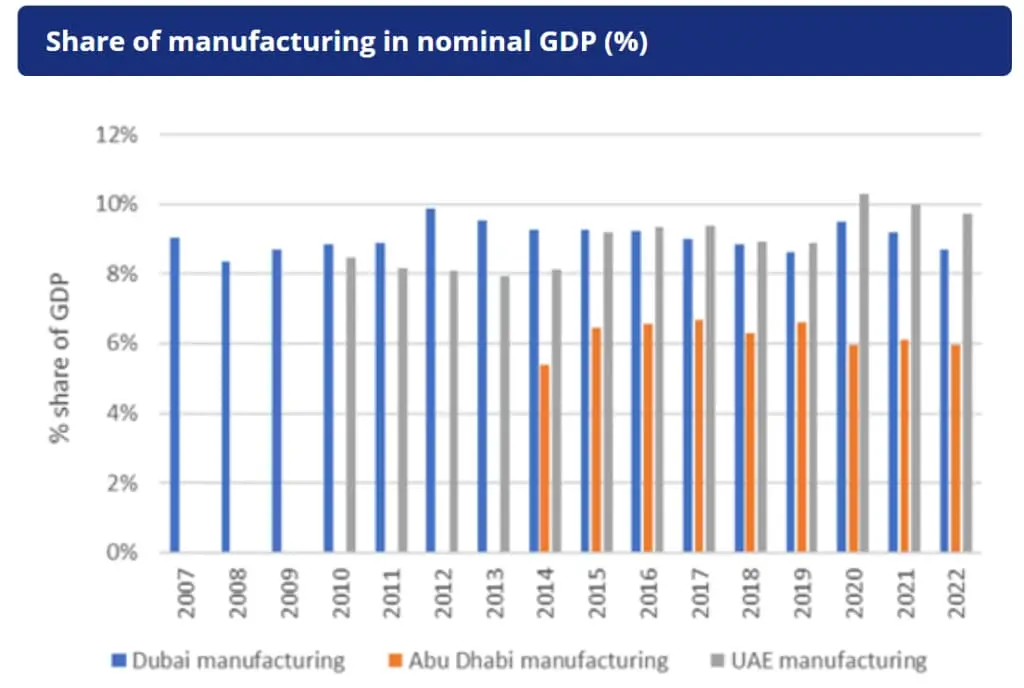
Manufacturing Industry in UAE isn’t just a sector—it’s a vital part of the country’s heartbeat, pumping life into its economy. It’s fantastic that manufacturing is the third-largest contributor to the nation’s nominal GDP behind mining, retail, and wholesale trade. In 2023, manufacturing made up almost 10% of the UAE’s GDP, which is no small feat!
While Dubai and Abu Dhabi might have a slightly smaller slice of this manufacturing pie, other Emirates like Ras Al Khaimah and Sharjah step in to boost the numbers with their solid industrial bases. It’s a team effort that makes the UAE’s manufacturing story compelling.
Speaking of stories, let’s talk about Operation 300bn, the UAE’s ambitious vision for its manufacturing future, announced in March 2021. Led by the Ministry of Industry and Advanced Technology (MoIAT), this 10-year plan aims to increase the industrial sector’s contribution—from USD 36.2 billion to a whopping USD 81.7 billion by 2031. And it’s not just about big numbers; the strategy focuses on nurturing key sub-sectors like food, beverage and pharmaceuticals, showing a thoughtful approach to growth.
So, when we talk about manufacturing in the UAE, we’re not just about statistics but about a thriving community, innovative ideas, and a bright future.
Dubai’s Manufacturing
Dubai’s manufacturing scene is buzzing with energy! While the UAE’s manufacturing real GDP soared by 8.75% in 2022—way above the 2.8% average from 2017 to 2019—Dubai’s growth was a bit steadier at 0.26%. Sure, it’s a modest climb compared to earlier years, but there’s still plenty of excitement in the air.
Despite some ups and downs since 2013, the outlook is sunny. All manufacturing sub-sectors are gearing up for growth. Take the food and beverage sector, for instance—it’s set to nearly triple in value by 2031, highlighting its growing importance to the UAE’s global trade.
Regarding global trade, the operation 300bn strategy makes UAE exports more competitive. Dubai’s exports are diverse and vibrant, from pearls and precious metals to rubber, plastics, and food.
Investment-wise, we’re talking big numbers—around USD 9.7 billion in planned or ongoing projects. The ‘other manufacturing’ sector is leading the charge, but there’s also a noticeable boost in funding for food and beverage, aligning with Operation 300bn’s focus.
The Emirates Development Bank also contributes USD 8.17 billion to support the sector’s growth, aiming to assist around 13,500 SMEs. Manufacturing is unique in Dubai’s economic heart, and the future looks promising!
Top Manufacturing Industry in UAE
The Top Manufacturing Industry in Dubai are as follows:
Plastic
Dubai’s not just a city of skyscrapers; it’s also a hotspot for plastic manufacturing! Thanks to its strategic location and top-notch infrastructure, Dubai has become a go-to hub for producing and exporting plastic goods. With plenty of raw materials and a business-friendly vibe that encourages investment, the plastic industry here is all about pushing boundaries and sparking innovation.
Chemicals
Dubai’s chemical industry covers everything from simple substances to intricate compounds. What sets our manufacturers apart is their commitment to international standards and quality. Whether for construction, pharmaceuticals, or agriculture, you can trust Dubai-made chemicals to be top-notch and reliable.
Rubber
Rubber manufacturing is more than just a sector; it’s an essential thread in Dubai’s industrial fabric. With growing demand from industries like automotive and construction, our local producers are stepping up their game. By embracing the latest technologies, they’re not just keeping pace—they’re setting it, making Dubai a force to be reckoned with in the global rubber scene.
Metals
Dubai’s metal manufacturers have it all: Aluminium, steel, and steel. Serving diverse sectors, from construction to aerospace, they benefit from Dubai’s stellar logistics and transportation network. That means efficient distribution to our neighbours or halfway around the world.
Food
Let’s talk food! Companies like Global Food Industries and Al Islami Foods are making waves here. Take Global Food Industries, for example. Part of the Albatha Group since ’92, they’ve been bringing us tasty, Halal frozen foods from their base in Sharjah. Brands like Healthy Farm, Al Areesh, and Arctic Gold offer everything from seafood to veggies in the UAE and beyond. The next time you’re enjoying a meal, it might be a taste of Dubai’s manufacturing excellence!
First, choose a catchy name for your company compliant with UAE’s naming rules. Your name should represent your business and resonate with the local culture. So, let’s keep it respectful and steer clear of anything that might raise eyebrows!
Get Your Trade License
Once you’ve sorted your name, it’s time to get a trade license. This is your golden ticket to manufacturing in Dubai! The type of license you’ll need can vary depending on where you set up shop—in Dubai or one of its free zones. But don’t worry—these licenses cover many manufacturing activities, ensuring you’re all set to thrive in Dubai’s vibrant industrial scene.
Sort Out Your Visa
You can only run a business if you are there, right? So, you’ll need a visa to operate in Dubai. The Green visa is an excellent option for investors like you keen to contribute to the UAE’s economy. It even offers a more prolonged stay compared to other residence visas. Ensure you’ve got all your investment proofs and the nod from the ICP and local authorities, and you’re good to go!
Open Your Corporate Bank Account
Lastly, it’s time to open a corporate bank account. This isn’t just about keeping your money safe—it’s about managing your finances like a pro! With a local bank account, you’ll be all set to receive payments and handle expenses smoothly in Dubai’s bustling business landscape.
And there you have it—four straightforward steps to kickstart your manufacturing dream in Dubai. Are you ready to make it happen?
Cost of a manufacturing license in Dubai
The cost of Getting a manufacturing license in Dubai starts at around USD 3,760*. Think of it as your ticket to the UAE’s bustling manufacturing scene. It’s an initial investment that opens doors to opportunities in the UAE’s vibrant industrial landscape. Ready to take the plunge?
Documents required to open a manufacturing company in Dubai
To set up your manufacturing company in Dubai, you’ll need a solid stack of documents. It’s all about making sure everything’s in shape right from the start. Here’s what you’ll need:
A detailed factory report covering
Factory layout
Machinery details
Production costs
Funding sources
Remember, you’ll also need the green light from the Ministry of Health, Environment, and Water. They’ll ensure you meet UAE health, safety, and environmental standards. So, gather up those papers and start this exciting journey!
What You Can Do with a Manufacturing License in Dubai
So, you’ve got your manufacturing license from the Department of Economic Development (DED) in Dubai—great move! This little piece of paper opens up possibilities for your business and helps enrich the emirate’s diverse economic tapestry.
What can you do with this licence? Well, the sky’s the limit! Here’s a taste of the wide range of activities you’re permitted to engage in:
Making Appliances and Machinery
Crafting Bags, Shoes, and Leather Goods
Working with Blocks and Building Stones
Creating Carpets and Mats
Producing Coatings, Insulations, Seals, and Protective Materials
Manufacturing Equipment and Engines
Delving into Food Industries and Food Packaging
Crafting Glassware and Chinaware
Cutting Gold and Precious Stones
Building and Maintaining Light Aircraft
Making Lighting Equipment
Producing Chemicals
Processing Meat
Manufacturing Medicines
Creating Metal Containers and Boxes
Making Ovens and Stoves
Crafting Paper and Paper Products
Producing Petroleum Products
Diving into Plastic Industries
Building and Repairing Ships
Making Stationery
Running a Steel Workshop
Producing Textiles and Textile Products
Crafting tyres and Rubber Goods
Bottling Water
And the list goes on! From woodworking to electricity generation and precision activities like lens cutting to ship construction, Dubai’s vibrant industrial landscape has something for everyone.
The Bright Future of Manufacturing in Dubai
Dubai is gearing up for exciting changes, aiming to attract more foreign investment with its strategic plans. One big move? The new energy policy will be launched in 2024 as part of D33. Managed by DEWA, this policy encourages sectors like data centres and agri-tech to use solar power. It’s a win-win: businesses save on energy costs and help the environment, earning them a leg up with i-RECs for net-zero emissions.
The buzz around this policy is expected to boost manufacturing, logistics, and trade services, showing Dubai’s commitment to a green and resilient industrial sector. Since February 2022, the IDB has been gearing up for this, focusing on automating and improving factory operations.
And for American companies eyeing the UAE market? The U.S. Commercial Service in the UAE is here to help with matchmaking and market research, making it easier to tap into Dubai’s vibrant manufacturing scene.
Speaking of growth, let’s remember Operation 300bn! Launched in 2021, this 10-year plan by MoIAT aims to more than double the industrial sector’s contribution to AED 300bn by 2031. With a focus on sub-sectors like food, beverage and pharmaceuticals, and a new flexible industrial law, the UAE is set to boost its manufacturing game. Ready to join the ride?
Source: FCSA, DSC, SCAD, ENBD Research
Manufacturing: A Big Player in UAE’s Economy
Manufacturing isn’t just making things—it’s making a mark on the UAE’s economy! As the third largest sector after mining and retail, it contributed nearly 10% to the UAE’s GDP in 2022. While Dubai and Abu Dhabi contribute slightly less, around 8.7% and 6%, respectively, places like RAK and Sharjah help pick up the slack with their bustling industrial scenes.
And here’s some good news: UAE manufacturing is picking up steam! In 2022, it grew by a whopping 8.75%, leaving the 2017-2019 average of 2.8% in the dust. So, whether you’re a local business or an international player, there’s plenty of room to grow in the UAE’s thriving manufacturing landscape. Ready to jump in?
Diverse Activities in the Manufacturing Sector
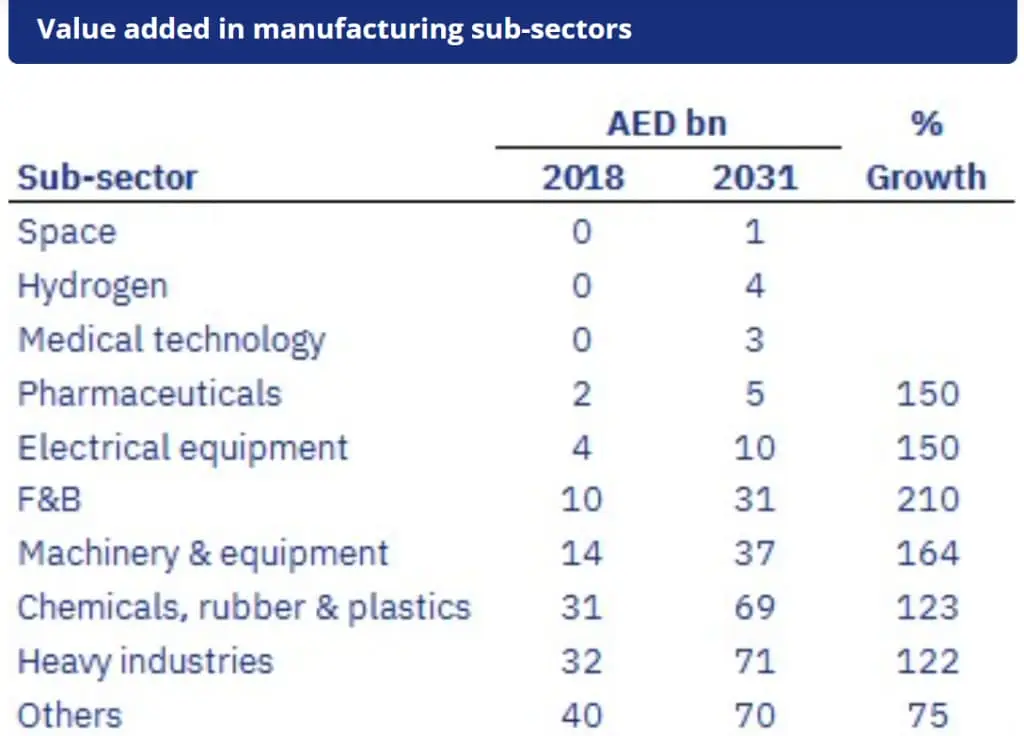
In the manufacturing world of the UAE, heavy industries have traditionally taken the lead, making the most enormous contribution to value added. Following closely behind are sectors like chemicals, rubber and plastics, machinery and equipment, and food and beverage, all playing their part in the vibrant manufacturing landscape.
Source: FCSA, DSC, SCAD, ENBD Research
Across all manufacturing sub-sectors, we’re looking at substantial growth ahead. However, the food and beverage (F&B) sector takes the cake, with a whopping expected growth of 210% by 2031.
Post-COVID, the F&B sector has been in the spotlight, especially with the UAE’s growing population and its focus on long-term food security. To give it an extra boost, a UAE F&B digital platform was launched in September 2023. This platform connects investors, manufacturers, banks, and trade partners, making supporting and growing the sector easier.
Manufactured Goods Boost UAE’s Non-Oil Exports
Manufactured products are vital to the UAE’s non-oil exports. Operation 300 bn’s strategy aims to increase the UAE’s export competitiveness on the global stage.
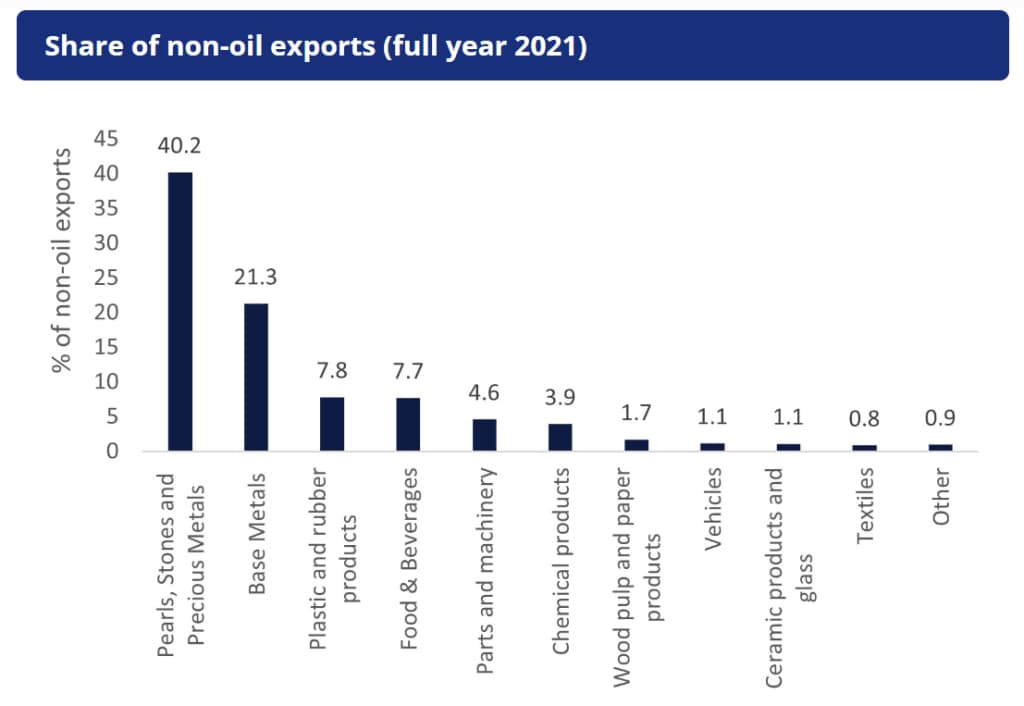
As the UAE shifts its focus from oil, non-oil exports have gained momentum. While it’s tricky to pinpoint the exact types of goods, a significant chunk of these exports likely come from the manufacturing sector. The top categories for non-oil exports are pearls, stones, and precious metals (40.2%), followed by base metals at 21.3%.
It’s important to note that while some of these exports might be raw materials, the current trade codes don’t let us distinguish between raw, semi-manufactured, and entirely manufactured goods.
Source: MoIAT Industrial Investment Guide
Non-Oil Exports: Plastic, Rubber, and Food & Beverage Lead the Way
In 2021, plastic and rubber products and food and beverage exports were significant players, making up 7.8% and 7.7% of non-oil exports, respectively. If we put aside the dominant categories like pearls, stones, precious metals, and base metals, the priority sub-sectors under Operation 300bn seem to align with these smaller export groups.
Recent data show that plastic and rubber products and food and beverage exports have grown enormously among these smaller categories. Between Q3 2021 and Q3 2022, exports in the rubber and plastics category jumped by 24%, while food and beverage exports grew by 22%.
Despite this impressive growth in 2022, the food and beverage sector has yet to reach its 2018 and 2019 export levels.
Dubai Manufacturing: Where Innovation Meets Opportunity
Dubai’s manufacturing scene is more than just factories and production lines—a hub of innovation and forward-thinking. It’s been the driving force behind the region’s economic growth and diversity, proving resilient even in a changing global landscape. Investors, entrepreneurs, and business leaders can’t help but be drawn to its magnetic charm.
Thanks to game-changers like Operation 300bn, the future looks even brighter. We’re discussing a future where sustainability and cutting-edge tech go hand in hand. With Dubai investing in top-notch infrastructure, nurturing talent, and creating a business-friendly vibe, our manufacturing industry is all set to shine on the world stage.
So, if you love being part of something big and exciting, Dubai is where you want to be. We’re not just keeping up with the future but shaping it. Come join Shuraa as we embrace the challenges and seize the opportunities of tomorrow’s manufacturing world!
The textile industry in UAE stands as a lively witness to the nation’s commitment to economic change and invention. Amidst the towering skyscrapers and active cityscapes, this often-overlooked sector quietly succeeds, intertwining a rich textile of ritual, technology, and trade. From the ancient art of intertwining to cutting-edge fabric technologies, the textile industry in the UAE has evolved into a dynamic ecosystem, an amalgamation of heritage with modernity, to carve out a niche in the global marketplace. In this blog, Shuraa Business Setup, we research the intricacies of this fascinating industry, discovering its historical roots, current landscape, and promising prospects.
What Is the Textile Industry?
The textile industry in UAE encompasses all features of generating, producing, and distributing fabric, garments, and related materials. Traditionally reliant on natural fibers, technological advancements now allow for the manufacture of synthetic textiles using artificial compounds.
Over the past few decades, the textile sector has undergone significant alteration, and the acceptance of modern equipment and techniques to improve efficiency. This development has led to the production of durable materials and technical textiles while prioritizing environmentally sustainable practices. By employing greener manufacturing processes, such as reducing energy consumption and minimising carbon emissions, industry is adapting to meet contemporary demands.
The Dubai textile industry is a prime example of rapid technological advancement. In recent years, substantial investments have been made to improve environmental sustainability nationwide, focusing on bolstering the local textile sector.
Understanding Textile Industry of the UAE
Despite minimal marketing efforts, the United Arab Emirates (UAE) hosts a vigorous textile sector, producing a range of items including child safety seats, curtains, luggage, and high-end fashion pieces tailored for local preferences. Woven goods like knitwear stand out as top sellers, propelling the industry to second place in the country’s economy, just behind oil. While serving over 50 international markets, local demand, particularly from male consumers in cities like Dubai, significantly contributes to growth in the high fashion segment.
Moreover, the UAE’s Fujairah “free zone” has attracted considerable business relocation, offering tax exemptions and repatriation benefits. This strategic advantage has spurred the establishment of a major textile mill in 2012, surpassing any other in the Middle East. Notably, its operational efficiency is enhanced by employees maneuvering on roller skates, confirming swift productivity.
Advantages of Textile Industry
The United Arab Emirates (UAE) benefits from strategic advantages that fuel its textile industry’s growth. Its prime location as a shipping hub increases trade opportunities, while booming economies attract businesses looking for tax incentives, expanding the customer base. Initiatives like the International Textile Fair (ITF) in Dubai foster industry collaboration and global visibility. Additionally, the UAE’s expansion into Africa leverages lower production costs and central shipping routes, enhancing competitiveness and market reach.
Challenges Faced by the UAE Textile Industry
One of the primary challenges confronting the United Arab Emirates (UAE) textile industry is its limited marketing efforts. Products are mainly distributed through existing channels or to customers already familiar with them, impeding international exposure. While initiatives like the ITF have been launched to address this, international advertising remains insufficient.
Furthermore, the industry faces stiff competition, notably from Turkey, which benefits from a central location and produces similar goods. This direct rivalry poses a significant threat to the UAE’s market share.
Another pressing concern is the energy crisis. While the situation has improved, many Middle Eastern countries still grapple with power outages and soaring prices of natural gas and other energy sources. This drives up manufacturing costs, leading to higher prices for textile products and eroding competitiveness.
Exploring Dubai Textile City
Dubai Textile City (DTC) is a venture between TEXMAS and the Dubai Port and Customs Authority to allow textile traders in Dubai and beyond. This innovative free zone provides a platform for storing textile fabrics over long periods without experiencing customs duties, mainly catering to traders engaged in re-export activities.
Backed by comprehensive support from Dubai Ports and Customs, DTC offers support in directing visa requirements for its members and rationalising the operational landscape for traders. TEXMAS imagines DTC as a compound for imparting correction within the trade while forecasting its potential to attract global attention, thereby accompanying new markets and customers for Dubai-based traders.
Crucially, obedience to international standards is authoritative within DTC and its affiliated cities, necessitating the utilisation of the metric system for measuring textile capacities. Additionally, vendors must guarantee their products meet national safety regulations, as non-compliance poses significant barriers to business growth and development.
Types of Corporate Structures
Below are the following types of corporate structures:
Free Zone Limited Liability Company (FZ-LLC): A FZ-LLC is an independent legal entity with a single owner or shareholder, an individual or a corporate entity. This structure provides stakeholders with limited liability, dropping their risk. However, the risk-to-reward ratio tends to be lower.
Free Zone Company: A Free Zone Company is a corporate entity comprising two or more shareholders, akin to the FZ-LLC structure. Shareholders may be individuals or corporate entities. This structure is widely adopted as the primary form of company formation within free zones.
Branch of a UAE or Foreign Company: A branch operates under the name of its parent company and represents an existing entity. The parent company may be located elsewhere in the country or a different jurisdiction.
Once the appropriate business entity type is selected, the next step is determining the specific business activities.
Permissible Business Activities
Like other free zones in Dubai, this location maintains a roster of authorised business activities. This entails diverse opportunities across various sectors, enabling companies to leverage the advantages and perks available. These activities encompass industries such as:
Trading
Textile
Fashion
The free zone fosters an environment conducive to entrepreneurial growth and sectoral diversification by offering a broad spectrum of permissible business activities.
Why Invest in the Dubai Textile Industry?
Here are the reasons why you should consider investing in the textile industry in UAE:
Popularity Surge: The textile industry in UAE has experienced a surge in popularity, fueled by social media and modern marketing, particularly in fashion apparel.
Fast Fashion Dominance: The rise of fast fashion, joined with online shopping trends, presents a lucrative opportunity for investment in the textile sector.
Online Store Advantage: Investing in an online store requires less capital and offers a convenient way to tap into the UAE and global markets.
Dubai’s Strategic Location: Dubai is one of the world’s most efficient transportation and logistics centres. Its airport handles millions of passengers annually, facilitating global trade.
Online Selling Platforms: Various online platforms, including Shopify, offer marketing and brand-building tools, shortening the procedure of selling textile products online.
Steps to Starting an eCommerce Business in Dubai
Making an online store or eCommerce business in Dubai has become increasingly straightforward, thanks to healthy online tools that eliminate the need for coding. Below are a few steps to set up your online store:
Step 1: Define Your Product: Begin by finalising your product. Given the competitive online landscape, investing time in refining your product is crucial to distinguish it from competitors. Professional photography can meaningfully improve your product presentation and make it stand out on your website.
Step 2: Start Your Online Store: Utilise user-friendly platforms like Shopify to set up your online store flawlessly. These platforms mix eCommerce solutions into website builders, allowing you to purchase a domain, design your website, and manage your inventory all within one interface. Moreover, such platforms offer affordable packages, making them accessible for businesses of all sizes.
Step 3: Invest in Marketing: Marketing plays a pivotal role in the success of your eCommerce business. Beyond promoting individual products, focus on marketing your entire online venture. Study leveraging social media ads and applying SEO strategies to improve your website’s search engine ranking.
How to Start a Business in the UAE?
Going on board a business venture in the UAE is an efficient procedure that can be accomplished within a few weeks, particularly with the help of professional consultants. Here’s an essential step to start a business in the United Arab Emirates:
Step 1: Choose a Memorable Name: Begin by selecting a convincing and straightforward name for your business. Opt for something catchy yet easy to remember, as this lays the foundation for creating a recognisable brand that resonates with customers.
Step 2: Start a Business Bank Account: Next, open a business bank account to manage your finances effectively. Modern business banking solutions automate statement generation, facilitating efficient financial management and providing real-time insights into your company’s financial health.
Step 3: Get a Business License: Once your preparations are complete, proceed to apply for a business license. Depending on your business type, you may need to approach either the Department of Economic Development or the Municipality in the Emirate. Given the details of the process, engaging a professional consultant is advisable. These experts possess local knowledge and language proficiency, expediting the licensing procedure and guaranteeing compliance with relevant regulations.
Documents Needed for Business Incorporation
Below are the mentioned documents which are needed to start a business:
Passport copies of the owner and shareholder.
Passport and CV of the manager.
The UAE Embassy authenticates the notarised Memorandum of Association and Articles of Association.
Physical address details.
Evidence of trade name reservation.
Initial approval documentation for business incorporation.
Proof of capital investment.
Board resolution from the parent company (for branch office setups).
What are the Benefits of Starting a Business in the UAE?
Favorable Business Environment: The UAE offers a business-friendly environment with minimal organisation and efficient procedures for company formation.
Strategic Location: Situated at the crossroads of Europe, Asia, and Africa, the UAE is a doorway to lucrative markets, facilitating global trade and accessibility to diverse consumer bases.
Tax Advantages: The UAE imposes no personal income tax and provides favourable corporate tax rates, offering critical financial incentives for businesses.
World-Class Infrastructure: The UAE boasts state-of-the-art infrastructure, including modern transportation networks, advanced telecommunications systems, and cutting-edge facilities conducive to business growth and development.
Political Stability: With a stable political climate and robust legal framework, the UAE provides a protected environment for business operations, instilling confidence among investors and entrepreneurs.
How to Get a Long-Term Visa in Dubai
Safeguarding a long-term visa in Dubai knowingly benefits investors and entrepreneurs contributing substantial investments to the UAE. Here’s an essential guide to the procurement a long-term visa through investment in Dubai:
Step 1: Entry into the Country: Begin by entering the UAE, which can be done on any visa, including a tourist visa. Once in the country, you can initiate the process of applying for an investor visa.
Step 2: Investor Visa Application: Submit your investor visa application custom-made to the specific visa type you’re seeking. Typically, this requires documentation such as proof of health insurance, a good conduct certificate from Dubai police, a current UAE visa, a no-objection letter from the bank, a passport, and recent bank statements.
Step 3: Medical Examination: Undergo mandatory medical examinations, including X-rays and blood tests, conducted at a certified medical centre. While this process usually takes a few days, it’s a requirement for all visa types.
Step 4: Submission of Supporting Documents: Finally, submit all required supporting documents, including company registration papers and bank statements, to demonstrate adequate funds. The investment amount varies based on the visa category pursued, with the Golden Visa option necessitating a minimum investment of AED 10 million.
1. Which Freezone is Dedicated to the Textile Industry?
Dubai Textile City helps as the designated free zone for the garment industry.
2. How to Establish a Garment Company in Dubai?
In brief, select your desired location, compile and submit all necessary documents for licensing, and register your business with approvals from relevant authorities.
3. Who Grants Business Licenses in Dubai?
The Department of Economic Development issues the business license upon receiving approvals from the relevant authorities.
4. What License is Required to Sell Clothes Online in the UAE?
An E-trade license is required to sell clothes online or via social media.
5. What is the Cost of Establishing a Textile Company in the UAE?
The cost varies depending on the chosen location and the nature of the business activity.
Dubai’s position as a global hub drives ongoing demand for essential business services. This environment presents a strong opportunity to open a successful typing centre.
Typing centres connect Dubai’s diverse population with government digital systems, processing visas, IDs, license renewals, and legal documents. This business meets ongoing demand in a rapidly growing city.
Starting requires navigating Dubai’s licensing requirements, selecting a suitable location, and establishing efficient operations, all of which can be complex.
This guide outlines the entire process:
The Strategic Advantage: Why a typing centre is a resilient and lucrative business model in the UAE.
Step-by-Step Setup: From mandatory GDRFA registration and securing a Local Service Agent to finalising your commercial license.
Operational Mastery: How to recruit certified typists, choose the perfect location, and implement marketing that attracts clients from day one.
With 26 years of experience and over 100,000 business setups in the UAE, Shuraa Business Setup has developed this guide to help you establish a compliant and profitable business.
Read on to learn how to turn this opportunity into your next business success.
Key Benefits of Opening a Typing Centre in Dubai
A typing centre in Dubai is a high-demand, essential service that benefits from the city’s unique business environment.
1. Recession-Resistant & Essential Service Demand
Typing centres offer essential services for new residents, employees, business visitors, and companies, including government transactions such as visas, IDs, licenses, and attestations. This ensures a steady customer base that is less affected by economic changes.
2. Recurring Revenue Streams
Clients return for renewals, amendments, and new applications. Developing a portfolio of corporate clients through PRO services ensures consistent monthly revenue.
3. Low Operational Overhead with High-Value Services
Overhead costs are lower than in retail or F&B, with certified staff and a strategic location as primary assets. Standardised service fees for government transactions support strong profit margins.
4. Gateway to a Broader Business Services Hub
A typing centre provides an effective foundation for expanding into related high-demand services, such as PRO services, document clearing, attestation, legal translation, and corporate secretarial services. This expansion can significantly increase your average transaction value.
5. Direct Benefit from Dubai’s Growth & Policy
Population Growth: Every new resident is a potential customer for visa and ID services.
Business Influx: Each new company setup requires trade license processing and employee visa services, providing direct business opportunities.
Government Digitisation: Although many processes are online, the demand for expert assistance in navigating systems such as GDRFA’s Tasheel continues to grow.
6. Strategic Positioning in the Community
A well-located centre becomes a trusted community hub, fostering long-term relationships with individuals and businesses. This leads to loyalty and valuable word-of-mouth referrals within the expatriate community.
In summary, a typing centre leverages Dubai’s administrative framework and demographic growth to establish a stable, scalable, and profitable business with clear opportunities for expansion.
Legal Requirements for Opening a Typing Centre in Dubai
The Dubai Department of Economy and Tourism (DET), specifically the Commercial Registration & Licensing Sector, is the primary authority. All typing centres must also be registered with the General Directorate of Residency and Foreigners Affairs (GDRFA).
Required Documents for Opening a Typing Centre in Dubai
To open your typing centre in Dubai, please prepare and organise the following documents:
A. Company Formation & Legal Documents
Application Forms: DET initial application and license application forms.
Trade Name Reservation Certificate: Issued by DET for a name that includes “Typing Centre.”
Passport Copies: For all proposed partners or owners.
Visa Copies: UAE residence visa copies, if applicable.
Local Service Agent (LSA) Agreement: Notarised contract with the required UAE national partner (51% shareholder).
Opening a typing centre requires compliance with government regulations. Adhering to each step below will help ensure a successful setup.
Begin by partnering with a UAE National who will hold a 51% ownership stake as your Local Service Agent. Prepare a notarised LSA Agreement that clearly defines roles and profit sharing. This legal requirement is mandatory.
Submit your initial application to the Department of Economy and Tourism (DET).
Reserve a trade name ending with “Typing Centre” or “Business Services Centre” for DET approval.
Secure a physical commercial office, as virtual offices are not permitted. Obtain an Ejari (tenancy contract) registered with Dubai Municipality. Choose a location that is easily accessible and has high foot traffic, such as near residential complexes or business districts.
Recruit typists and ensure they pass the required GDRFA certification exam.
Obtain Police Good Conduct Certificates and Dubai Police NOCs for all employees.
Operation is not permitted without GDRFA-certified staff.
Dubai Police NOC: Apply for the business activity clearance.
GDRFA Registration: Register your centre and each certified typist with the General Directorate of Residency and Foreigners Affairs to be integrated into the “Tasheel” system.
DET License Application: Submit all required documents (LSA agreement, MoA, Ejari, staff certificates, and approvals) to DET to obtain the Commercial License.
Expand your services beyond basic typing by offering:
Core: Visa processing, renewal, cancellation.
Extended: PRO services, document attestation, translation, Emirates ID assistance, and court paperwork.
Corporate: Dedicated account management for business clients.
Install software and hardware that comply with GDRFA standards.
Set up a secure document management system.
Develop standard operating procedures (SOPs) for each service to maintain accuracy and compliance.
Claim and optimise your Google Business Profile as soon as possible.
Utilise hyper-local marketing channels, such as community Facebook groups and local directories.
Network with business consultants, freelancers, and small businesses to generate B2B referrals.
Final Note: This is a compliance-intensive business. Partnering with experts such as Shuraa Business Setup can streamline the process from securing your LSA to completing GDRFA registration, ensuring a smooth and error-free launch.
Costs of Opening a Typing Centre in Dubai
The cost of obtaining a typing centre license in Dubai varies. The initial trade license fee typically ranges from AED 10,000 to AED 18,000. Total setup costs, including rent, technology, and approvals, can reachAED 50,000 to AED 150,000 or more, depending on location and services offered. Major expenses include the DET license, office rent (Ejari), government approvals (such as GDRFA), smart portal access (Amer, Tasheel), and equipment.
Key Cost Factors
Trade License: Primary expense from DET, approximately AED 10,000 to AED 18,000.
Location: Mainland locations are generally more expensive than free zones.
Office Space: Rent and Ejari contribute significant annual costs, typically AED 20,000 to AED 50,000 or more.
Government Approvals: Special approvals from GDRFA and MOHRE, along with related fees.
Technology: Costs for smart portal access (Amer, Tasheel) and software fees.
Initial Setup Total: AED 50,000 to AED 150,000 or more, depending on specific requirements.
Annual Renewal Costs: Typically, AED 6,000 to AED 15,000 or more for renewals (DET and related fees).
Typing Centre License Cost in Sharjah
Opening a typing centre in Sharjah involves several costs. These include initial trade license fees, which may range from AED 1,000 to AED 5,000 for a basic license; a mandatory AED 6,000 fee for ICP Smart Services (AED 1,000 subscription and AED 5,000 deposit); and operational expenses such as office rent, setup, and staff salaries.
Costs vary depending on location (mainland or free zone, such as SHAMS) and the services provided. For precise figures, consult the Sharjah Economic Development Department (SEDD) or a qualified service provider.
Note: All costs are reference only.
Pro Tip:Consult a business setup expert, such as Shuraa, for accurate and up-to-date cost estimates tailored to your business plan and preferred location.
Staffing and Operational Strategies for a Dubai Typing Centre
1. Strategic Recruitment & Team Assembly
Prioritise hiring GDRFA-certified typists to meet legal requirements. In addition to certification, seek candidates with the following qualifications:
Technical Proficiency: Candidates should demonstrate speed, accuracy, and expertise in using government portals such as Tasheel, Dubai Police, and RTA.
Cultural and Linguistic Agility: Fluency in Arabic and English is essential. Proficiency in additional languages such as Urdu, Hindi, Tagalog, or Russian is highly valued to serve Dubai’s diverse population.
Customer Service Skills: Select individuals who demonstrate patience, clear communication, and professionalism when handling sensitive documents and assisting clients.
2. Continuous, Government-Focused Training
Initial GDRFA certification is only the beginning. Establish a recurring training program that includes the following areas:
Procedure Updates: Conduct weekly briefings on changes to visa regulations, government fees, and document requirements.
Soft Skills: Provide training in managing challenging customer interactions, cross-cultural communication, and setting client expectations.
Advanced Services: Offer training for processing specialised transactions such as court attestations, license renewals, and PRO services to expand service offerings.
3. Rigorous Operational Protocols
Standardise all client interactions to maintain efficiency and ensure compliance.
Document Checklists: Develop clear, step-by-step checklists for each service type, such as new visas, renewals, and cancellations, to minimise errors.
Digital File Management: Implement a secure and organised system to track client documents and monitor transaction statuses.
Double-Verification Protocol: Require all applications to be reviewed by a second typist before submission to prevent errors.
4. Exceptional, Culturally-Tuned Customer Service
In a trust-based service environment, customer experience is the primary differentiator.
Clarity and Transparency: Offer clear price lists and explain all steps and fees to clients in advance.
Proactive Communication: Use SMS or WhatsApp to update clients on application status, reducing incoming inquiries.
Premium Service for Corporations: Provide dedicated account managers and offer pickup and delivery services for business clients, including PRO services.
5. Digital Presence & Local Marketing
Google Business Profile (GBP): Fully optimise your profile with services, operating hours, photos, and active review management. This is the primary source for local lead generation.
Hyper-Local SEO and Content: Target keywords such as “Typing Centre near Deira,” “Visa Renewal Dubai,” and “GDRFA Services.” Develop straightforward blog guides, for example, “Step-by-Step Guide to Renewing a Residence Visa.”
Targeted Social Media: Use Facebook and Instagram for targeted advertisements in specific residential and commercial areas, and to highlight client testimonials.
6. Strategic Networking & Partnerships
B2B Focus: Network with small business owners, startup hubs, and freelancers who require regular PRO or typing support. Offer tailored corporate packages.
Complementary Partnerships: Establish referral agreements with neighbouring businesses such as travel agencies, courier services, and printing shops.
Community Integration: Sponsor local events or provide free informational workshops to build brand trust.
7. Competitive Positioning: Beyond Price
While competitive pricing is important, focus on delivering value rather than competing solely on cost.
Service Guarantee: Emphasise accuracy, speed, and a seamless service experience.
Extended Hours: Consider operating beyond standard government hours, such as evenings or weekends, to better accommodate clients.
Loyalty Programs: Introduce discounts or priority services for returning customers.
Start Your Typing Centre Venture with Confidence
Starting a typing centre in Dubai involves more than launching a business. It requires integration into the city’s dynamic ecosystem and becoming a key service provider for its diverse community. By understanding regulations, choosing a strategic location, and delivering exceptional, reliable service, your venture will be well-positioned for success.
In this competitive market, your success will depend on attention to detail, a customer-centric approach, and the ability to adapt to Dubai’s rapidly changing environment.
Consider seeking expert guidance throughout this process.
Establishing a typing centre requires careful attention to legal, governmental, and operational procedures. Working with experienced professionals can simplify and streamline this process.
With over 26 years of experience and more than 100,000 successful business setups across the UAE, we have the local expertise to guide your typing centre from concept to grand opening and beyond.
We look forward to supporting your venture. Shuraa Business Setup is ready to provide clarity on licensing, costs, and every critical step.
Contact us today for a comprehensive consultation and take your first step toward success in Dubai.
Frequently Asked Questions (FAQs)
1. What is the main license required to open a typing centre in Dubai?
To operate legally, you must obtain a Commercial License from the Dubai Department of Economy and Tourism (DET) and register with the General Directorate of Residency and Foreigners Affairs (GDRFA). GDRFA registration authorises you to process official visa and residency transactions.
2. Do I need a UAE partner to open a typing centre?
Yes, this is mandatory. The typing centre must be established as a local company with a UAE National serving as the Local Service Agent (LSA), holding at least 51% of the shares. A notarised legal agreement is required for this partnership.
3. What are the requirements for typists in a Dubai typing centre?
All typists must be certified by the GDRFA, pass a specialised exam, obtain a Police Good Conduct Certificate, and secure individual No Objection Certificates (NOCs) from Dubai Police. The owner or manager is often required to be certified as well.
4. How much does it cost to set up a typing centre in Dubai?
Setup costs typically range from AED 50,000 to AED 150,000 or more. This includes licensing fees, office rent (Ejari), security deposits, GDRFA system setup, salaries for certified staff, and initial marketing. A detailed business plan is essential for accurate budgeting.
5. Can a typing centre operate from a home or virtual office?
No. Dubai authorities require a physical commercial office in an approved location. A registered tenancy contract (Ejari) is mandatory for licensing. Virtual offices and home setups are not permitted.
6. What other services can a typing centre offer?
In addition to document typing, many centres offer PRO (Public Relations Officer) services, document attestation and legalisation, translation, Emirates ID registration, and corporate license renewal. Diversifying services can significantly increase revenue.
7. How long does it take to get a typing centre license in Dubai?
With all documents prepared, the process usually takes 4 to 8 weeks. The timeline depends on the speed of approvals from DET, GDRFA, and Dubai Police, as well as staff certification. Engaging a professional business setup consultant can help streamline the process.
Disclaimer: This information is for general guidance only. Licensing rules are subject to change. We strongly recommend consulting with the relevant authorities (DET, GDRFA) or a licensed business setup consultant for the most up-to-date and accurate advice tailored to your specific case.
Starting an online business in Abu Dhabi isn’t simple or easy, but with the right guidance and a clear strategy, you can turn your entrepreneurial vision into reality. The capital of the UAE is a dynamic hub where tradition meets innovation, offering a unique blend of opportunities for businesses willing to navigate its competitive landscape.
Abu Dhabi’s vibrant markets, cutting-edge tech infrastructure, and business-friendly policies make it a strategic launchpad for online ventures. Whether you’re eyeing e-commerce, digital services, or innovative tech solutions, this emirate provides the ideal environment to thrive.
We’ll guide you through the complexities and unlock the compelling advantages of setting up an online business in this global hotspot. Let’s explore how you can harness the potential of Abu Dhabi to kickstart your entrepreneurial journey.
Benefits of Start an Online Business in Abu Dhabi
Starting an online business in Abu Dhabi comes with several advantages that make it an attractive option for entrepreneurs. Here’s why:
Strategic Location: Abu Dhabi connects global markets across the Middle East, Africa, Asia, Europe, and the Americas, making it a prime hub for trade and business.
Tax Benefits: Enjoy tax exemptions in free zones, including no personal or corporate taxes and no import/export duties, creating a cost-effective business environment.
World-Class Infrastructure: With advanced technology and a robust IT ecosystem, Abu Dhabi offers the perfect foundation for online businesses.
Rapid Growth Opportunities: A booming economy attracts global companies, creating a fertile ground for businesses to thrive and grow.
Tech-Savvy Population: Abu Dhabi’s digitally engaged and internet-savvy population provides an ideal customer base for online businesses.
Global Connectivity: Positioned as a trade hub, Abu Dhabi connects businesses to global markets, facilitating international trade and growth.
Affordable Setup and Renewal Costs:Setting up a business in Abu Dhabi is cost-effective, with lower trade license renewal fees compared to other emirates.
Entrepreneurial Ecosystem: Abu Dhabi fosters opportunities for startups and SMEs, providing a supportive environment for entrepreneurs to start and scale ventures
Tourism and Business Hub: Its status as a regional hub attracts tourists and businesses, enhancing opportunities for online services in various sectors.
Launch your online business in Abu Dhabi to leverage these advantages and establish a successful business in a thriving market.
How to Start an Online Business in Abu Dhabi
To start an online business in Abu Dhabi, you’ll need to obtain an e-commerce license, which can be done through the Abu Dhabi Department of Economic Development (ADDED) or a free zone authority. You’ll need to choose your business structure, register a trade name, and potentially secure additional approvals depending on your specific activities. It’s also crucial to develop a user-friendly website, secure payment gateways, and comply with UAE consumer protection laws.
Here’s a more detailed step by step breakdown:
Step 1: Choose Your Business Structure and Activities:
They can help you navigate the legal and regulatory requirements, choose the right jurisdiction, and secure the necessary licenses and approvals, according to experts on company registration.
By following these steps and utilizing the resources available, you can successfully launch your online business in Abu Dhabi.
Cost of Starting an Online Business in Abu Dhabi
The starting cost for an e-commerce license in Abu Dhabi is AED 5,500*. However, the final cost depends on several factors, including your chosen business activities, the selected jurisdiction (mainland or free zone), and specific business requirements.
Key factors influencing the cost include:
Licensing Fees: The base cost for obtaining your business license.
Administrative Expenses: Charges for paperwork and government approvals.
Trademark Registration: Optional fees to secure your brand identity.
Agent Fees: Costs for local sponsor or agent services if required.
Government Fees: Includes cultural and other mandatory charges.
Your business location—mainland or free zone—also impacts the pricing. Each jurisdiction has unique benefits, so it’s essential to choose one that aligns with your business goals.
For accurate pricing tailored to your requirements, contact Shuraa Business Setup for expert advice and a customised consultation.
Start Your Online Business in Abu Dhabi With Shuraa!
Our commitment to supporting your business establishment in Dubai goes beyond the initial setup. In addition to facilitating the setup process, we offer various services such as tax preparation, legal counsel, and HR management. As a valued client, you gain entry into our booming community of like-minded entrepreneurs. Engage with the broader business community in the region through Shuraa Business Setup Connect, our networking tool designed to foster meaningful connections.
1. Do I need a license to sell online in Abu Dhabi?
Yes, you need an online business license to legally sell products or services online in Abu Dhabi. You can obtain this license through the Department of Economic Development (DED) or set up in one of Abu Dhabi’s free zones for additional benefits.
2. Is it legal to do online business in the UAE?
Yes, it is completely legal to operate an online business in the UAE. However, you must obtain the necessary licenses and adhere to regulations specific to your business activity and jurisdiction.
3. How to start an online business in the UAE?
To start an online business in the UAE, choose a business activity that meets market demand and select the appropriate jurisdiction (mainland or free zone). Register your business and obtain the necessary license, then create a professional website with secure payment options. Finally, develop a marketing strategy to attract and engage your target audience.
4. How to start an ecommerce company in Abu Dhabi?
Starting an e-commerce business in Abu Dhabi requires deciding on your business activity and products or services. Choose a suitable jurisdiction (mainland or free zone) and register your business with the Department of Economic Development (DED) or a free zone authority to obtain an e-commerce license. Build a user-friendly website with a secure payment gateway and promote your business through effective digital marketing strategies.
Disclaimer: The information in this post is for general guidance only and may change due to updates in government policies or regulations.
The pharmacy sector in Dubai and the wider UAE is a cornerstone of its world-class healthcare system. With a booming population, high per-capita income, and a strong government focus on health, the demand for pharmaceutical services is rising steadily. The UAE pharmacy market is projected to reach $9.5 billion by 2030, offering a significant opportunity for investors.
This comprehensive guide will walk you through every step of how to open a pharmacy in Dubai, covering the latest legal requirements, costs, and the process for obtaining your pharmacy license in Dubai.
Why Start a Pharmacy Business in the UAE?
Before diving into the “how,” let’s look at the “why.” The UAE offers distinct advantages for pharmacy owners:
Thriving Market: An expanding population and growing focus on preventive healthcare drive continuous demand.
100% Foreign Ownership: As per recent UAE law, you can now own 100% of your mainland pharmacy business, eliminating the need for a local sponsor in most cases. (Strategic sectors like oil and gas are exceptions).
Tax Benefits: Benefit from minimal corporate taxes and a low 5% VAT, maximizing your profit margins.
Strategic Hub: Dubai’s location provides access to a diverse customer base and international supply chains.
Government Support: Streamlined processes through authorities like the Dubai Health Authority (DHA) make setup efficient.
Legal Requirements for a Pharmacy License in Dubai
Navigating the legal landscape is your first critical step. The primary regulator in Dubai is the Dubai Health Authority (DHA). Key requirements include:
DHA Pharmacy License: This is the core permit to operate, issued after meeting all standards.
Qualified Pharmacist-in-Charge: The managing pharmacist must hold a valid UAE license and have a minimum of two years of professional experience.
Approved Location: The physical premises must comply with DHA regulations for size, layout, and facilities.
Additional Licenses: You may need permits from the Ministry of Health and Prevention (MoHAP) for controlled substances or medical devices.
Mainland Trade License: You must obtain a commercial license from the Department of Economy and Tourism (DET)—formerly known as the DED.
Mainland vs. Free Zone: Where Should You Set Up Your Dubai Pharmacy?
1. Mainland (DET License):
Pros: Can operate directly anywhere in Dubai and the UAE mainland; sell to hospitals and other pharmacies; higher revenue potential.
Cons: Typically higher setup and operational costs (like rent); requires physical storefront.
Ideal for: Owners targeting the general retail public and B2B opportunities within the UAE.
2. Free Zone:
Pros: Often faster and 100% ownership was standard; can be more cost-effective for warehousing and logistics.
Cons:Critical Limitation: Operations are generally restricted to the specific free zone. A free zone pharmacy cannot open a retail storefront for public walk-in sales on the mainland. Primarily suited for wholesale, manufacturing, and export.
Ideal for: Businesses focused on logistics, wholesale, re-export, and manufacturing, not public retail.
The Verdict: For a community retail pharmacy serving the public in Dubai, a mainland license through the DET is the necessary and standard route.
Choosing the Right Location for Your Dubai Pharmacy
Your pharmacy’s location can make or break your business. The DHA has strict criteria, but you also need to consider commercial viability. Here are key factors to evaluate:
DHA Zoning Regulations: The authority must pre-approve your location. It typically cannot be in a purely industrial area and must be easily accessible to the public.
Foot Traffic & Visibility: High-traffic areas like residential communities, near hospitals and clinics, or busy commercial streets are ideal. Ground-floor units with clear signage are preferred.
Accessibility and Parking: Ensure customers can easily reach you. Ample parking, proximity to public transport links, and accessibility for people of determination are crucial.
Competitor Analysis: Is the area already saturated with pharmacies? A location with high demand and low competition is perfect. Alternatively, consider a niche (e.g., specializing in diabetic care, organic products) to differentiate yourself.
Demographic Fit: Align your location with your target market. A pharmacy in a family-oriented community should stock pediatric products, while one in a business district might focus on wellness and cosmetics.
Step-by-Step Guide: How to Open a Pharmacy in Dubai
Follow this clear, actionable plan to establish your pharmacy business.
Solidify Your Plan & Structure: Conduct in-depth market research. Decide on your business model (retail, specialized, etc.) and choose a legal structure (e.g., LLC). With the new ownership laws, you can proceed with 100% ownership.
Secure DHA Initial Approval: Apply for initial approval from the DHA. This involves submitting key documents, including your business plan, the pharmacist-in-charge’s credentials, and proposed location details.
Finalize Your Location: Your pharmacy’s location must be inspected and approved by the DHA. It must meet specific criteria for size, cleanliness, and accessibility.
Register Your Company & Get Trade License: Register your business trade name and obtain your commercial license from the Department of Economy and Tourism (DET) in Dubai.
Obtain the DHA Pharmacy License: Once your location is fit-out and all staff credentials are verified, the DHA will issue the final pharmacy operating license.
Procure Stock & Launch Operations: Establish relationships with authorized pharmaceutical suppliers. Set up your inventory management system, hire staff, and prepare for launch with a strong marketing plan.
Cost of Opening a Pharmacy in Dubai
The cost of a pharmacy license in the UAE typically ranges from AED 10,000* to AED 12,000*. However, this is just one part of the total investment. You must also budget for:
Company registration and trade license fees
Rent for your retail space
Fit-out and interior costs (shelving, counters, refrigeration)
Initial inventory investment
Staff salaries and visa costs
Navigating Challenges: How to Ensure Your Pharmacy’s Success
Starting any business has its hurdles. Being aware of these common challenges for pharmacy owners in Dubai will help you prepare and overcome them.
Challenge 1: Stringent Regulatory Compliance
The Issue: The DHA has strict, non-negotiable rules on storage, documentation, and staffing. Non-compliance can result in heavy fines or license suspension.
The Solution: Implement a robust compliance management system from day one. Use certified software for inventory and prescriptions. Ensure all staff are thoroughly trained on DHA protocols. Many owners find that partnering with an experienced business setup consultant provides invaluable ongoing support for navigating audits and regulatory updates.
Challenge 2: Intense Market Competition
The Issue: Dubai’s pharmacy market is competitive, with both large chains and independent stores.
The Solution:Differentiate yourself. Don’t just be another drug store. Consider specializing in a specific area (e.g., compounding, home healthcare equipment, vegan supplements). Offer superior customer service, home delivery, or medication management consultations to build a loyal customer base.
Challenge 3: Supply Chain and Inventory Management
The Issue: Managing stock levels for a wide range of products with different shelf lives is complex. Shortages or expired stock can hurt both revenue and reputation.
The Solution: Build strong relationships with multiple authorized distributors. Invest in a modern pharmacy management system that tracks inventory in real-time, predicts demand, and automates reordering.
Challenge 4: Recruiting and Retaining Qualified Staff
The Issue: Finding a licensed, experienced, and customer-focused Pharmacist-in-Charge and supporting staff is competitive and costly.
The Solution: Offer competitive salaries and a positive work environment. Clearly define roles and invest in your team’s continuous professional development. A happy team leads to better customer service.
Frequently Asked Questions (FAQs)
1. What are the requirements for opening a pharmacy in Dubai?
The key requirements are: 1) A DHA pharmacy license, 2) A licensed pharmacist with 2+ years of experience, 3) A DHA-approved physical location, and 4) A trade license from the Department of Economy and Tourism (DET).
2. Can a foreigner own a pharmacy in the UAE?
Yes. Following recent law changes, foreigners can now own 100% of a pharmacy business in the UAE mainland, without the need for a local Emirati partner.
3. How much does it cost to get a pharmacy license in Dubai?
The government fee for the DHA pharmacy license itself is approximately AED 10,000 to AED 12,000. The total cost to start and operate a pharmacy is significantly higher, covering company setup, rent, inventory, and staff.
4. What is the difference between DHA and MOHAP for a pharmacy license?
The Dubai Health Authority (DHA) regulates healthcare and pharmacies within the Emirate of Dubai. The Ministry of Health and Prevention (MOHAP) is the federal authority. You primarily need a DHA license to operate in Dubai, but MOHAP may be involved for specific federal-level registrations or permits for controlled drugs.
5. Do I need a physical store to open a pharmacy?
Yes, to obtain a traditional retail pharmacy license, a DHA-approved physical storefront is mandatory. The rise of online pharmacy services is regulated separately and often requires a traditional pharmacy as a base.
6. How long does it take to open a pharmacy in Dubai?
The complete process typically takes 3-6 months, depending on document preparation, location approval, and government processing times. Working with an experienced consultant can help streamline this timeline.
Conclusion: Your Partner in Starting a Pharmacy in Dubai
The journey to starting your pharmacy business in Dubai is filled with opportunity but requires meticulous planning and navigation of local regulations. Partnering with an experienced business setup consultant can save you time, ensure compliance, and streamline the entire process.
Ready to turn your pharmacy business dream into a reality? Shuraa Business Setup has the expertise to guide you from concept to grand opening.