Category: Business Strategies

  • Moving Your Australian Company To Dubai 2026

    Moving Your Australian Company To Dubai 2026

    For many Australian founders, moving to Dubai starts with conversations around major tax advantages. But after a few months of research, they realise the real opportunity is much bigger than tax. 

    It becomes a question of where the business should actually operate. Many Australian founders realise their clients, suppliers, and teams are now global, while their company remains tied to Australian tax residency despite most growth happening overseas. That is when they look at Dubai seriously, because of the flexibility and reputation their businesses have in Dubai. But the founders who benefit most from Dubai company setup are the ones who approach this move carefully and strategically. 

    In this guide, we will explain how Australian founders are setting up their businesses in Dubai in 2026, what changes legally and financially after the move, and what practical realities people often discover only after arriving. 

    Why Are More Australian Founders Looking at Dubai? 

    The interest in Dubai among Australian entrepreneurs has grown significantly over the last few years, especially among e-commerce operators, consultants and agency owners, tech founders, remote-first businesses, import-export companies, and international contractors. 

    The major reason for this is geography. Running a business from Australia can become difficult once the clients, suppliers, or partners spread across Europe, the Middle East, Asia, and Africa. Different time zones also start creating operational hindrances. Dubai, on the other hand, sits in a far more central position for international business. 

    But geography is only one part of the picture. Here are some other factors which makes Dubai a better option to operate business for Australian founders. 

    Factor Why It Matters 
    UAE residency pathways Easier long-term relocation and family sponsorship 
    Business-friendly setup Fast incorporation and international ownership 
    Access to global markets Better overlap with Europe, GCC, India, and Africa 
    International banking ecosystem Useful for cross-border business operations 
    Lower personal tax exposure Particularly attractive for globally mobile founders 
    Strong expat infrastructure Large international business community 

    At the same time, many Australians are becoming more cautious about rising costs back home. High living expenses, increasing operational costs, and limited international scalability are pushing some founders to reconsider where they want their business base to be over the next decade. If there is confusion in evaluating the right choice, they can make expensive mistakes later. 

    Can You Actually Move an Australian Company to Dubai? 

    Technically, no. You generally do not “transfer” an Australian company into the UAE. An Australian-incorporated company remains an Australian company unless it is formally deregistered. 

    In practice, most founders do one of the following – 

    • Establish a new UAE company
    • Shift operations and contracts gradually
    • Maintain the Australian entity temporarily
    • Operate both structures in parallel during transition 

    Note that even if you personally move to Dubai or your daily operations happen from Dubai, your Australian company may still remain fully taxable in Australia. That is why relocation is usually a restructuring process rather than a simple business move. 

    Australian Tax Residency & ATO Risks 

    Moving physically to Dubai does not automatically stop Australian tax residency. The ATO examines factors like family location, permanent home, economic ties, control over businesses, time spent in Australia, and intention to reside overseas. 

    Major Risk Areas 

    1. Central Management & Control (CMC) 

    If major company decisions are still effectively made from Australia, the UAE company may still be considered Australian tax resident. 

    2. Controlled Foreign Company (CFC) Rules 

    Australian residents controlling UAE companies may still face Australian taxation under CFC provisions. 

    3. Capital Gains Tax (CGT) 

    Leaving Australia can trigger CGT consequences depending on assets and business interests.

    Professional tax advice before relocation is extremely important. 

    Understanding Your Dubai Business Setup Options 

    The right UAE business structure depends heavily on where your customers are and how your business earns revenue. Most Australian founders choose between Free Zone company and Mainland company or Holding company

    Free Zone Company 

    A Free Zone company is the most common setup for Australians moving to Dubai. It is especially popular among consultants, agencies, e-commerce businesses, SaaS operators, and international service businesses. 

    Why many Australians prefer Free Zones 

    100% foreign ownership Faster setup Lower starting costs 
    Easier remote incorporation Visa eligibility Foreign business activity 

    Popular Free Zones include: 

    Free Zone Common Use Cases 
    IFZA Cost-efficient service businesses 
    DMCC Trading, commodities, larger operations 
    RAKEZ Budget-conscious startups 
    DIFC Financial and professional services 

    However, a Free Zone company setup doesn’t fit with every business requirement. If your company plans to work directly with UAE mainland customers, pursue government contracts, or operate heavily inside the local UAE market, then a Mainland setup may make more sense. 

    Mainland Company 

    UAE Mainland company allows direct access to the UAE domestic market. This is often better for retail businesses, construction, logistics, regulated industries, commercial contracting, and businesses working with the government. 

    Mainland companies now allow 100% foreign ownership for most activities. However, compared to Free Zones, Mainland setups usually involve higher costs, stricter office requirements, additional approvals, and more operational obligations. 

    For Australian founders planning long-term UAE operations with local clients, Mainland can still be the stronger option despite the higher setup cost. 

    Holding Company or SPV 

    Some founders establish holding companies, SPVs, or investment vehicles through DIFC or AGDM. These are generally used for holding shares, IP ownership, investment structures, or group-company arrangements. 

    They are not usually suitable for active day-to-day trading options. For Australians, these structures require careful tax review because Australian CFC rules may still apply depending on ownership and residency status. 

    Free Zone vs Mainland: Which Is Better for Australians? 

    The best option depends less on marketing promises and more on how your business actually operates. 

    Here’s a simplified comparison. 

    Factor Free Zone Mainland 
    Foreign ownership 100% 100% for most activities 
    Best for International business UAE local market 
    Setup cost Lower Higher 
    Office requirements Flexible Usually stricter 
    UAE government contracts Limited Better access 
    Local UAE trading Restricted in some cases Full access 
    Popular among Australians Very common Common for operational businesses 

    Many founders choose the cheapest setup first and only later realise: 

    • Their banking becomes difficult
    • Their activity does not match their operations
    • They need extra approvals they did not plan for 

    That is why activity selection matters just as much as jurisdiction selection. 

    How UAE Corporate Tax Works in 2026? 

    One of the biggest misconceptions among Australians is that Dubai businesses automatically pay zero tax. That is no longer accurate. The UAE now applies 0% corporate tax on taxable profits up to AED 375,000 and 9% corporate tax above that threshold. 

    However, certain Free Zone businesses may still qualify for a 0% rate on qualifying income if they satisfy specific conditions. This is known as Qualifying Free Zone Person (QFZP) status

    Qualifying Free Zone Person (QFZP) Requirements 

    • Qualifying activities
    • Transfer pricing compliance
    • Audited financial statements
    • Proper bookkeeping
    • Income thresholds maintained 

    This is especially important for Australian founders because both UAE and Australian authorities increasingly look at where decisions are made, where operations happen, and whether the structure reflects commercial reality. 

    Can You Keep Your Australian Company? 

    Yes, many founders do. But keeping the Australian entity means ongoing ASIC obligations, annual filings, tax lodgments, accounting requirements, and Australian tax exposure may still continue. 

    Some founders keep the Australian company temporarily, use it for Australian operations, or maintain local invoicing relationships. Others wind down the entity, transfer operations, or fully exit Australia commercially. 

    The right approach depends on your revenue sources, client base, ownership structure, and long-term plans. This is why Australian tax advice before relocation is extremely important. 

    Banking in Dubai for Australian Founders 

    Banking is one of the hardest parts Australian founders face in their UAE company formation process. Most UAE banks apply strict KYC and compliance checks, especially for consulting businesses, fintech, crypto-related activities, investment structures, and internationally owned companies. 

    Banks commonly ask for your business plans, projected transition volumes, proof of source of funds, existing contracts, office details, and shareholder background information. 

    Typical account opening timelines: 

    Business Type Estimated Timeline 
    Standard service business 2–6 weeks 
    Trading company 4–8 weeks 
    Complex ownership structures 1–3 months 

    Many Australians maintain Australian banking access during the transition phase to avoid operational disruption. 

    What Does It Actually Cost to Relocate a Business to Dubai? 

    Costs vary widely depending on jurisdiction, visas, office requirements, activity type, and business scale. 

    Here’s a broad estimate for 2026: 

    Cost Item Estimated AED 
    Basic Free Zone setup 15,000 – 25,000 
    Mainland setup 30,000 – 70,000+ 
    Investor visa 3,500 – 6,500 
    Emirates ID and processing 1,000 – 2,000 
    Flexi-desk 5,000 – 15,000 
    Physical office lease 50,000+ annually 
    Health insurance 1000 – 2000 annually 

    Many founders also underestimate housing deposits, agent fees, DEWA setup, chiller charges, furnishing, schooling, and relocation logistics. Dubai can absolutely improve savings potential for some Australians, but lifestyle inflation happens quickly if spending is unmanaged. 

    A Practical Relocation Timeline for Australian Founders 

    Relocating properly requires sequencing the process correctly. Most business relocations follow a sequence similar to this: 

    Stage Typical Timeline 
    Choose jurisdiction and activity 1–2 weeks 
    Prepare documents and approvals 1–2 weeks 
    Company incorporation 5–10 business days 
    Investor visa process 2–4 weeks 
    Emirates ID issuance 1–2 weeks 
    Bank account opening 2–8 weeks 
    Operational transition 1–3 months 

    The founders who experience the smoothest transitions usually prepare tax planning, banking documentation, and operational charges well before relocation. 

    Documents Required for Australians Setting Up a Company in Dubai 

    The exact documents depend on the jurisdiction and business activity, but most Australians will need the following: 

    Document Purpose 
    Passport copy Shareholder/director verification 
    Passport-size photographs Visa processing 
    Proof of address KYC and banking 
    Business plan Banking and approvals 
    Australian company documents If linking existing company 
    Bank reference letter Banking compliance 
    CV or professional profile Certain regulated activities 
    MOA/AOA Company formation 
    Board resolution If Australian company involved 

    Apostille & Attestation Requirements 

    Australian corporate documents often require Notarisation, DFAT Apostille, and UAE legalisation, where applicable. This is especially important for branch structures, shareholder companies, and corporate ownership setups. 

    Final Thoughts 

    Moving an Australian business to Dubai in 2026 can create major opportunities when done correctly. The founders who benefit most from Dubai are usually the ones who plan the transition carefully before incorporation begins. 

    This is where expert guidance becomes valuable. From selecting the right UAE jurisdiction and handling company formation to visa processing, banking support, and compliance assistance, Shuraa Business Setup helps Australian founders simplify the transition and build a business setup that matches their long-term goals. 

    If you are planning to move your Australian company or expand into Dubai, contact Shuraa Business Setup experts today for personalised guidance on the right structure, setup process, and UAE business strategy. 

    Frequently Asked Questions  

    1. Can I directly transfer my Australian company to Dubai? 

    No. Most founders establish a new UAE company and gradually move operations, contracts, or assets to the new entity. 

    2. Do Australians still pay tax after moving to Dubai? 

    Potentially, yes. Australian tax obligations depend on residency status, company structure, and ATO rules. Relocating physically does not automatically remove Australian tax residency. 

    3. What is the best Free Zone for Australian founders? 

    Popular options include IFZA, DMCC, RAKEZ, DIFC, and ADGM. The best choice depends on your activity, banking needs, and budget. 

    4. How long does Dubai company setup take? 

    Company incorporation can often take 5–10 business days. Banking and residency processes usually extend the full transition timeline to several weeks. 

    5. Can Free Zone companies trade directly in the UAE mainland? 

    Free Zone companies generally cannot trade directly with UAE mainland customers without additional approvals or legal arrangements. 

    6. Is Dubai still tax-free for businesses? 

    The UAE now has corporate tax. Standard corporate tax is 9% above AED 375,000 taxable profit, though qualifying Free Zone income may still receive 0% treatment. 

    7. What documents do Australians need for Dubai company formation? 

    Common documentation requirements include passport copies, proof of address, business plans, shareholder documents, bank references, and attested Australian corporate records where applicable.

  • Dubai vs. Abu Dhabi for Business: The Strategic Guide to Choosing Your UAE Hub

    Dubai vs. Abu Dhabi for Business: The Strategic Guide to Choosing Your UAE Hub

    The first and most important strategic decision for your UAE business is choosing between Dubai vs. Abu Dhabi. It is not about which city is superior, but which powerhouse is the perfect engine for your specific ambition. This choice will dictate your market access, operational costs, regulatory pathway, and growth trajectory from day one.

    Dubai operates as the world’s hyper-connected commercial hub, a launchpad for startups and global brands into high-growth markets. Abu Dhabi, the capital, is the bedrock of long-term stability, offering sovereign-backed scale for industrial and strategic ventures. With over 26 years of experience guiding more than 100,000 businesses, Shuraa Business Setup provides the expert framework in this guide to cut through the clutter. We will equip you with the insights to make a confident, strategic choice for your company’s long-term home.

    Two Economic Powerhouses, One Strategic Choice

    Understanding the core economic drivers of each emirate is essential to aligning your business with the right ecosystem.

    Dubai: The Diversified Global Nexus

    Dubai is a masterclass in economic diversification, with oil contributing less than 1% to its GDP. A nominal GDP of approximately $138 billion is driven by trade, tourism, logistics, real estate, and financial services. This private-sector-led model creates a dynamic, fast-paced environment. Dubai’s genius lies in its connectivity: positioned within an 8-hour flight radius of most major economies, it operates as a gateway for East-West trade and innovation.

    Abu Dhabi: The Capital of Scale and Stability

    Abu Dhabi, the capital of the UAE and the largest contributor to the national GDP, stands out for its scale and long-term stability. While rooted in substantial hydrocarbon resources, a strategic vision has successfully diversified its economy. Today, non-oil sectors contribute over 50% of GDP, driven by government-led investments in manufacturing, renewable energy, aerospace, and advanced technology. This translates to a market of major projects, significant capital, and strategic partnerships.

    The Modern UAE Business Landscape: Clarity and Access

    Navigating the UAE’s business setup requires understanding the established legal framework, which offers unparalleled advantages for foreign investors.

    • 100% Foreign Ownership is the Standard: The requirement for a local majority partner has been removed. Full foreign ownership is now permitted for most commercial and professional activities on the mainland and in all free zones, granting you complete operational and profit control.
    • Seamless Market Access for Free Zone Companies: The historical barrier between free zones and the mainland market is gone. Companies can now legally serve the entire UAE through a Department of Economy and Tourism (DET) permit, by establishing a mainland branch, or via a Dual License from select zones.
    • A Competitive and Transparent Tax Regime: The UAE offers a 0% tax on personal income and a competitive federal corporate tax. The standard rate is 9% if taxable profits exceed AED 375,000. Crucially, Qualifying Free Zone Persons can benefit from a 0% corporate tax rate on qualifying income, creating powerful structures for international business.

    Dubai vs. Abu Dhabi: Your Strategic Decision Framework

    This comparative framework, enhanced with Shuraa’s expert insights, is designed to guide your choice beyond superficial advantages.

    Decision FactorDubai: The Global Commercial HubAbu Dhabi: The Strategic CapitalThe Shuraa Insight
    Core Economic EngineHighly diversified; driven by trade, tourism, logistics, real estate, finance. Oil is <1% of GDP.Largest UAE economy; diversified but with strong roots in oil, energy, manufacturing, and aerospace.Dubai offers agility and market velocity. Abu Dhabi offers scale and sovereign-backed stability.
    Ideal Business ProfileStartups, SMEs, trading firms, international HQs, service-based industries (tech, media, consulting, retail).Large-scale industrial projects, energy & renewables, defense, healthcare, businesses seeking government partnerships.Match your industry to the emirate’s strategic priorities for optimal support and incentives.
    Regulatory & Setup EnvironmentFast-paced and flexible, particularly in over 40 specialized free zones. Speedy setup is a hallmark.Structured, policy-driven, and meticulous. Offers immense long-term stability for large investments.Dubai is built for speed to market. Abu Dhabi is built for enduring, scaled operations.
    Market Access & LogisticsUnrivalled global connectivity (ports, airports). A gateway for East-West trade and e-commerce.Direct access to federal government contracts and major regional industrial supply chains.Where are your primary customers, suppliers, and partners located?
    Free Zone SpecializationDMCC (commodities trade), DIFC (finance), Dubai Internet City (tech), Dubai Media City.ADGM (global finance & fintech), KIZAD (industrial logistics), Masdar City (clean tech).Both offer 100% ownership. The choice is about which specialized ecosystem fits your industry.
    Operational Cost RealityGenerally higher for premium office space, visas, and marketing. The price for global visibility.Typically 15-30% lower for comparable commercial rent and living costs. Cost-efficient for scaling.Model your 5-year financial plan. The higher cost in Dubai is an investment in unparalleled access.
    Final Strategic VerdictChoose Dubai if your success depends on global branding, rapid networking, and a fast-paced, private-sector-led ecosystem.Choose Abu Dhabi if your venture is capital-intensive, benefits from government incentives, and prioritizes long-term, stable growth.This is a foundational strategic decision. The right choice unlocks growth; the wrong one creates friction.

    Business Setup Costs: Dubai Vs. Abu Dhabi

    A transparent understanding of costs and the tax regime is vital for planning.

    Understanding Setup Costs

    Initial investments vary based on jurisdiction, license type, and visa needs. As a guide:

    • Dubai: Total setup costs typically range from AED 15,000* to AED 50,000*+, influenced by premium free zone locations or mainland approvals.
    • Abu Dhabi: Often more cost-effective, with total setup for a mainland company frequently between AED 15,000* and AED 25,000*.

    These costs generally encompass trade license fees, registered office/agent fees, and government charges.

    Shuraa’s Proven Insight: The marginally higher cost of a specialized free zone is often your best initial investment. You’re paying for an ecosystem, industry-specific networking, talent pipelines, and regulatory support, not just a license.

    Beyond the Checklist: Insights from 100,000+ Client Journeys

    Beyond the data, successful market entry relies on nuanced understanding. Based on our extensive client portfolio, we advise:

    1. Plan for Your Future Self: A tech startup might launch in Dubai Internet City but later establish an Abu Dhabi branch in Hub71 to tap into different grant and funding networks. Structure for flexibility.
    2. The “Local Service Agent” serves as a facilitator rather than a partner. For mainland professional licenses (consultants, architects), an LSA is required. This position is a streamlined administrative role with no ownership stake or profit share.
    3. Your Banking Strategy is Key: Location can influence banking options. Dubai’s vast network of international and local banks is ideal for multi-currency trade, while Abu Dhabi can offer strong relationships for large-scale project finance.

    Your Next Steps: From Decision to Launch

    Follow this logical pathway to translate analysis into action:

    1. Define Your Core Activity: Be specific about your primary business (e.g., “software development for logistics”, not just “technology”).
    2. Identify Your Primary Market: Are you exporting globally, serving the UAE mainland, or targeting government tenders?
    3. Apply the Framework: Use the table above to shortlist your emirate and preferred jurisdiction (e.g., Mainland Dubai vs. ADGM in Abu Dhabi).
    4. Engage Expert Execution: Partner with a trusted market entry specialist to navigate licensing, banking, and visas without costly delays.

    The choice between Dubai and Abu Dhabi is the first test of your venture’s strategic clarity. With the right partner, it becomes a straightforward step toward a successful launch.

    Are you prepared to put this analysis into practice? The Shuraa team can analyse your specific business model, target market, and growth plan to recommend the optimal jurisdiction and manage your entire setup process. Contact Shuraa Business Setup for a Free Consultation.

    Further Reading on Shuraa

    Frequently Asked Questions (FAQs)

    1. Which is better for business: Dubai or Abu Dhabi?

    There is no universal “better”—it depends on your business model. Dubai is the undisputed hub for global trade, tourism, startups, and fast-paced service industries. Abu Dhabi is the strategic capital ideal for long-term, large-scale investments in sectors like energy, aerospace, and government projects, offering greater cost efficiency and stability. The best choice aligns with your industry, target market, and growth timeline.

    2. Is it cheaper to set up a business in Abu Dhabi than Dubai?

    Yes, in most cases. Abu Dhabi typically offers lower commercial rents, warehousing costs, and overall operational expenses. Dubai involves a premium for its global brand visibility and market access. For cost-conscious businesses planning to scale, Abu Dhabi often provides a more efficient cost base.

    3. Do both emirates allow 100% foreign ownership?

    Yes. Following UAE federal law reform, 100% foreign ownership is permitted for most business activities on the mainland and in all free zones across both emirates. This is now the standard, not an exception, giving you full control.

    4. Can my Dubai free zone company do business on the UAE mainland?

    Yes, absolutely. Regulations now provide clear pathways. Your free zone company can obtain a permit from the Department of Economy and Tourism (DET) to operate on the mainland, establish a branch office, or, in some cases, hold a dual license for full market access.

    5. Dubai or Abu Dhabi for startups?

    Dubai has a denser ecosystem for general startups (e.g., e-commerce, tech services) with numerous incubators and investors. However, Abu Dhabi is a powerhouse for specialised startups in fintech (via ADGM) and clean energy/deep tech (via Hub71), offering substantial government grants and R&D partnerships. Your startup’s sector dictates the best fit.

    6. Are corporate tax rules different in Dubai and Abu Dhabi?

    No. Both follow the UAE’s federal corporate tax regime: a 9% rate on taxable profits above AED 375,000. The key advantage in both emirates is for Qualifying Free Zone Persons, who can benefit from a 0% tax rate on qualifying income, making free zones in either location powerful for international business.

    7. How can a business setup consultant help me choose?

    Professional consultants, like Shuraa Business Setup, analyse your specific business activity, financial model, and growth plan against the nuanced realities of each emirate’s licensing, incentives, and ecosystem. We provide a data-backed recommendation and handle the entire setup process, ensuring you make an optimal choice and launch efficiently.

    Disclaimer: The information provided in this guide is for general informational purposes only and does not constitute legal, financial, or professional advice. While we strive to ensure accuracy, UAE regulations and policies are subject to change. It is strongly recommended that you consult qualified professionals, such as Shuraa Business Setup, for advice tailored to your specific business circumstances before making any decisions. We do not accept liability for any actions taken based on the content of this article.

  • How to Import Food Products into the UAE: A Comprehensive Guide

    How to Import Food Products into the UAE: A Comprehensive Guide

    The UAE is one of the fastest-growing markets for food imports because of its diverse population and thriving economy. With over 80% of its food supply coming from imports, the country relies heavily on food products from around the world to meet the needs of both locals and expatriates. From fresh fruits and vegetables to packaged goods and specialty items, the UAE is a major player in the global food trade industry.

    What makes the UAE such an attractive market for food imports? Its geographical location, excellent infrastructure, and growing demand for international food products make it a hotspot for food businesses. The country’s expat community, which makes up around 88% of the population, creates a demand for a variety of global cuisines, making it a lucrative opportunity for importers.

    However, importing food into the UAE isn’t as simple as just shipping in products. So, how to import food products to UAE successfully? While the market is full of opportunities, it’s essential to understand that the UAE has strict regulations in place to ensure food safety and quality. Following these guidelines is essential to avoid delays, fines, or even having your products rejected.

    Here we will guide you through the steps you need to follow and the important regulations you must know to successfully import food products into the UAE.

    UAE Food Import Market

    Food consumption trends in the UAE are largely influenced by its multicultural society, with a significant portion of its population being expatriates. There is a rising demand for fresh produce, organic foods, and healthier options as consumers become more health conscious. Packaged and processed foods are also popular, driven by busy lifestyles and convenience.

    According to recent reports, the UAE’s food market is expected to grow at a compound annual growth rate (CAGR) of 4.5% between 2021 and 2026, reflecting the increasing demand for both local and international food products.

    Key Sectors that Depend on Food Imports

    Several key sectors in the UAE rely on food imports to sustain operations:

    1. Hospitality Industry: The UAE is home to world-class hotels and restaurants that offer a variety of international cuisines, heavily dependent on imported ingredients.
    2. Retail Sector: Supermarkets and hypermarkets such as Carrefour and Lulu stock shelves with imported products from around the globe to meet consumer demands.
    3. Food Service Providers: Catering companies and food delivery services, which have grown rapidly in recent years, also rely on a consistent supply of imported food items.

    Commonly Imported Food Products in the UAE

    The UAE imports a wide range of food products, including:

    • Grains: Wheat, rice, and barley are among the most commonly imported staples.
    • Dairy Products: Milk, cheese, yogurt, and other dairy products are in high demand, especially from countries like the USA, Australia, and Europe.
    • Fresh Produce: Fruits and vegetables from countries such as India, Egypt, and China.
    • Packaged and Processed Foods: Ready-to-eat meals, snacks, and beverages are increasingly popular due to busy urban lifestyles.
    • Meat and Seafood: Halal-certified meat from countries like Brazil and Australia, as well as seafood from nearby and distant suppliers.

    Key Regulations and Authorities Governing Food Imports in the UAE

    Importing food products into the UAE requires adherence to a comprehensive regulatory framework. Several key authorities oversee and enforce these regulations:

    • Federal Law No. 10 of 2015 on Food Safety: This law establishes the foundation for food safety in the UAE, outlining the responsibilities of food businesses and the standards for food handling, processing, and distribution. It aims to protect public health by ensuring that all food products meet strict safety criteria.
    • Ministry of Climate Change and Environment (MOCCAE): MOCCAE is responsible for developing and implementing policies related to food safety and security. It oversees the import and export of food products, ensuring compliance with national standards and international agreements.
    • Emirates Authority for Standardization and Metrology (ESMA): ESMA sets the standards for food products in the UAE, including labelling requirements, packaging, and quality specifications. Importers must ensure that their products conform to ESMA’s standards to gain market access.
    • Dubai Municipality: For imports into Dubai, the Dubai Municipality’s Food Safety Department plays a crucial role. It manages the registration and inspection of imported food products through the Food Import and Re-export System (FIRS), ensuring that all food items meet local safety and quality standards.
    • Gulf Cooperation Council (GCC) Food Safety Laws: As a member of the GCC, the UAE adheres to regional food safety regulations and standards. These laws facilitate trade among member states and ensure a unified approach to food safety across the region.

    How to Import Food Products into the UAE

    Importing food products into the UAE requires careful planning and adherence to strict regulations. Here’s a step-by-step process:

    1. Register Your Business and Obtain Licenses

    The first step to importing food products into the UAE is to set up a legally registered business. Here’s what you need to do:

    • Decide whether you want to operate as a mainland company or set up in a free zone. A mainland company allows you to trade within the UAE market, while a free zone company offers benefits like 100% foreign ownership but requires working with a local distributor for UAE sales.
    • You’ll need to apply for a General Trading License or Food Trading License, depending on the scope of your activities. This license allows you to import, store, and distribute food products.
    • Ensure your business is registered with the relevant local authorities, such as the Department of Economic Development (DED) and the local Chamber of Commerce.

    Before you can start importing, you must register with the Ministry of Climate Change and Environment (MOCCAE) or relevant authorities such as the Dubai Municipality’s Food Safety Department.

    2. Product Registration

    Before importing, register your food products with the appropriate UAE authorities, such as the Dubai Municipality’s Food Safety Department or the Abu Dhabi Agriculture and Food Safety Authority (ADAFSA). This ensures your products meet local standards and regulations.

    3. Compliance with Labeling and Packaging Requirements

    Ensure that all food products have labels in both Arabic and English, detailing ingredients, nutritional information, country of origin, expiration dates, and any allergen warnings. Compliance with the Gulf Cooperation Council (GCC) Standardization Organization’s guidelines is essential.

    4. Obtain Necessary Certifications

    Secure health certificates from the country of origin, confirming that the products are safe for consumption. For meat and poultry products, obtain Halal certification from an Islamic organization recognized by UAE authorities.

    5. Prepare Import Documentation

    Essential Documents Include:

    • Commercial Invoice
    • Packing List
    • Bill of Lading or Airway Bill (a legal document issued by the carrier to the shipper, acknowledging receipt of the goods for shipment)
    • Certificate of Origin
    • Health and Halal Certificates
    • Import Permit

    6. Submit Import Declaration

    Submit an import declaration through the UAE’s online customs portal, providing all necessary documentation and details about the shipment. Pay any applicable customs duties and taxes during this process.

    7. Inspection and Clearance

    Upon arrival, the shipment will undergo inspection by UAE food safety authorities to verify compliance with local standards. Ensure that the products are stored and transported under appropriate conditions to pass the inspection.

    8. Distribution and Sale

    Once cleared, the food products can be distributed to retailers, wholesalers, or directly to consumers within the UAE market. Maintain records of all transactions and ensure ongoing compliance with UAE food safety regulations.

    Detention of Imported Food Consignment

    The detention of an imported food consignment in the UAE occurs when food products do not meet the required safety, quality, or regulatory standards. The authorities may detain the consignment to further inspect or assess the products before they are allowed to enter the market. 

    Imported food consignments can be detained for several reasons, including but not limited to: 

    1. Missing or incorrect labels (e.g., no Arabic labels, incomplete expiry dates).
    2. Lack of required certifications (e.g., Halal, health certificates).
    3. Incomplete or incorrect documents like invoices or certificates.
    4. Signs of spoilage, contamination, or substandard quality.
    5. Food exposed to unsuitable conditions (e.g., wrong temperature).

    Detention Process

    1. Inspection and Testing: Authorities inspect the consignment for compliance with health and safety standards.
    2. Notification: Importers are informed of the detention and given a chance to correct the issues.
    3. Correction or Re-export: Importers can correct labeling or provide missing documents, or the consignment may be sent back to the country of origin.
    4. Destruction: Unsafe goods may be destroyed if they cannot be rectified.

    HACCP Regulations

    The Hazard Analysis and Critical Control Point (HACCP) system is a food safety management system adopted by the UAE for food imports. It focuses on: 

    • Recognizing potential hazards that could affect food safety, from raw materials to finished products.
    • Monitoring specific points in the food production and supply chain where risks must be controlled to ensure safety.
    • Implementing measures to prevent hazards from occurring at each stage of food handling.

    HACCP certification is required for certain food businesses and products, particularly those involved in meat and poultry, seafood, fish processing, dairy & processed foods, and food processing & manufacturing. 

    Partnering with Shuraa Business Setup

    Importing food products into the UAE involves several important steps, from registering your business and getting the right licenses to following food safety rules and passing inspections. With the growing demand for organic, sustainable, and healthy food options in the UAE, the food import market offers great opportunities.

    But it’s crucial to follow the UAE’s regulations to make sure your food products are accepted. Not meeting these standards can lead to delays, extra costs, or even having your goods held up. 

    Partnering with a business setup consultant in the UAE can make the whole process much easier. At Shuraa Business Setup, we can help with everything from company registration and licensing to handling customs and ensuring your products meet the local requirements.

    By working with us, you can avoid the hassle, stay compliant with local laws, and focus on growing your food import business in the UAE. Let us make your import process simple and smooth. Get a free consultation today at +971 4 4081900, WhatsApp at +971 50 7775554, or info@shuraa.com.

    *Please note that the information provided in this blog is for general informational purposes only and may be subject to changes due to updates in government policies and regulations.

  • Unified Digital Platform for Business Setup in Dubai

    Unified Digital Platform for Business Setup in Dubai

    Nestled within the vibrant pulse of Dubai’s business hub, a transformative entity quietly reshapes the landscape of enterprise: the Unified Digital Platform. Imagine it as your business’s trusted ally, effortlessly intertwining every aspect of your operations into a seamless symphony of productivity. No longer will you struggle with disparate systems; this platform stands as your unwavering partner, refining processes and nurturing growth with unparalleled precision. Beyond mere technology, it embodies the essence of seamless integration and human-centric innovation.

    Join us as we embark on a journey to unveil a new era in business management, where professionalism converges with the warmth of human connection, all amidst the thriving heart of Dubai’s economy.

    In this blog, Shuraa Business Setup serves as your guide, delving deeper into the realm of the Unified Digital Platform for Business Setup in Dubai. 

    What is a Unified Digital Platform?

    A unified Digital Platform is a comprehensive and integrated system that combines various digital tools, technologies, and functionalities into a single cohesive platform. It serves as a centralised hub for managing multiple aspects of business operations, such as customer relationship management, sales and marketing, finance, human resources, supply chain management, and more. 

    The key characteristics of a Unified Digital Platform include: 

    1. It seamlessly integrates data and processes from different departments and systems within an organisation, eliminating data silos and promoting collaboration. 
    1. It provides a centralised location for accessing and managing all relevant information and resources, improving efficiency and decision-making. 
    1. It can scale up or down to accommodate the changing needs and growth of the business without requiring significant infrastructure changes. 
    1. It offers flexibility and customisation options to tailor the platform to specific business requirements and workflows. 
    1. It incorporates analytics and reporting capabilities to provide actionable insights and drive data-driven decision-making. 

    Overall, a Unified Digital Platform empowers businesses to streamline operations, enhance productivity, improve customer experiences, and more effectively adapt to evolving market dynamics. 

    Transforming Government Services: The Unified Digital Platform in UAE

    1. As a comprehensive hub, the Unified Digital Platform integrates all UAE Government’s services. Acting as a one-stop destination, it becomes the trusted go-to platform for accessing various governmental services.
    1. The platform prioritises customer needs and satisfaction by relentlessly focusing on user experience. Its user-friendly interface ensures easy navigation, making it accessible to users of all backgrounds and technical abilities. 
    1. The platform’s intuitive interface fosters a personal connection by guiding users through each step. Simplifying processes and instilling confidence builds users’ trust, enhancing their overall experience. 
    1. Embracing a proactive approach, the platform leverages data as a primary driver for designing, enhancing, and developing services. By harnessing insights from data analytics, it continually evolves to meet its users’ changing needs. 
    1. Empowering government entities, the platform enables the addition of new services with minimal development efforts. This agility ensures that the platform remains adaptable and responsive to emerging needs and evolving service requirements. 

    Advancing Government Services: The Unified Digital Platform Policy

    The UAE Government introduced the Unified Digital Platform Policy as a cornerstone of the UAE’s Strategy for Government Services. This policy is designed to: 

    • Consolidate all government services onto a single unified platform. 
    • Enhance user experience in accessing digital government services. 
    • Transition of traditional services into integrated and interconnected digital offerings. 
    • Utilize digital government enablers to integrate and connect the digital systems of the UAE federal government. 
    • Enhance efficiency in the delivery of digital services. 
    • Foster trusts in digital government services. 

    Foundations of the Policy

    The Unified Digital Platform Policy is built upon the following pillars: 

    • Clarifying roles and responsibilities of government entities. 
    • Utilising digital government enables effectively. 
    • Defining the content of the unified digital platform. 
    • Ensuring the integrity, source, and authenticity of data. 
    • Facilitating digital payments on the platform. 
    • Embracing new and emerging technologies. 
    • Enhancing capacity building within government entities to manage the platform. 
    • Efficiently managing the unified digital platform. 
    • Measuring the performance of digital services. 

    Concluding Thoughts with Shuraa!

    This blog on the Unified Digital Platform has provided valuable insights and addressed your queries. Should you still have any concerns or questions, please contact us at +97144081900 or send a WhatsApp message to +971507775554. Alternatively, you can reach us via email at info@shuraa.com for prompt assistance. Interested in learning more about setting up a business with Shuraa? Don’t hesitate to give us a call anytime.

  • The DED Payment Voucher: How to get it

    The DED Payment Voucher: How to get it

    Starting a business in the United Arab Emirates (UAE) demands careful attention to administrative procedures and getting the Dubai Economic Department (DED) Payment Voucher is a vital step for a smooth setup process. Recognising the meaning of this document, Shuraa is dedicated to guiding you through professionally procuring your DED payment voucher.

    This blog serves as your complete source for understanding and learning the difficulties of the DED payment voucher system. From its benefits to the process of getting and reviving it, we provide actionable visions to allow your business and safeguard compliance in the dynamic UAE market. Shuraa Business Setup will shorten the voyage to success together by connecting the power of the DED payment voucher.

    What Does DED Stand for in Dubai?

    The Department of Economic Development (DED) plays a key role in shaping and steering economic policies within Dubai. Its main aim is to propel Dubai into a global financial powerhouse. This objective is pursued by applying six strategic pillars, each geared towards fostering the necessary infrastructure, regulations, and technology to attract local and foreign investors, businesses, and SMEs to operate within Dubai’s vibrant economic landscape.

    These six pillars encompass:

    • Economic Growth
    • Economic Competitiveness
    • Business Community Happiness
    • Economic Foresight and Planning
    • Advance DED
    • Financial Sustainability

    Moreover, the DED is trusted with granting, amending, and overseeing company licenses throughout Dubai. It has the authority to issue trade licenses for up to 2,100 business activities categorised under industrial, commercial, professional, and tourist sectors.

    What is a DED Payment Voucher in the UAE?

    In the United Arab Emirates (UAE), a payment voucher is critical for recording your business’s daily financial activities. It is essential for preserving accurate financial records and guaranteeing compliance with regulations. One specific type of payment voucher is the DED payment voucher, generated by the Department of Economic Development (DED) upon successfully submitting all necessary documents for trade license renewal. This voucher acts as proof of payment for the renewal fees and guarantees the timely renewal of your trade license.

    How Can I Get a DED Voucher?

    Securing your DED voucher can be achieved through several avenues. Firstly, you can receive it directly on your mobile phone via SMS, visit designated service centres such as Ta-sheel or Amer, or generate it online from the official DED website.

    Receive Payment Voucher Via SMS

    Through SMS, you can get your DED payment voucher in the quickest and easiest way possible. Encrypt your trade license number and send it to 6969 via text message. Within approximately 20 seconds, you’ll receive a web link to download the payment voucher in PDF format instantly.

    Alternatively, if you prefer personal assistance or have the time for face-to-face interaction, head to the nearest Amer or Ta-sheel service centre; upon providing your Trade License Number, an advisor will print out the voucher for you, enabling immediate payment. However, a service charge may be applicable for this option.

    Lastly, for the online generation, access the DED website at https://www.dubaipulse.gov.ae/organisation/ded and log into your account. From there, navigate through the renewal process to obtain your payment voucher. Further details on the renewal procedure will be provided later in this guide.

    How Can I Check My DED Fines?

    You must access the DED website and log into your account to ascertain your DED fines. Once logged in, follow these straightforward steps to determine if there are any penalties and proceed to clear them:

    • Direct to the business dashboard and locate the ‘My Transactions’ section. Click on ‘Pay Fines’.
    • In the ‘View Fines’ section, input your license number into the provided text box and click ‘View’.
    • The system will produce an inspection report, displaying any penalties imposed on your license.
    • You’ll then be directed to the payment gateway to settle the outstanding amount.

    The DED issues fines related to trade licenses and their renewals. For example, failing to renew your trade license on time can result in a fine of AED 250. Additionally, operating a company in Dubai without a valid license may incur a further penalty of AED 5,000.

    What are the Advantages of Possessing a Payment Voucher?

    Below are the following benefits of having a payment voucher:

    • The DED payment voucher serves as evidence of payment for various transactions, such as license renewals, fines, fees, and other business-related payments.
    • By using the voucher, businesses can maintain accurate financial records and guarantee compliance with regulations set by the DED.
    • The DED payment voucher invoice clearly records all financial transactions, facilitating audits and demonstrating compliance with financial regulations.
    • Using the payment voucher helps ensure businesses make timely payments for licenses, fines, fees, and other responsibilities, thereby avoiding financial penalties, operational disruptions, and potential blacklisting by the government.

    How Do I Verify My DED Fines?

    Below are the following procedures for verifying the DED fines:

    • Individuals can verify their DED fines through both online and offline channels, ensuring accessibility and convenience.
    • Visit the official DED website or access the DED e-services section. Within this platform, locate the fines verification option.
    • The fines verification section provides a straightforward interface, allowing users to input their trade license details easily.
    • Upon entering license details, the system retrieves and displays all outstanding fines, clearly outlining each violation and the corresponding amount due.
    • After reviewing fines, users can settle them directly through the online platform, ensuring a secure and straightforward payment process.
    • Upon successful payment, the system generates a confirmation, providing assurance that fines have been addressed.
    • Alternatively, individuals can visit a DED service centre for personalized assistance from knowledgeable staff, combining online accessibility with face-to-face support for efficient fine management.

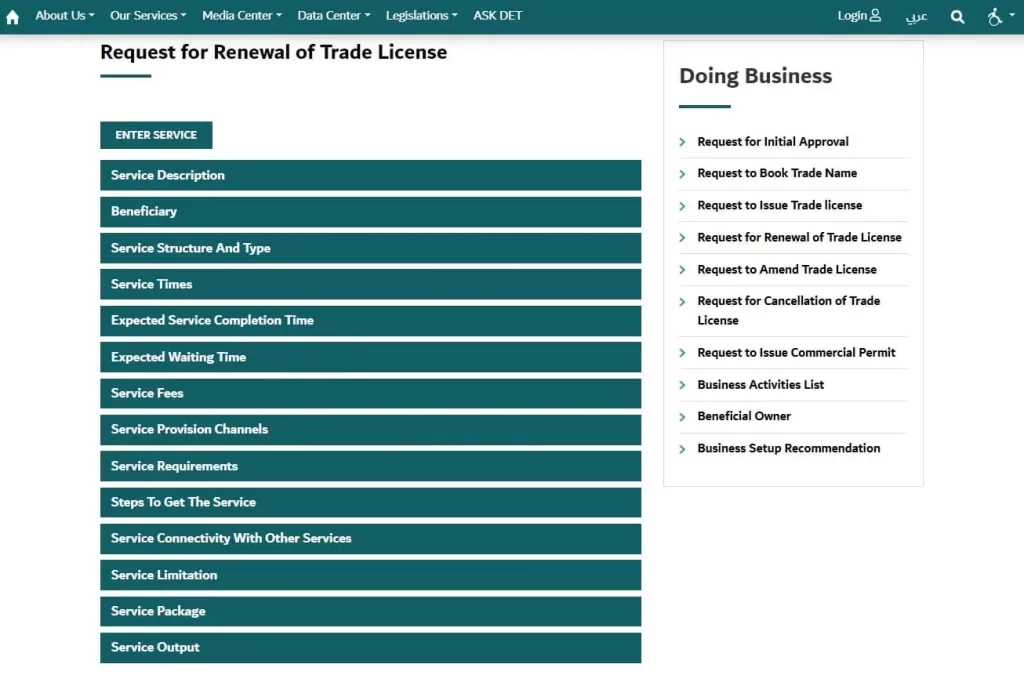
    Steps to Renew Your DED Trade License

    Steps to Renew Your DED Trade License

    Below are the following steps to renew your DED trade license:

    1. Initiate Renewal Process: Begin the renewal process at least one month before the expiration date. Access the DED’s online portal or visit a DED service centre to kick-start the journey.
    2. Access Online Portal: Log into the DED’s e-services platform and navigate to the license renewal section. Follow the prompts to select the renewal option and initiate the systematic process.
    3. Document Submission: Provide the necessary documents for verification, ensuring compliance with regulatory standards and ethical business practices. Submit the required documents through the online portal.
    4. Payment Phase: Generate a DED payment voucher specific to the renewal fees securely through the online platform. The system calculates fees based on business nature, providing a transparent breakdown of costs.
    5. Complete Transaction: Proceed to complete the transaction securely online, utilizing the DED payment voucher. Ensure precise and informed payment, adhering to regulatory requirements.
    6. Receive Renewed License: Upon successful payment, the system electronically issues the renewed trade license. Enjoy uninterrupted business activities, facilitated by the seamless integration of online and offline elements provided by the DED.

    What is the cost of a DED License?

    The cost for a DED license begins at AED 12,000*, varying depending on the nature of your business. For an accurate quote tailored to your specific business activities, reach out to one of our experienced business setup managers. They will provide you with an up-to-date price reflecting the activities you intend to undertake.

    What is The DED in UAE?

    The Department of Economic Development (DED) in the UAE holds the responsibility of shaping and guiding economic policies in Dubai. Its primary objective is to position Dubai as a leading global economic hub.

    To get a DED payment voucher, individuals can opt to receive it via SMS, visit or contact service centres like Ta-sheel or Amer, or generate it online from the DED website.

    Additionally, the DED plays a critical role in implementing the UAE VAT Law and Regulations. These regulations introduce considerations for businesses, particularly regarding the use of vouchers. Vouchers have become essential for businesses across various industries in the UAE, offering customers opportunities for goods, services, or discounts. Effectively navigating the UAE VAT landscape necessitates a thorough understanding of the VAT implications associated with vouchers.

    How to Lower Your Payment Voucher Amount in the UAE

    While the DED payment voucher remains a vital document for Dubai businesses, there are strategies to potentially reduce the amount you need to pay. Submitting your Dubai Residential Ejari and the most recent DEWA bills to the DM Revenue Department is one avenue that could potentially lead to discounts on the voucher amount.

    Another approach is to request an instalment cashback facility for the license renewal fee. This can be accomplished by providing specific documents, including a copy of the last voucher issued for previous renewal or incorporation, a letter requesting instalment payments, and a copy of the Emirates ID of the license holder.

    Exploring other potential discounts and benefits during DED license renewal is also worthwhile. These may include reduced market fees, sales, and discounts on chamber of commerce fees.

    Engaging with Shuraa

    By now, you should have a clear understanding of what a DED payment voucher involves and how to get it. Should you still have any inquiries, feel free to reach out to one of our business setup advisors, who will gladly assist you. Shuraa Business Setup stands as the UAE’s premier and most reliable business setup authority. With a track record spanning since 2001, we’ve supported over 50,000 entrepreneurs in successfully starting their ventures.

    Our expertise lies in providing custom-made solutions that precise match your requirements when boarding on a business venture. We pride ourselves on bringing prompt, dependable, hassle-free, and seasoned assistance. Our services extend beyond just setting up your business in Dubai. Through Shuraa Business Setup, our networking tool, you can engage with the broader business community in the region.

    To connect with us, you can dial +97144081900 or send a WhatsApp message to +971507775554. Alternatively, reach out via email at info@shuraa.com for swift assistance.

    The DED issues trade licenses across four categories: industrial, commercial, professional, and tourist/instant licenses.

    Frequently Asked Questions (FAQs)

    1. How Can I obtain a payment voucher from DED?

    You can obtain a DED payment voucher by submitting your license application or renewal online through the DED portal, service centers, or typing centers. The system generates the voucher automatically, which may be downloaded or printed.

    2. How Can I pay a payment voucher online?

    To pay your DED payment voucher online, log in to the DED e-services site or DubaiNow app, input the voucher number, and pay with a debit or credit card. When the payment is completed, you will receive a confirmation receipt.

    Disclaimer: The information in this post is for general guidance only and may change due to updates in government policies or regulations.

  • How Do I Register and Apply for a Dubai Customs Code?

    How Do I Register and Apply for a Dubai Customs Code?

    Dubai stands as a modern global business hub, welcoming foreign investors and enterprises with open arms. Situated within the United Arab Emirates (UAE), this city-state offers abundant business opportunities. However, akin to any nation, Dubai enforces specific regulations for business operations. Therefore, the need for Dubai Import Code becomes crucial.

    To operate a business in Dubai, one essential requirement is obtaining an Import Code Dubai, also known as a Dubai Customs Code. In this blog, crafted by Shuraa Business Setup, we delve into the significance of having an Import Code Dubai and highlight its indispensability. Additionally, we outline the step-by-step procedural requirements for acquiring this code.

    What is an Import Code Dubai?

    For businesses aiming to import goods into Dubai, having an import code is crucial. The approval process for this code is managed by Dubai Customs, which meticulously reviews applications from interested enterprises. Possessing this Dubai Customs code ensures a smooth and legal clearance process for imported goods through customs.

    The UAE is widely recognized as a premier global business hub by investors and businesses worldwide. This reputation is attributed to its transparent and straightforward taxation policies, robust infrastructure, and advantageous geographical positioning. Additionally, the UAE government consistently introduces initiatives to enhance business activities, particularly through the establishment of free zones.

    Who Is Eligible to Apply for an Import Code?

    A valid trade license is fundamental for applying for and acquiring an import code in Dubai. To be eligible for a customs code application, you must possess one of the following types of trade licenses:

    Applicants may also utilise a governmental notification to apply for an import code Dubai in certain exceptional circumstances.

    If you currently lack a trade license, it is imperative to obtain one before initiating the import code application process. You can swiftly acquire your trade license by submitting the requisite documents and fees through the Dubai Economy & Tourism Department (DED) website.

    What’s the Purpose of a Dubai Customs Code?

    Dubai Customs rigorously adheres to the regulations outlined in the Gulf Cooperation Council (GCC) Customs Tariff Codes and policies. The customs authorities in Dubai and the UAE remain vigilant in enforcing import regulations and preventing the importation of prohibited goods.

    A Dubai customs code serves as a specialised import license for your business. This code enables authorities to track your business’s imports, oversee your compliance with customs regulations, and verify the accurate payment of import duties.

    Benefits of Obtaining Dubai Import Code

    Below are the advantages of obtaining an import code in Dubai:

    • Compliance with Legal Requirements: Acquiring an import code in Dubai is imperative to fulfil legal obligations. While the UAE government welcomes businesses and foreign investors, adherence to regulations is strictly enforced, making possessing an import code essential for compliance.
    • Mitigation of Customs Penalties: Possessing a valid import code in Dubai reduces the risk of facing costly customs penalties. This code is evidence of legal importation practices, ensuring smooth transactions within the customs framework.
    • Streamlined Customs Clearance:  A valid import code in Dubai expedites customs clearance, which can otherwise be time-consuming and intricate. With this code, the customs authority efficiently processes imported goods, eliminating the need for separate approvals and saving valuable time and resources.
    • Enhanced Supply Chain Management: Utilising a Dubai customs code enables efficient tracking of imported goods through customs, thereby enhancing overall supply chain management capabilities.
    • Access to Dubai’s Free Zones: Access to Dubai’s Free Zones, offering various benefits such as foreign ownership, tax exemptions, and profit transfer flexibility, requires an import code Dubai. This code is a prerequisite for establishing businesses within these economic zones and availing their advantages.

    Understanding the significance of possessing a valid Dubai customs code, let’s explore the process of obtaining one upon establishing a new import-export business in Dubai.

    Step-by-Step Guide to Obtain Your Import Code

    Initiating your application for an Import Code in Dubai with Dubai Customs is a straightforward process through the eService portal. You can anticipate approval within one business day, assuming all documents are in order. Here’s a breakdown of the procedure to obtain your Dubai Customs code. It’s noteworthy that the process is similar to the renewal of the Dubai Customs code, a topic we’ll also cover. 

    Step 1: Gather Required Documents for Applying for an Import Code Dubai

    Ensure you have all necessary documents before applying for your customs code to prevent procedural delays. Here’s what you’ll need:

    • Valid Copy of Trade or Commercial License: Obtain a valid copy of your trade or commercial license from the Dubai Economy & Tourism Department (DED).
    • Copy of Valid Passport: Provide a copy of your valid passport. If your business has multiple partners, include copies of their passports.
    • Emirates Post License (Optional): If you wish to receive documents via courier service, include a copy of your Emirates Post License.

    Note:

    • Submitting passport copies is mandatory for new import code Dubai applications. 
    • For Dubai customs code renewal, passport copies are not required. However, ensure you have valid copies of your trade and Emirates Post licenses. 

    Step 2: Application Fees for Your Import Code

    When submitting your application for a Dubai Customs code, it’s crucial to be aware of the following fees:

    New Application:

    • Total Fee: AED 120
    • Application Fee: AED 100
    • Knowledge and Innovation Fees: AED 20

    Dubai Customs Code Renewal:

    • Fee: AED 25

    Step 3: Applying Online

    Access the online service portal of Dubai Customs through the Dubai Trade website. Head to the Service section of the website and select “New Business Registration” under the Dubai Customs tab.

    Here, you’ll discover the prerequisites and cost details for applying for your Import Code Dubai.

    Upon receiving your unique customs code, it remains valid for 60 days (about 2 months). Therefore, renewing it within this period is crucial to ensure its continued functionality.

    To register your business with the Dubai Customs portal, ensure you provide the following details:

    Business Information:

    • Business name in English and Arabic (optional)
    • Select “Dubai-based company” from the registration category drop-down menu
    • Specify the number of employees by selecting a range

    License Details:

    • License number and type
    • Issuing authority
    • Issue date and validity period

    Business Contact Details:

    • Phone and fax numbers (mandatory fields)
    • Email address
    • Business website and NOC for the applicant applying for the customs code.

    After entering all the required information, you can save your application as a draft for later completion or proceed to the next step. The system will prompt you to upload relevant documents. Once uploaded, click “Next” to proceed to the payment page and submit your application.

    Step 4: Monitoring Your Application

    Once you’ve submitted your application, expect approval within one business day if all documents are in order. Subsequently, you can utilise the same portal for renewals or amendments.

    Furthermore, if you have any inquiries regarding your application or the process itself, you can submit them through the portal. Each query will be assigned a Request ID, enabling you to track its status at your convenience.

    How to Renew Your Dubai Customs Business Code

    Before initiating the Business Code Renewal process, ensure your contact details are up-to-date and verified through the e-Service “Manage Contact Details.”

    Follow these steps for the renewal of your Dubai Customs Business Code:

    • Visit www.dubaitrade.ae.
    • Navigate to the Service Centre and select Dubai Customs > Registration Tools > Renew Business Code.
    • Enter the Business Code and the system-generated captcha, then click OK.
    • Adjust the expiry date to align with your trade license validity and set the renewal date as the current date.
    • Upload copies of your trade license and passport.
    • Save the changes by entering the system-generated captcha and submit the renewal request for approval.

    Prohibited Items in Dubai: Regulations and Approval Requirements

    Here are the regulations and approval requirements:

    • The International Trade Administration of Dubai enforces restrictions on certain items for import or export.
    • Prohibited items are not covered by your import code Dubai.
    • Approval from specific regulatory bodies is necessary before trading these items.

    Examples of prohibited items include:

    • Agro products like plants, live animals, and fertilisers require additional permission from the Ministry of Climate Change and Environment.
    • Pharmaceutical or medical products need approval from the Ministry of Health & Prevention.
    • Telecommunication and wireless communication equipment necessitate approval from the Telecommunications Regulatory Authority.
    • Alcoholic beverages, demanding permission from Dubai Police.
    • Processed food and personal hygiene products mandate prior approval from Dubai Municipality. Additionally, obtaining approval for these items may involve submitting a product sample and paying for a lab test.

    Streamlining Procedures with Expert Guidance

    Acquiring an import code in Dubai is essential for legally importing goods into Dubai or the UAE for your trading or commercial activities. Fortunately, the process of obtaining or renewing a Dubai Customs code is streamlined when all necessary documents are prepared for your export-import business in Dubai.

    Leveraging investor-friendly economic policies and robust infrastructure support, the UAE emerges as an appealing destination for trading businesses. Not sure where to start? Obtain professional assistance from Shuraa Business Setup today. Contact us at +971 4 4081900, reach out via WhatsApp at +971 50 7775554, or email us at info@shuraa.com for comprehensive support in launching your business ventures in Dubai.

    Frequently Asked Questions (FAQs)

    1. What is the purpose of the Dubai Customs Code?

    The Dubai Customs Code ensures compliance with regulations set forth by the Gulf Cooperation Council (GCC) Customs Tariff Codes and policies. It facilitates legal importation while preventing the entry of prohibited goods.

    2. What are the advantages of obtaining an Import Code Dubai?

    Acquiring an Import Code Dubai ensures compliance with legal requirements, mitigates customs penalties, expedites customs clearance, enhances supply chain management, and provides access to Dubai’s Free Zones.

    3. How can I apply for an Import Code Dubai?

    You can initiate your application online through the Dubai Customs portal, ensuring all required documents are prepared and fees are paid.

    4. How do I renew my Dubai Customs Business Code?

    To renew your Dubai Customs Business Code, update and verify your contact details, then follow the renewal process outlined on www.dubaitrade.ae, ensuring compliance with your trade license validity.

    Disclaimer: The information in this post is for general guidance only and may change due to updates in government policies or regulations.

  • Joint Venture Company Formation in the UAE

    Joint Venture Company Formation in the UAE

    Dubai, the City of Gold, the commercial capital of the Middle East, is a melting pot of diversity. The city has a predominantly expat population from over 100 nations worldwide. The presence of both business-friendly laws and liberal tax incentives attracts a huge number of entrepreneurs every year. Among the many businesses that are formed each year in the UAE, there is one that is extremely popular. Joint venture company formation in Dubai is the preferred choice of several foreign investors. Opening a joint venture company in Dubai shares the same advantages that come with a Limited Liability Company in Dubai.

    Here is a complete breakdown of the process of joint venture company formation in Dubai, including the documents, its features, and advantages.

    What are Joint Venture Companies?

    The joint venture company is one of the forms of doing business in Dubai, as it allows one or more foreign investors to come together to conduct a particular business activity of their choice. This commercial agreement can take place between two or more participants with the aim of achieving select business goals, generally to break into a new market.

    Features of a Joint Venture Company in Dubai

    Joint ventures in Dubai have several distinctive features that make them different from the traditional means of company formation.

    • There is no limit to the number of entities that can come together in collaboration for the joint venture
    • Investors can come to a mutual agreement regarding profit and loss distribution
    • It is a preferable legal structure for companies that come together to work on specific projects

    How to set up a joint venture company in Dubai?

    Because of its unique disposition, joint venture company formation in Dubai falls under the domain of the Department of Economic Development (DED) and the Dubai Municipality. They are responsible for reviewing and approving the business for the joint venture. Even though you do not need to apply for a separate trade license, there are certain steps you need to follow to register your joint venture company in Dubai.

    • Foremost, all parties involved must register a Joint Venture Partnership Agreement with the Dubai DED
    • They will also need to finalise the business activities they want to conduct as well as the trade name
    • Then, the DED issues a form that all parties involved must sign before a public notary
    • After the contract is drafted, you will need to get an initial approval from the DED
    • After the approval, you will need to submit any additional documents the DED may require
    • The final step is to pay the license fees

    Documents for Initial Approval:

    • Application form (Filled)
    • Reserved Trade Name Certificate 
    • Passport copies/ID of all applicants 
    • Local sponsor’s NOC 
    • Approval for chosen business activities 
    • Resolution issued by company management board 
    • Dubai residence permit (for foreign applicants)

    Companies that are looking to crack their business activities into a new region generally prefer the approach of a joint venture to kickstart their operational beginnings. In such a situation, it is important to find the right business partner. Only then will there be a significant opportunity to generate and increase your profits. 

    Benefits of a Joint Venture Company

    The biggest advantage of starting a joint venture company in Dubai is that two entities come together with their shared market knowledge and access to the latest technological advancements. Additionally, Dubai’s business friendly environment, tax liberties and innovative administration make it more attractive to foreign investors. The partners’ experience can therefore become a crucial asset in ensuring the growth of any joint venture company. 

    Connect for a consultation

    With the UAE on the cusp of becoming the Middle East financial leader, Dubai is set to be its crown jewel. Dubai’s strategic location and the presence of extremely well-equipped sea and airports provide greater commercial visibility. Business setup in Dubai, UAE is booming across all sectors. Every year, thousands of expats come to Dubai in the hopes of making the next big thing. 

    Shuraa Business Setup guides you through the entire joint venture company formation process in Dubai with the backing of 26 years of business setup experience. Experience world class services, speedy government processing, ensured PRO and visa services, and everything you need to start the venture of your dreams. Contact Shuraa and get a FREE consultation with our seasoned business setup consultants in Dubai

    Call: +971 4 4081900 

    WhatsApp: +971 50 7775554 

    Email: info@shuraa.com 

  • How to Start a Media and Entertainment Business in Dubai

    How to Start a Media and Entertainment Business in Dubai

    Dubai is quickly becoming the place to be for anyone in media and entertainment. It’s a super exciting hub that’s drawing in creative minds and big media companies from all over the world. Free zones like Dubai Media City, Studio City, and Production City are home to over 3,000 companies and more than 34,000 creative professionals, offering everything from modern office spaces to high-tech production studios.

    Dubai has amazing facilities, easy-to-understand business rules, a perfect location linking different parts of the globe, and a diverse population that loves all sorts of content. This means huge chances for your business to grow and innovate.

    But, if you’re wondering how to start a media and entertainment business in Dubai, it’s not just about having a brilliant idea. You also need to obtain appropriate media license, register your business, and follow the right legal steps. Choosing between Mainland or Free Zone, picking the right license, and getting the necessary media approvals from authorities like the Dubai Media Council or Film & TV Commission can make all the difference.

    Why Start a Media and Entertainment Business in Dubai?

    Dubai is one of the fastest-growing markets for media and entertainment in the region and for good reasons. Here’s why starting a media and entertainment business in Dubai makes real sense:

    1. Creative Free Zones Tailored for the Industry

    Zones like Dubai Media City, IFZA, Studio City, and Production City are built specifically for media businesses. They provide access to top-tier production studios, recording rooms, green screens, editing suites, and co-working spaces that are ideal for creative professionals and agencies.

    2. High Demand for Content & Live Experiences

    With a growing digital audience, booming tourism, and a calendar full of international events, Dubai’s market is always hungry for fresh content, entertainment experiences, and creative storytelling, both online and offline.

    3. Full Ownership & Tax Benefits

    In free zones, you can enjoy 100% foreign ownership, zero personal income tax, and zero corporate tax up to AED 375,000. This means more control over your business and better profit margins, especially valuable for startups and independent creators.

    Get Your Free Accounting or Tax Consultation

    4. Government Support & Licensing Ease

    The UAE government has made major investments in its media sector and continues to support startups and content creators. Licensing is streamlined in many free zones, and authorities like the Dubai Media Council and Dubai Film & TV Commission work to support creative entrepreneurs rather than restrict them.

    5. World-Class Events and Networking Opportunities

    Dubai hosts international festivals, expos, film markets, and creative summits that bring together industry leaders and innovators. Events like Dubai Lynx, GITEX, Dubai International Film Festival, and Arab Media Forum open doors for collaboration and exposure.

    What are Some Popular Media and Entertainment Business Activities in Dubai?

    Here are some of the most popular business activities in the media and entertainment sector:

    1. Film & TV Production

    This covers everything from creating feature films, documentaries, and TV series to producing high-quality commercials. Dubai offers world-class sound stages and post-production facilities that attract both international and local projects.

    2. Digital Content Creation

    A massive growth area, this includes producing online videos for platforms like YouTube and TikTok, developing engaging web series, and creating popular podcasts for the large, digitally-savvy audience.

    3. Advertising & Marketing Agencies

    With businesses constantly seeking to reach consumers, there’s high demand for agencies specializing in digital marketing (SEO, social media, paid ads), traditional advertising campaigns, branding, and public relations.

    4. Gaming & eSports

    This rapidly expanding sector involves designing and developing new video games, localizing existing ones, and organizing or participating in eSports tournaments and leagues.

    5. Event Management & Live Entertainment

    Dubai is a global hub for events. This includes planning and executing large-scale concerts, music festivals, theatrical productions, exhibitions, and conferences, as well as providing technical support like staging and AV.

    6. Animation & Visual Effects (VFX)

    As demand for visually rich content grows, so does the need for businesses specializing in 2D/3D animation for films, TV, and digital platforms, along with creating stunning visual effects.

    7. Talent Management & Booking

    Agencies that manage and book artists, performers, models, and influencers for various media projects, events, and brand collaborations are a key part of the industry.

    8. Media Technology & Solutions

    This involves developing innovative tech solutions for the industry, such as software for content production, AI-powered tools for media analysis, or creating immersive experiences using VR/AR.

    9. Music Production & Distribution

    This includes Recording Studios, Music Labels, Music Publishing (managing copyrights), and Digital Music Distribution (getting music onto streaming platforms).

    10. Photography & Videography Services

    High-end commercial photography, corporate videography, aerial cinematography (drones), and specialized event coverage are always in demand.

    What are the License Requirements and Regulatory Approvals?

    To legally run a media and entertainment business in Dubai, you need to get the right license and follow certain regulatory approvals, especially if your work involves public content, publishing, or events.

    Here’s what you need to know:

    1. Choose the Right Licensing Authority

    The first step is deciding where to set up your business: 

    A. Mainland (DED – Department of Economy and Tourism, Dubai)

    B. Free Zones (e.g., Dubai Media City, IFZA, Studio City, Production City, twofour54)

    Ideal for creative and content-focused businesses.

    • Offers benefits like 100% foreign ownership, tax exemptions, and industry-specific infrastructure.
    • License is issued by the Free Zone Authority managing that zone (like TECOM Group for Media City).

    Read more: Free Zone Vs Mainland

     2. Types of Media Licenses You Can Apply For

    Depending on your activity, you may apply for:

    • Media Production License
    • Publishing License
    • Event Management License
    • Advertising & Marketing Services License
    • Digital Content Creation License
    • Music and Audio Production License
    • Broadcasting or Film Distribution License

     Note: Some licenses allow for multiple activities, but all must be clearly listed in your trade license.

    3. Additional Regulatory Approvals (If required)

    For certain activities, especially those involving public content, you may need extra approvals from authorities such as:

    4. Event Permits and Public Content Approvals

    If your business involves organizing public events, performances, concerts, or exhibitions, you must:

    • Obtain an event permit from Dubai Tourism or Dubai Police depending on event type and size.
    • Follow content regulations to avoid fines or cancellations, content must comply with UAE’s cultural and moral standards.

    What are the Documents Required to Start a Media and Entertainment Business in Dubai?

    Setting up a media and entertainment business in Dubai requires certain documents, which generally includes:

    • Passport copies of all shareholders and directors
    • Visa copy and Emirates ID (for UAE residents)
    • Passport-sized photographs (white background, recent)
    • No Objection Certificate (NOC) from current sponsor, if needed
    • Trade name reservation certificate
    • Completed application form for business registration
    • Ejari certificate (for Mainland businesses) or Flexi-desk agreement (for Free Zone businesses)
    • Location plan (for production or studio setup)

    Note: If you are a corporate entity (like a foreign company opening a branch or subsidiary), you’ll also need attested company incorporation documents, a board resolution, and a power of attorney.

    How to Start a Media and Entertainment Business in Dubai, UAE

    Here’s a step-by-step guide on how to start a media and entertainment business in Dubai, UAE the right way.

    Step 1. Define Your Business Activities

    Clearly identify what your media and entertainment business will do (e.g., film production, digital marketing, broadcasting, gaming, event management, animation, talent management, etc.). This is crucial as it dictates your license type and regulatory requirements.

    Step 2. Choose the Right Jurisdiction

    Dubai offers two main jurisdictions for media businesses:

    • Free Zone: Provides 100% foreign ownership, tax exemptions, and built-in media infrastructure, ideal for content-focused startups
    • Mainland (DED): Offers full access to the UAE market and opportunities to bid on government contracts. Full foreign ownership is now also allowed in most sectors, though a local service agent may be needed for certain professional activities

    Step 3: Decide on Legal Structure

    Decide on the legal form of your company (e.g., Free Zone LLC, Branch of a Foreign Company, Sole Establishment, Civil Company, or Mainland LLC). If you’re a solo creator, editor, writer, or digital marketer, some Free Zones offer freelancer licenses. These are low-cost and allow you to work legally as an individual professional.

    Step 4. Register & Obtain a Media License in Dubai

    Select a suitable license based on your activity e.g. film production, publishing, event management, broadcasting, or digital content creation. Reserve a trade name, submit your Memorandum of Association (MoA), and apply through DED or the relevant free zone authority.

    You must also register with Dubai Film & TV Commission (DFTC) if you’re producing film, TV, or commercial content in Dubai, as they issue production permits and ensure compliance with local regulations.

    All content creators and influencers earning commercial revenue must now hold a valid media license from the UAE Media Council. Non-compliance risks steep fines of up to AED 1 million under the new media law (Cabinet Decision No. 41 of 2025).

    UAE Media Council (UAMC) Approvals: The UAMC (formerly NMC) is the federal body regulating media content. For most media and entertainment activities involving public dissemination, content creation, broadcasting, or advertising, you will likely need direct approval or specific permits from the UAMC or a competent authority in your chosen free zone. This ensures compliance with UAE laws, cultural values, and content standards. Examples include:

    • Filming permits (ground and aerial)
    • Permits for scripts (film, TV, theatrical)
    • Broadcasting licenses (radio/TV)
    • Publication permits
    • Advertiser/Influencer licenses (for social media content creators generating income)

    Step 5. Lease Office or Studio Space

    Mainland companies require a physical office. Free zones often allow flexi-desk or co-working space, which is cost-effective for startups. Media zones provide purpose-built studios and production infrastructure, especially in Dubai Media City, Studio City, and Production City.

    Step 6. Acquire Infrastructure & Hire Talent

    Invest in production and post-production equipment, high-speed internet, cloud storage, and content management tools. Hire creative and technical professionals, such as editors, animators, producers, marketers, and event planners. Ensure all employees have valid UAE work permits and visas under the Wage Protection System (WPS).

    Step 7. Protect Your Intellectual Property (IP)

    Register trademarks, copyrights, and contracts that specify ownership rights over content. Protecting your IP is vital in the media space and may be required during licensing or investor processes.

    Step 8. Finance, VAT & Ongoing Compliance

    Prepare for all costs: license application fees, office rent, visas, and bank/accounting service fees. Note that businesses earning over AED 375,000 annually must register for VAT (5%) and may be subject to 9% corporate tax on profits.

    Get Your Free Business Setup Consultation

    What is the Cost of Starting a Media & Entertainment Company in Dubai?

    In the Mainland, media licenses typically cost between AED 15,000 to AED 25,000, while in Free Zones like Dubai Media City or Studio City, expect to pay around AED 18,000 to AED 22,000. Some Free Zones even offer budget packages starting from AED 12,500, especially for solo creators or freelancers.

    Other essential costs to consider:

    You may also need approvals from the National Media Council (NMC) or Dubai Development Authority (DDA), which can cost between AED 2,500 and AED 7,500. If you’re sponsoring employee, visa costs per person are around AED 3,500 to AED 7,000.

    Certain activities require extra approvals. For example, publishing permits cost around AED 5,000 per title, while broadcasting or TV licenses can go up to AED 20,000. Content creators and influencers now also need a valid media license to operate legally.

    How Shuraa Can Help You Set Up

    Dubai is full of exciting opportunities for anyone looking to start a media and entertainment business. Doesn’t matter if you’re into filmmaking, music, content creation, or event planning, the city has everything you need to grow your creative brand, from top-class infrastructure to a supportive business environment.

    Starting a company here might sound complicated, but with the right help, it’s actually quite simple. That’s where Shuraa comes in. We help you with everything from start to finish – choosing the right location (Mainland or Free Zone), getting your media license, handling permits, visas, content approvals, and even finding the right office or studio space.

    Want to know the best setup option for your business? Get in touch with Shuraa for a free consultation and we’ll guide you every step of the way.

    Frequently Asked Questions (FAQs)

    1. How to start a media and entertainment business in Dubai?

    To start a media and entertainment business in Dubai, you’ll need to obtain the appropriate licenses, choose the right jurisdiction (Mainland or Free Zone), reserve your trade name, register your business, and secure any required approvals. Shuraa can help you through the entire process, from setup to licensing.

    2. Do I need approvals for media content in Dubai?

    Yes, depending on your activity, you may need approvals from authorities like the Dubai Media Council, Dubai Film & TV Commission, or the Ministry of Culture and Youth, especially for publishing, filming, or events.

    3. Which media business is most profitable in Dubai?

    Digital content creation, event management, film production, and influencer marketing are among the most profitable due to high demand from brands, tourism, and the growing online audience.

    4. Can foreigners fully own a media company in Dubai?

    Yes! In Free Zones, foreigners can own 100% of the business. Even in the Mainland, most media-related activities now allow full foreign ownership with no need for a local partner.

    5. What licenses do I need for a media company?

    You may need a Media Production License, Publishing License, Event Management License, or Digital Content License, depending on your business activity. Shuraa can help you choose the right one.

    6. Can I run a media company from home or online in Dubai?

    Yes, if your Free Zone allows a flexi-desk or virtual setup. Many content creators, editors, and marketers operate remotely, but you must still have a valid license and follow UAE regulations.

    Disclaimer: The information in this post is for general guidance only and may change due to updates in government policies or regulations.

  • Holiday Home License in Dubai – A Detailed Guide

    Holiday Home License in Dubai – A Detailed Guide

    Dubai’s tourism industry is incredibly profitable. This Middle Eastern Emirate is well-suited for East-meets-West adventures, discovering the glory of the deserts, and visiting the historic souks, markets, and Dubai Mall in downtown for a luxurious shopping vacation. Owners who want to rent out their homes as vacation rentals in Dubai must submit an application for a Holiday Home License.

    With the rise of Airbnb and other similar holiday home operator services, the market for vacation rentals in Dubai has flourished. Property owners have excellent business opportunities regarding vacation homes and short-term rental properties.

    The Dubai Department of Tourism and Commerce Marketing (DTCM) and Dubai Economy and Tourism Department now allow homeowners to list their properties as short-term vacation rentals.

    However, it is illegal to list properties on websites like Airbnb without a license. The good news is that you can easily get this license and any other approvals and visas you might need with the right assistance. Continue reading to learn how to obtain a Holiday Home License in Dubai for a vacation home.

    What does a Dubai Holiday home rental Business entail?

    According to the Dubai Department of Economic Development (DED), the vacation home rental industry includes well-furnished lodgings. These places can be rented to tourists and travellers on daily, weekly, or monthly basis. The manager of these properties is in possession of a license that entitles them to rent these properties for short-term.

    Dubai draws visitors and vacationers from all over the world, which has led to an increase in the Dubai Holiday Home rental industry and the number of people taking advantage of the lucrative business opportunity.

    Benefits of obtaining a short-term rental license in Dubai

    The hospitality industry is booming around 20 million tourists visit Dubai annually.

    Property owners now have an easier time entering the vacation rental market thanks to the simplified laws governing licenses. In comparison to long-term rentals in Dubai, it translates to an average 25–30% premium for return on investment. This implies that demand for and bookings of vacation rentals in Dubai will rise.

    You can make profit by starting your business in Dubai. In the United Arab Emirates, you enjoy the emirates’ 0% tax on all business and personal income. Establishing your company in a free zone has the additional benefit of allowing you to use any currency without any restrictions.

    Dubai is one of the most well-liked tourist and business destinations, so its tourism industry will continue to grow. Therefore, now is the ideal time to sign up and get your Holiday Home License.

    How to Get a Holiday Home License in Dubai

    The first step is to apply for your trade license in order to start your vacation home rental business. Since, the applicant already owns the property, but to register your business with the DED, you must provide the following information:

    • Duly filed application form
    • Passport copy of the potential owner
    • Details of the Property
    • 2 passport size photographs (coloured)

    Additionally, you must obtain approval from the Department of Tourism and Commerce Marketing. This sector regulates the development and marketing of Dubai’s tourism industry.

    Your property will undergo periodic inspections after registration to make sure adhering to the necessary standards. You are required to put your DTCM certificate on display in your rental home.

    Documents needed in Dubai to start a vacation home rental business

    Before starting your vacation rental business in Dubai, you must have certain documents, including:

    • Owner’s passport
    • Duly Filed License application form
    • Property Details
    • Trade License from DED
    • DTCM’s certification

    How to Start a Holiday Home Business in Dubai?

    You must adhere to a set of procedures when beginning your vacation home rental business in Dubai. These consist of:

    1. Choosing Your Commercial Activity

    The DED classifies a vacation home rental agency as a “Vacation Homes Rental” business activity.

    2. Choose a name for your business

    Decide the name of the organisation beforehand. There are a few guidelines that needs to be followed while selecting business name. It is also crucial to remember that you cannot use any name or phrase that could be offensive or scandalous.

    You must also avoid any names that are already in use by well-known corporations. Additionally, if you use your name, it is advisable to you refrain from abbreviating it. Use your full name; do not use any acronyms.

    3. Obtain Holiday Home License

    There are a few licenses you must obtain before opening your business. The first license to obtain is a trade license from the Department of Economic Development. One must always have a certificate from the Department of Tourism and Commerce Marketing (DTCM) in your rentals in case they is any random inspection.

    4. Complete your Visa Application

    A UAE visa is necessary if you want to operate a vacation home rental agency in Dubai. If you don’t have the residential permit, a business can’t operate.

    One can can easily operate a business in the UAE if they have Visa.

    Holiday Home License Cost in Dubai

    There are numerous expenses to consider when starting a vacation home rental business in Dubai. Starting a holiday home rental business in Dubai can be a bit pricey, from the licensing fee to the fee for the DTCM approval.

    You will need to pay about AED 300 a year for the separate allowance fees, which are calculated for each room you are renting. Additionally, one must also pay a tourism fee of AED 10–15 per bedroom.

    Connect with business consulting firms where professionals can walk you through every step of starting your vacation home rental business so that you fully understand the cost structure.

    Dubai Holiday Home Rental Regulations

    Before renting out your apartment, keep in mind the following laws and ordinances of Dubai:

    • Owner should supply necessities like water and electricity free of charge.
    • Proper Care and Maintenance should be provided all the time.
    • Every vacation home must adhere to DTCM guidelines.
    • The visitors must contribute 10% to the municipality tax.
    • Standard and deluxe accommodations charges an additional AED 10 to AED 15 in tourism fees.

    How Does Shuraa assist you in Opening Holidays Home Business in UAE?

    One of the most reputable organisations that assists foreigners in establishing 100% owned businesses in Dubai is Holiday Home Rental Business. With Shuraa you can start your business on your terms and feel empowered. Our experts are with you every step of the way, guiding you toward the best choices for your company. Shuraa’s dedication in assisting you in finding the best business solutions for you. From starting up to locating the best investors.

    Shuraa has helped entrepreneurs launch their businesses in Dubai, assisting them in everything from real estate and trading to supply chains and tourism. Meanwhile, come to us if you’re looking for a consulting firm that you can trust to lead you in the right direction!

    Related Post: How to Start an Airbnb Business in Dubai

    Takeaway

    Indeed, if you’re considering starting a business renting out vacation homes in Dubai, there isn’t a better time to do it than right now! You can speak with our professionals, and we can assist you with everything from obtaining your license and certificate to taking care of your immigration and visa processes.

    Furthermore, When forming a new business in the UAE, it’s a good idea to deal with a company formation specialist like Shuraa Business Setup to help you make sure that this is the case.

    We are a group of experts in company formation that are passionate about helping ambitious business owners and SMEs realise their aspirations.

    In addition to managing your license application, Shuraa can help you open corporate bank accounts and provide advice on the best financial institution to meet your unique needs. For a free consultation, call +97144081900, send us a WhatsApp message at +971 507775554, or send us an email at info@shuraa.com.

  • How To Get a Technical Services License in Dubai

    How To Get a Technical Services License in Dubai

    The choice of one’s business license is integral for the seamless functioning of the company. Therefore, based on their business activities, entrepreneurs can choose to acquire a professional license (for professional service activities like marketing), an industrial license (for manufacturing processes), or a commercial license (for trading activities). The technical services license in Dubai is highly useful because it covers specific business activities.

    These broad categories further have different licenses suited to more niche services. One such bracket is the technical services license in Dubai, which is a commercial license. In this blog, you will learn more about technical services in Dubai.

    What is a Technical License in Dubai?

    A Technical Services License in Dubai allows businesses to legally provide a range of maintenance, repair, and installation services, such as plumbing, electrical work, HVAC, and carpentry. This license is essential for businesses operating in Dubai’s construction, property maintenance, and related sectors. The license is issued by either the Department of Economic Development (DED) for mainland businesses or the respective free zone authority for those in free zones.

    Services Provided by a Technical Service Company in Dubai

    A technical service company handles equipment and installations used in production, focusing on optimisation, maintenance, and repair. Below are the services provided by a technical service company in Dubai:

    • Plumbing: Installing and repairing pipes, faucets, and drainage systems.
    • Electrical Work: Setting up and maintaining electrical systems and wiring.
    • Air Conditioning: Installing and servicing AC units.
    • Painting: Interior and exterior painting of buildings.
    • Carpentry: Building and fixing wooden structures and furniture.
    • Flooring and Tiling: Laying and repairing tiles and flooring materials.
    • Home Maintenance: General repair and upkeep of residential properties.
    • Installation: Setting up various equipment and machinery.

    List of Permitted Activities for Technical Services

    Technical services are a huge area of business. Consequently, numerous activities fall under its sphere. Business owners can opt for the activity best suited to their needs. The technical services license permits the following activities:

    • Plumbing & sanitary contracting
    • Electrochemical equipment installation
    • Painting contracting & apparatus installation
    • Insulation contracting & electricity transmission
    • Plaster & cladding works
    • Building cleaning services
    • Floor & wall tiling works
    • Air-conditioning & ventilation
    • Carpentry & floor contracting
    • Engraving & ornamentation works
    • Air filtration system installation & maintenance
    • Satellite equipment installation & maintenance
    • Electrical fittings
    • Partition & ceiling contracting

    Please note that even more activities fall under the scope of a technical license.

    Benefits of Technical Services License in Dubai

    A Technical Services license in Dubai offers numerous advantages for businesses in the technical sector, here’s a more detailed look at the benefits:

    1. Legal Authorization and Credibility:

    • Legal Authorization: The license provides the necessary authorization to operate legally within Dubai’s technical services sector, ensuring compliance with local laws and regulations.
    • Enhanced Credibility: Holding a Technical Services License boosts the business’s reputation and trustworthiness, making them more appealing to clients and partners.

    2. Business Expansion and Opportunities:

    • Diverse Service Offerings: The license allows businesses to offer a wide range of technical services, including electrical work, plumbing, air conditioning maintenance, and more.
    • Access to a Wider Client Base: With the license, businesses can attract a broader range of clients, including residential, commercial, and industrial customers.
    • Opportunities for Government Contracts: In some cases, a technical services license can open doors to opportunities to work with government entities and secure high-value contracts.

    3. Flexibility and Cost-Effectiveness:

    • Flexibility to Operate: Depending on the type of license (mainland or free zone), businesses can operate in various locations and with different types of clients.
    • Potential Tax Benefits: Some free zones offer tax advantages and exemptions for businesses operating under a technical services license.
    • Simplified Incorporation: Setting up a business with a technical services license can be a straightforward process.

    4. Growth and Scalability:

    • Unlimited Contract Values: Mainland technical services licenses allow for the pursuit of large-scale projects without restrictions on contract values.
    • Potential for Expansion: The UAE’s focus on infrastructure development and smart cities creates a strong market for technical services, offering long-term growth potential.

    How to Start a Technical Services Company in Dubai?

    Obtaining a technical services license in Dubai is easy with the help of experienced company formation consultants such as Shuraa Business Setup. Follow these steps to get your commercial license quickly.

    Step 1. Choose a Business Activity and Jurisdiction:

    • Identify your core services: Determine the specific technical services you’ll offer (e.g., electrical, plumbing, HVAC, etc.).
    • Select a jurisdiction: Decide between setting up on the Dubai mainland (Department of Dubai Economic Development (DED)) or a free zone (specific free zone authority). Mainland offers broader market access, while free zones may offer certain benefits like tax advantages.

    Step 2. Select a Legal Structure and Trade Name:

    Step 3. Secure Office Space and Obtain Initial Approval:

    • Lease office space: Renting a physical office is mandatory for mainland companies and often required for free zone companies.
    • Obtain initial approval: Apply for initial approval from the DED (for mainland) or the free zone authority.

    Step 4. Prepare and Submit Documents:

    • Gather necessary documents: This typically includes passport copies, photos, Memorandum of Association (MOA), and potentially a No Objection Certificate (NOC) from your current employer.
    • Submit the application: Submit your application along with the required documents and fees to the relevant authority.

    Step 5. Finalize and Obtain the License:

    • Pay the license fee: Pay the required fees, depending on your specific setup.
    • Receive your license: Once approved, the authority will issue your technical services license, allowing you to legally operate your business.

    Step 6. Additional Considerations:

    Cost of a Technical Services License in the UAE

    A technical services license in Dubai can range in cost from AED 11,900 to AED 30,000, depending on location and specific activities. Mainland licenses tend to be on the higher end (starting around AED 18,500) while free zone licenses can be lower (starting around AED 11,900). Additional costs for visas and office space can add another AED 5,000-10,000.

    Here’s a more detailed breakdown:

    Factors Affecting Cost:

    • Location: Mainland licenses generally have higher fees than free zone licenses.
    • Company Size: Larger companies or those requiring more visas may incur higher costs.
    • Business Activities: The specific technical services you intend to offer can impact the license cost.
    • Additional Services: Visa applications, office space rental (Ejari), and other related fees will add to the overall cost.

    Cost Breakdown (General Estimates):

    • Mainland License: AED 12,500 + AED 15,000 (including DED Special Activity fees)
    • Free Zone License: AED 11,900 – AED 18,000
    • Visa Costs: AED 3,000 – AED 5,000 per visa
    • Office Space (Ejari): AED 5,000 – AED 20,000 per year depending on location and size

    Additional Costs to Consider:

    • Trade Name Reservation:
    • Legal Documentation (MOA):
    • Medical Tests and Emirates ID:
    • Dubai Municipality Approvals (if required):
    • Annual Renewal Fees: AED 12,000 – AED 14,000

    For an accurate cost assessment and professional setup assistance, get in touch with Shuraa.

    How Can We Assist you for Getting Technical Services License!

    There is no better time for someone looking to start a technical services business in Dubai. Shuraa Business Setup offers affordable company formation packages & expert services. We are dedicated to building your enterprise from the ground up.

    If you want to reach our expert business consultants, call us at +97144081900. You can also drop a WhatsApp message at +971507775554 for a chat query. You can also email us at info@shuraa.com.

    Frequently Asked Questions (FAQs)

    1. How to Open Technical Services Company in Dubai?

    To start a technical services company in Dubai, you’ll need to follow a structured process, including choosing a business activity, selecting a legal structure, registering a trade name, obtaining initial approval, securing office space, and applying for the trade license.

    It’s recommended to partner with a business formation specialist for guidance throughout the process.

    2. What are the Benefits of Technical Services License in Dubai?

    A Technical Services license in Dubai offers numerous benefits for businesses in the technical sector, including legal authorization to operate, increased credibility, access to a wider client base, and opportunities for business expansion. It allows for diversification of services, enhanced professionalism, and can lead to greater profitability.

    3. What is the cost of a technical service license in Dubai?

    The cost of a technical services license in Dubai can range from AED 11,900 to AED 30,000 or more, depending on several factors including the chosen location (mainland or free zone), the specific activities included in the license, and the size of the company. Additional costs may include visa fees, office space rental, and other operational expenses.

    Disclaimer: The information in this post is for general guidance only and may change due to updates in government policies or regulations.